Travelers passing through airport security across the United States may notice a subtle but controversial change at Transportation Security Administration checkpoints.
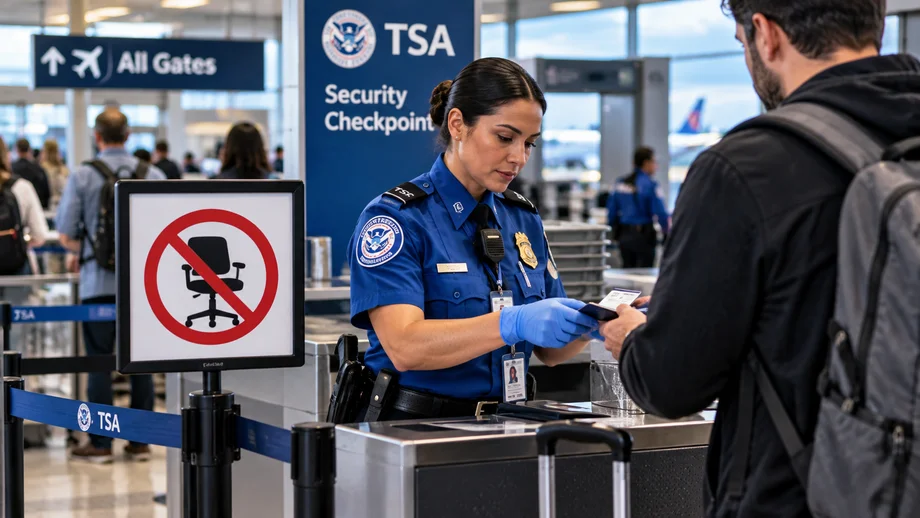
TSA officers assigned to check boarding passes and identification at the entrance to security checkpoints will no longer be allowed to sit while performing the job, according to the union representing the workers.
The American Federation of Government Employees TSA Council 100 says chairs are being removed from travel document checker positions at commercial airports across the country. CNN reported that the removal has already started at most commercial airports.
The change does not currently require passengers to do anything differently when going through airport security. Travelers should continue following normal TSA procedures when presenting identification and other required travel documents.
For TSA employees, however, the new policy has sparked a dispute over working conditions, safety and ergonomics.
Why are TSA officers no longer allowed to sit?
According to the union, workers began learning about the change on Friday afternoon.
AFGE TSA Council 100 said it did not receive formal notification before the chairs began disappearing from document checking positions.
The union strongly opposes the decision, arguing that the chairs provide important ergonomic support for security officers who already spend much of their working day standing and walking on hard airport surfaces.
CNN reported that it contacted both TSA and the Department of Homeland Security seeking additional information about the change.
The precise reasoning behind the decision therefore remains unclear.
What travelers need to know
Despite the attention surrounding the policy, passengers should understand one important point.
This is primarily a workplace change affecting TSA officers, not a new security requirement for travelers.
There is currently no indication in the reporting that passengers will need to arrive earlier, carry additional documents or follow a new screening procedure because officers are standing rather than sitting.
Travelers should therefore continue preparing for airport security in the usual way.
The visible difference may simply be that the officer checking identification at the beginning of the checkpoint is standing instead of sitting behind the document verification station.
The change comes during a major TSA overhaul
The timing is particularly notable because TSA is undergoing broader modernization under Administrator David P. Cummins.
Cummins launched the agency's Horizon 25 Strategy in August as TSA approaches the 25th anniversary of its creation.
The strategy is intended to modernize airport security while improving efficiency and the passenger experience.
TSA says Horizon 25 includes efforts to introduce new technology, strengthen identity management, expand risk based security programs and develop additional partnerships with the private sector.
However, there is currently no confirmation that removing chairs from document checking positions is officially part of Horizon 25.
Airport security could look very different in the future
The disagreement over chairs is occurring alongside much more significant technological changes at American airports.
TSA is increasingly deploying credential authentication systems, facial comparison technology, computed tomography scanners and advanced imaging systems.
Some future checkpoints could require considerably less physical interaction between passengers and officers.
Cummins has described plans for electronic gates using facial comparison technology that could eventually allow travelers to keep their driver's license and boarding pass in their pocket while their identity is verified digitally.
New scanning technology could also allow passengers to move through parts of the security process more naturally instead of stopping in traditional screening positions.
TSA has not provided a nationwide timetable for deploying all of these technologies.
TSA PreCheck is also part of the modernization push
TSA PreCheck remains another major component of the agency's strategy for changing how passengers move through American airports.
The program allows eligible travelers to use dedicated security lanes with simplified screening procedures at participating airports.
TSA has said its broader modernization efforts will continue expanding risk based security while attempting to improve the overall passenger experience.
The agency now employs approximately 60,000 people and operates within a security system that has changed dramatically since TSA was created following the September 11 attacks.
Union says the chairs are a safety issue
For the union representing TSA officers, the current dispute is much more straightforward.
It argues that employees who spend long shifts working in airport checkpoints should have access to basic ergonomic support.
The union says TSA officers already stand and walk for substantial periods on hard surfaces and disputes any suggestion that having a chair at the document checking position should be considered a workplace privilege.
That argument could keep the issue in the spotlight as the chair removal continues across airports.
Will airport passengers notice any difference?
For most travelers, probably very little in the immediate future.
Passengers will still encounter TSA officers when entering security checkpoints. Identification requirements and standard screening procedures remain in place.
The controversy is instead another sign of how quickly airport security operations in the United States are changing.
New leadership, artificial intelligence, facial recognition, advanced baggage scanners, expanded PreCheck services and other technologies are gradually reshaping the security checkpoint.
Now even something as simple as whether the officer checking a boarding pass can sit down has become part of the wider debate over the future of TSA.
For passengers flying through US airports, the most visible immediate change may be a small one.
The TSA officer waiting to check their documents could now be standing.