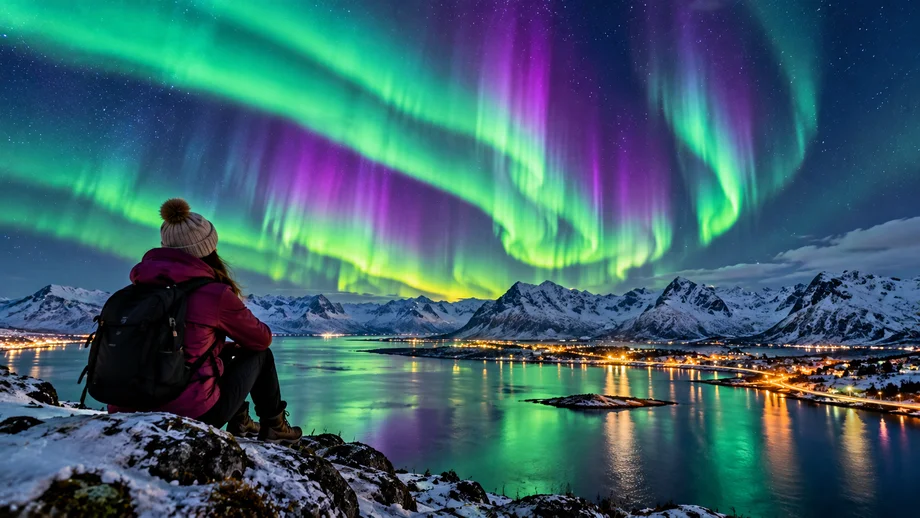
One of the world's most beautiful natural spectacles is again attracting the attention of travelers. The northern lights, known as aurora snowalis, can be seen during the coming nights in parts of North America, while their observation season has also begun in the Arctic destinations of Europe.
According to the American Space Weather Forecast Centre (NOAA), a solar explosion recorded on October 6th has launched particles and magnetic fields towards the Earth that could cause a geomagnetic storm of the G2 category on 9 October.
This can expand the area where northern lights appear, creating surveillance opportunities in Canada and some American countries.
If geomagnetic activity reaches the projected intensity, aurora can also be photographed in parts of New York, Pennsylvania, Colorado, and Oregon, reports the magazine People.
However, meteorologists warn that the phenomenon is not guaranteed. Visibility depends on the intensity of the solar storm, cloud cover, and artificial lighting.
For travellers wishing to see the aurora over the coming weeks, Arctic destinations remain the most reliable elections.
Tromsø, Norway
The Norwegian town of Tromsão is one of the world's most popular destinations for monitoring northern lights.
According to the Visit Tromsė tourist organisation, the Aurora season in this region begins in late August and runs through early April.
The city's position under the area where northern lights often appear creates good surveillance opportunities, especially during clear nights.
Visitors are recommended to leave the town's lighting and reserve several nights of residence, as the weather may change quickly.
Iceland
October is considered an attractive month to visit Iceland because nights are dark enough for the aurora, while days can still be used to explore natural landscapes.
According to Visit Iceland, some of the locations suitable for observation are the area of Lake Mãovat, National Parkingvellour, and regions outside Reykjavík.
Travelers can combine northern lights with visits to waterfalls, hot springs, and volcanic landscapes.
Abisco, Sweden
In northern Sweden, Abisco is another popular destination for tourists traveling especially for the snowy aurora.
The region attracts visitors because of its northern location and access to clear skies. Even here, however, the display of the phenomenon depends on weather conditions and solar activity.
Rovaniem, Finland
Finnish Lapland offers an experience that combines Arctic nature with tourist activities.
Rovaniem is especially appealing to families and travelers who want to combine aurora surveillance with cabins, nature trips, and winter experience.
Fairbanks, Alaska
For tourists in North America, Fairbanks in Alaska remains one of the most popular destinations for monitoring northern lights.
Its location at high latitude and the tourist infrastructure oriented towards the Aurora make it an alternative for travelers who do not want to travel to Europe.
According to NOAA, the periods near the spring equinoxes and autumn are especially favourable for geomagnetic activity.
Experts recommend surveillance in dark places, away from cities, usually during hours near midnight.
Before departure, travelers must control local weather forecasts and the Aurora map that NOAAA updates for intervals approximately 30 to 90 minutes.
Even an intelligent telephone with the function of phototype at night can catch colors that are sometimes hard to recognize.
Unlike specific tourist attractions, aurora snowalis remains an unpredictable phenomenon. But for travelers who choose the right destination and plan several nights of stay, the autumn of 2026 offers an interesting opportunity to experience one of the most extraordinary views of nature.