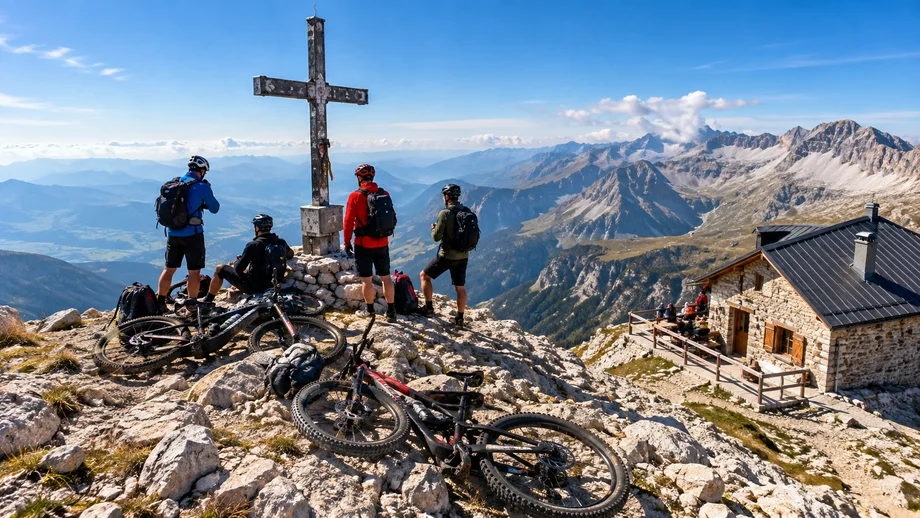
A newly reopened mountain shelter in Italy has become the center of controversy just days after welcoming hikers again, after visitors were accused of ignoring rules designed to protect one of the country's sensitive alpine environments.
The incident occurred at the Bivacco Cesare Mario Pelino, a mountain refuge near the summit of Monte Amaro in the Abruzzo region. Monte Amaro rises to 2,793 meters and is the highest peak in the Maiella massif.
According to Austrian outlet OE24, officials at Maiella National Park said they were “shocked” after seeing photographs showing several visitors with mountain bikes, apparently including electric bikes, close to the summit cross. Another image reportedly showed a dog inside the shelter.
Both activities are prohibited in the park's strictly protected Zone A.
Park authorities said the photographs would be forwarded to the Carabinieri Forestali, Italy's forestry police, potentially bringing official scrutiny of the incident.
The restrictions are not simply about keeping trails quiet. At such high elevations, vegetation grows extremely slowly and thin mountain soils are particularly vulnerable to erosion. Bicycle tires can damage fragile ground, while dogs can disturb wildlife through their presence, scent and waste.
The timing has made the controversy even more striking.
The Pelino shelter had reopened only on October 1 following renovation work reportedly costing around €120,000. Within days, images of visitors apparently violating park rules began circulating.
The park responded with a message that applies well beyond this particular incident: mountain landscapes are available for everyone to enjoy, but visitors also carry responsibility for protecting them.
The story has now attracted significant attention in German language searches, highlighting a wider problem facing some of Europe's most spectacular natural destinations.
As mountain tourism grows, the challenge is increasingly clear: making extraordinary landscapes accessible to travelers without allowing that popularity to destroy the very environment they came to experience.