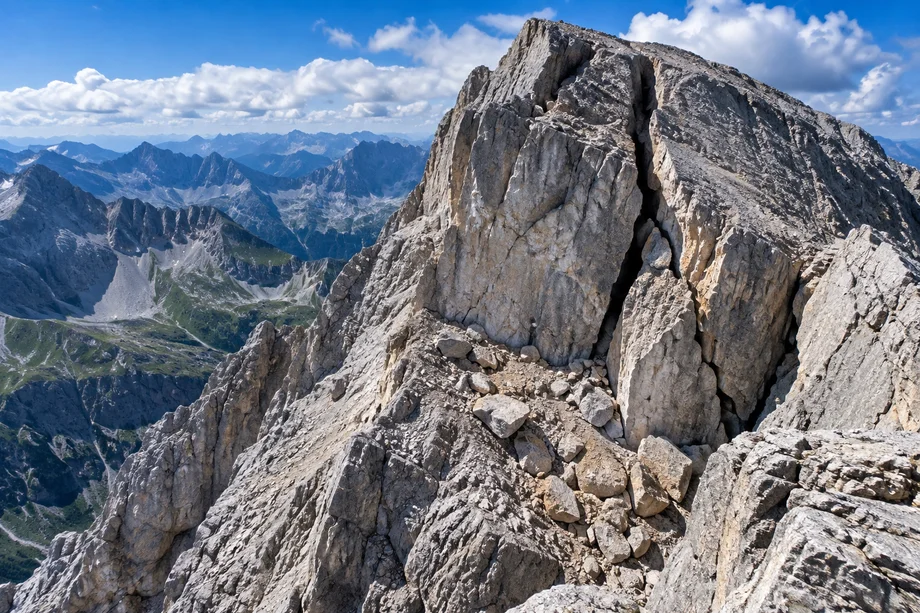
One of the best-known peaks of the Allgä Algu Alps is being monitored intensively as scientists have recorded new movements in the rocky mass of Hochvogel.
Scientists at Munich Technical University, TUM, have been monitoring the mountain for 12 years, and they expect a major rock collapse to occur in the future. The main hole at the top has reached some locations up to six feet [6 m] wide and some 70 feet [70 m] deep.
Geologist Michael Krautbutter, professor at TUM, told BiH that the process leading to the great collapse seems to have already begun. Scientists estimate that the measure that can be broken contains about 250,000 to 400,000 cubic metres of rock.
Important signs have been recorded this year.
Sensors measured up to five millimeters a week in the spring, reports Rosenheim24. In June, a rocky tower of about 2,000 cubic metres was already cut off from the mountain.
Now the attention of researchers is focused on a rift called “Spalt 6”, southwest of the mountain. According to Rosenheim24, this area is currently showing larger movements and can play a key role in the next collapse. Researchers also plan to establish a seismic sensor to measure rock differences with greater accuracy.
This does not mean, however, that hundreds of thousands of cubic metres of rock will collapse immediately.
BR24 quoted Krautbutter as explaining that the process to the final collapse could last several years. Sensors are set just to find out if movement begins to accelerate, which can give scientists the best chance to predict the approach to the event.
The traditional Bäumenheimer Weg road, which climbs on the Tirol side, has been closed since 2014 and, according to B92, is expected to be covered by rock masses when the major collapse occurs. Meanwhile, the bavarese climb and half the relevant top are currently considered safe.
Hochvogel is especially interesting to scientists because the measure is expected to drop into an uninhabited area. This allows researchers to test new technologies for predicting the collapses, which can then be used in mountainous areas where people and settlements are directly endangered.