Fuel prices remain one of the biggest costs of owning a car, which makes one question particularly important for drivers who cover thousands of kilometers every year: which diesel car actually uses the least fuel?
The answer depends on the market, model year, engine and equipment, but official European WLTP figures reveal several exceptionally economical diesel cars.
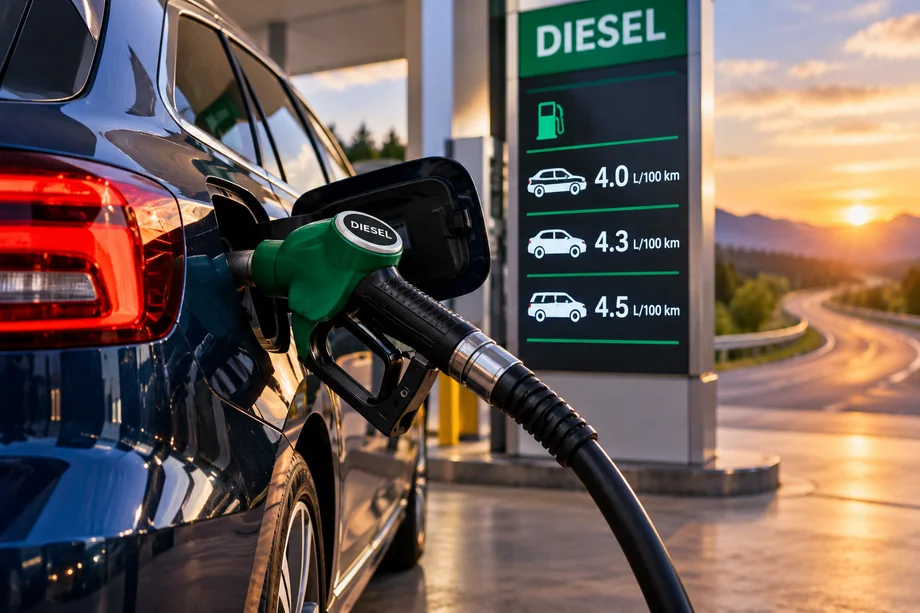
Among models appearing at the very top of fuel efficiency rankings are the Opel Corsa 1.5 Diesel and Peugeot 208 1.5 BlueHDi, both with official combined consumption of approximately 4.0 liters per 100 km in their most efficient configurations.
That translates to roughly 25 kilometers from a single liter of diesel under official test conditions.
The figures become even more impressive when translated into driving range. At 4.0 l/100 km, a theoretical 50 liter tank would contain enough fuel for around 1,250 kilometers, although actual range will depend heavily on driving conditions.
Bigger cars can also be remarkably efficient
Drivers do not necessarily need a small hatchback to achieve low diesel consumption.
The Škoda Octavia 2.0 TDI is another standout. Current official Škoda data puts the Octavia range as low as approximately 4.3 l/100 km, depending on configuration.
That combination of low consumption and considerably more passenger and luggage space makes the Octavia particularly interesting for drivers who regularly travel long distances.
The Volkswagen Golf 2.0 TDI is similarly efficient. The 116 horsepower diesel version has an official combined consumption around 4.3 l/100 km in efficient configurations.
Other diesel models near the top of WLTP efficiency rankings include versions of the BMW 2 Series Gran Coupé, Ford Focus, Citroën C4, Opel Astra and Audi A3.
But official consumption is not your real consumption
There is an important catch.
WLTP figures are designed primarily to allow consumers to compare vehicles under standardized conditions. They should not be interpreted as a guarantee of what every driver will achieve.
Škoda itself warns that official figures may not reflect real world driving results.
Driving at high motorway speeds, cold weather, heavy traffic, short journeys, additional passengers, luggage and aggressive acceleration can all increase fuel consumption.
A driver covering long distances at steady speeds will generally have a much better chance of approaching the official diesel figures than someone making repeated short urban journeys.
Is diesel still worth buying?
For drivers covering large annual mileages, particularly on highways, an efficient diesel can still make considerable economic sense.
The calculation becomes different for people who primarily make short trips around cities. Modern diesel engines use complex emissions equipment, and frequent short journeys are not necessarily their ideal operating environment.
Purchase price, diesel prices, insurance, maintenance, taxes and local restrictions should therefore be considered alongside fuel consumption.
So which one should you choose?
If the objective is simply the lowest official diesel consumption, small cars such as the Opel Corsa 1.5 Diesel and Peugeot 208 1.5 BlueHDi have recorded figures around the remarkable 4.0 l/100 km mark.
For drivers wanting more space without sacrificing much efficiency, cars such as the Škoda Octavia 2.0 TDI and Volkswagen Golf 2.0 TDI, at roughly 4.3 l/100 km in their most economical versions, provide an attractive compromise.
Ultimately, the most economical diesel is not simply the car with the smallest number on the specification sheet.
It is the one that can deliver low consumption in the type of driving you actually do every day.



