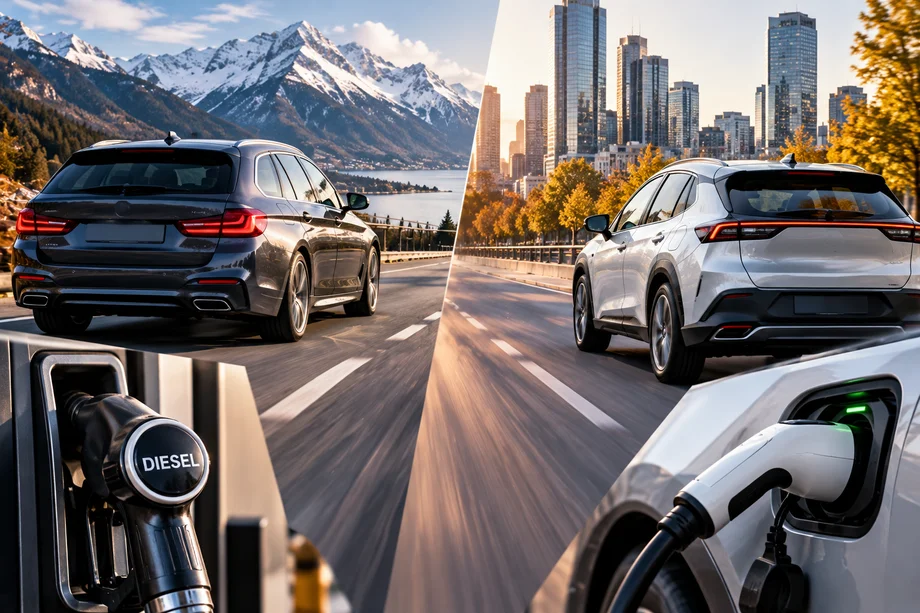
Buying a new or used car is an important financial decision. For many drivers, the dilemma remains the same: diet or hybrid?
The answer is not as simple as it seems. Although sun engines are known for low consumption on highways, hybrid technology has outstanding priorities in urban traffic.
According to the German automobile organization ADAC, the real cost of a car should be calculated, including fuel, maintenance, insurance, taxes and loss of value.
Diesel: Still Economics for Long Travels
Diesel engines continue to be alternative for drivers who travel long distances.
On the highway, a modern Diesel can consume approximately 4 to 6 liters of fuel per 60 miles [100 km], depending on the model, weight, and management conditions.
For drivers travelling 25,000 to 30,000 kilometers per year, relatively low consumption can translate into considerable savings.
Diesel engines, however, have complicated emissions control systems, including particles filters and AdBlue systems in many models.
These may increase maintenance costs, especially in older vehicles.
Hidd: The Great Advantage in City
Hybrid cars combine the engine with internal combustion and an electric engine.
In urban traffic, where brakes and stops are frequent, the hybrid system can recover energy and reduce fuel consumption.
According to consumer data published by the American Environmental Protection Agency (EPA), some hybrid models achieve markedly higher efficiency than their traditional versions of gasoline.
An economic hybrid can consume between 3 and 5 litres of gasoline for 100 kilometers in combined use.
However, real consumption depends on the model and mode of direction.
How much is fuel for 20,000 miles?
To understand the difference, we can take a simple example.
A diesel car that consumes 5 liters per 100 kilometers would use about 1,000 liters of oil for 20,000 miles.
A hybrid car that consumes 13 gallons [4 L] per 100 kilometers would use about 500 gallons [800 L] of gasoline at the same distance.
If oil costs 1.60 euros per litre and 1.70 euros gas, the expenses would be:
Diesel: 1,600 euros per year.
Hibrid: 1,360 euros per year.
In this scenario, the hybrid saves about 240 euros a year in fuel alone.
However, this is an illustrative example rather than a comparison between two concrete models.
What about maintenance?
Modern diesel engines can require additional expenses for gas treatment systems and injection components.
Hybrid cars, on the other hand, have batteries and electronic systems that may be expensive in case of defect.
However, regenerative resistance to hybrids can reduce brake consumption.
Real costs depend on manufacturer, model, machine age and maintenance history.
Should buyers be concerned about dysel restrictions?
In some European cities, there are areas of lower emissions where the circulation of more polluting vehicles can be limited.
According to the European Commission, urban transport policies target reducing pollution and improving air quality.
However, the rules vary from city to city and do not imply general bans on Sunday cars.
The buyers must control the Euro standard of the vehicle and local regulations before the purchase.
Which car is worth most in 2026?
For drivers moving mainly in the city, a common hybrid may be a more economic choice because of low consumption in traffic.
For those who regularly travel on highways and travel long distances, Diesel can continue to be competitive.
But the final decision should be based on the purchase price, annual kilometers, real consumption and maintenance costs.
In the end, the most economical car is not necessarily the least fuel consumer, but the least cost during the entire use period.



