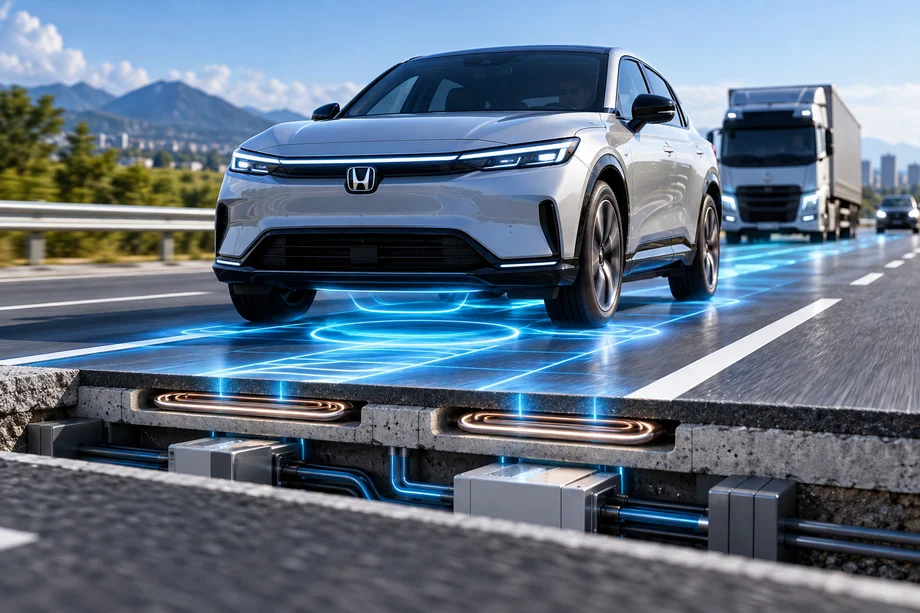
Imagine an electric car continuing to charge while moving on the highway, without having to stop to connect to a charger. This idea can become reality thanks to a new technology developing Japanese producer Honda.
According to Reuters agency, Honda has reportedly developed a wireless charge system designed to power electrical vehicles during the movement.
Technology aims to function not only for normal cars but also for large electric trucks that face significant challenges because of battery weight and charge time.
The project is being developed in co-operation with Japanese construction companies Taisei and Taisei Rotec.
The system uses devices attached to the surface of the road, which transmit electricity to vehicles equipped with relevant technology.
In this way the vehicle can gain energy on the journey, reducing the need for frequent stops.
Reuters reports that Honda plans to start testing on a Japanese highway during the financial year starting in April 2027 or later.
These tests will help the company assess the functioning of the system in real traffic conditions and determine whether technology can be used at large.
One possible benefit is reducing the size of batteries needed for electric vehicles.
If part of the energy is provided during the journey, manufacturers may be able to design vehicles with smaller batteries, reducing their weight and potentially their costs.
This may be especially important for transportation of goods, where electric trucks must travel long distances and carry heavy loads.
However, technology is still in the development phase and faces several challenges.
Building roads with integrated energy transmission equipment may require considerable investment in infrastructure.
Also, vehicles should be equipped with special energy-taking systems, while charge efficiency and safety should be tested under different conditions.
According to Reuters, an engineer at Honda did not provide an assessment of the cost of this technology compared to traditional fast charge networks, stressing that economic convenience remains to be analysed.
At the moment, Honda has not announced a date for commercial use of the system.
However, the project represents an interesting direction for the automotive industry, which is looking for ways to make the use of electric vehicles more practical.
If tests result in success and costs become affordable, roads that charge vehicles during the movement can turn into an alternative to traditional infrastructure.
For the drivers of electric vehicles, this would mean fewer stops, more flexibility, and a completely new way of travel.



