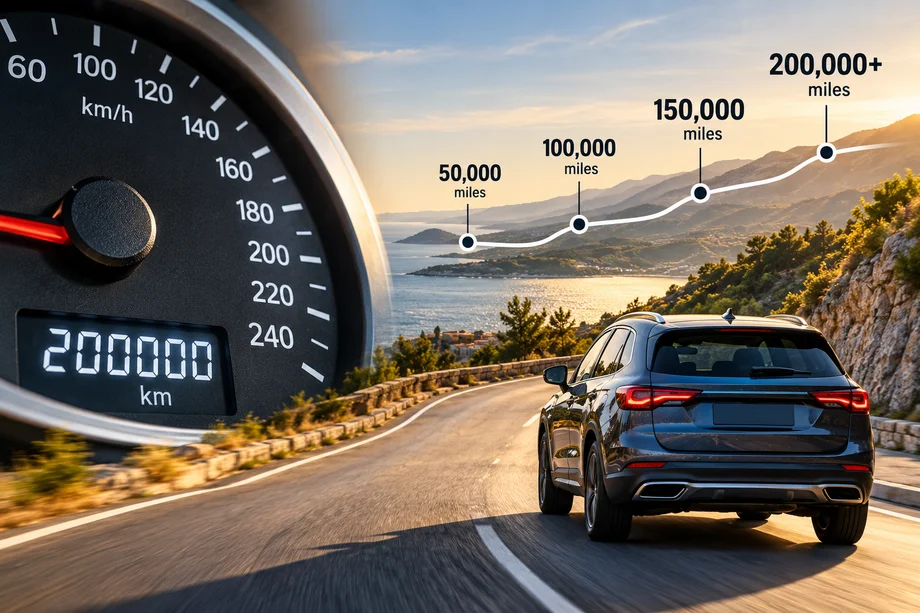
For decades, reaching 100,000 miles, about 161,000 kilometers, was considered a major milestone for a car. Many drivers assumed that once the odometer crossed six figures, expensive problems were around the corner.
Modern cars have changed that calculation.
Consumer Reports says a well maintained modern vehicle from a manufacturer with a strong reliability record should be capable of reaching 200,000 miles or more.
So when is a car actually considered high mileage, and when should you start worrying?
Is 100,000 miles still high mileage?
Technically, yes. But it does not necessarily mean the car is near the end of its life.
A vehicle with 120,000 miles and a complete maintenance history can be a better purchase than one with 70,000 miles that has been neglected.
Consumer Reports notes that 100,000 miles remains psychologically important for buyers, even though modern vehicles regularly continue to 200,000 miles and beyond.
The condition of the engine, transmission, suspension and body matters considerably more than the odometer alone.
Can a car reach 200,000 miles?
Absolutely.
Consumer Reports says routine maintenance is one of the most important factors in getting a vehicle to 200,000 miles. Following the manufacturer's service schedule, using the correct engine oil and dealing with small problems before they become serious can dramatically affect longevity.
That translates to approximately 322,000 kilometers.
Some vehicles travel considerably farther, although keeping an extremely high mileage car running can eventually require expensive repairs.
What happens after 100,000 miles?
This is where maintenance becomes particularly important.
Between approximately 100,000 and 150,000 miles, owners may need to replace components such as spark plugs, suspension parts, the starter or alternator.
Vehicles equipped with timing belts may also require replacement according to the manufacturer's specified interval. Ignoring a worn timing belt can potentially result in severe engine damage.
None of these repairs automatically means a car has become unreliable. Many are simply consequences of components reaching the end of their normal service lives.
What happens after 150,000 miles?
The likelihood of larger repair bills begins to increase.
Oil seals can start leaking. Exhaust components may deteriorate. Suspension components may need attention, and some vehicles can eventually develop problems with head gaskets or other major mechanical systems.
Consumer Reports says the potential for major repairs rises after approximately 150,000 miles.
At this stage, owners need to compare repair costs with the value and overall condition of the vehicle.
Highway miles versus city miles
Mileage alone does not reveal how a vehicle was driven.
A car accumulating most of its mileage on highways may experience less wear on brakes and some mechanical components than a lower mileage vehicle driven primarily through congested cities.
Frequent short trips, heavy traffic, repeated cold starts, aggressive acceleration and poor roads can all increase wear.
This is why two cars showing identical mileage can have completely different mechanical conditions.
Maintenance history matters enormously
If you are buying a high mileage used car, service records can be extremely valuable.
Look for evidence of regular oil changes and scheduled servicing. Check the condition of the brakes, tires and suspension. Inspect for oil or coolant leaks and unusual engine or transmission behavior.
A professional inspection before purchasing an older used vehicle can uncover problems that are difficult to detect during a short test drive.
When should you stop repairing an old car?
There is no universal mileage at which a car suddenly becomes too old.
A 200,000 mile vehicle that remains safe, reliable and inexpensive to maintain could still make financial sense.
The calculation changes when major repairs become frequent.
Consumer Reports suggests reconsidering an aging vehicle when a major repair costs more than the car is worth, structural rust compromises safety, or the vehicle remains unreliable despite repeated repairs.
How to make your car last longer
The simplest advice is also the most important: follow the maintenance schedule specified by the manufacturer.
Use the correct oil and fluids. Maintain proper tire pressure. Address warning lights quickly. Monitor coolant and oil levels, and do not ignore unusual noises, vibrations or leaks.
Batteries also require attention. Consumer Reports says conventional car batteries commonly last around three to five years, although climate and vehicle usage can shorten their lifespan.
Small preventive expenses can help avoid much larger repair bills later.
So, how many miles is too many?
There is no magic number.
100,000 miles is no longer automatically old.
150,000 miles does not automatically mean unreliable.
And 200,000 miles is achievable for many modern vehicles with proper maintenance.
When judging an older car, the better question is not simply how many miles it has traveled.
Ask how those miles were driven, how carefully the vehicle was maintained and what condition it is in today.
Those answers can tell you far more than the odometer.



