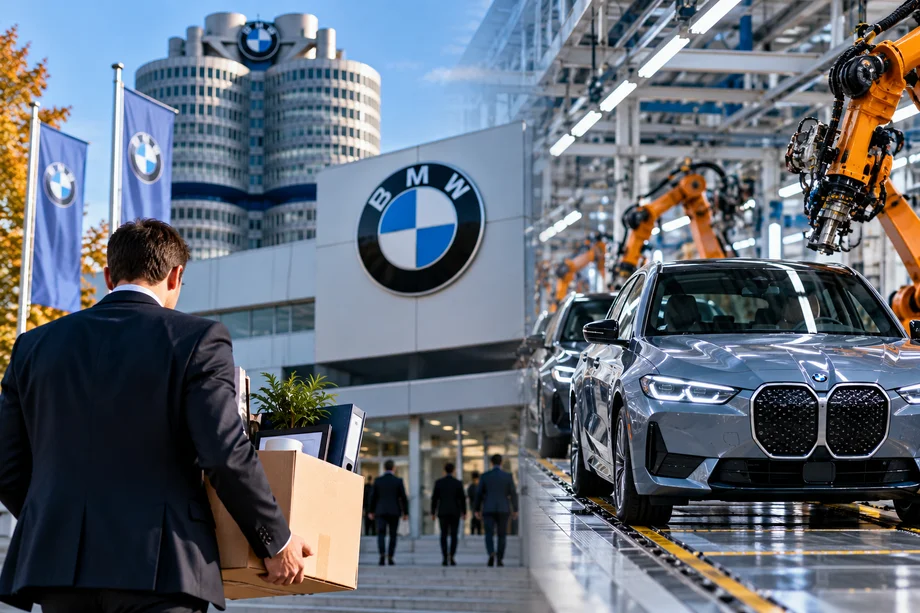
BMW is accelerating one of the biggest restructurings in its recent history, with around 8,000 jobs expected to disappear as the German luxury carmaker tries to restore profitability.
The Munich based company is combining workforce reductions with a major expansion of artificial intelligence across its operations, while preparing a wave of new vehicles aimed at strengthening its position in Europe, the United States and China.
Reuters reports that BMW plans to reduce management roles by 20 percent by the middle of 2027 and use AI more extensively across development, purchasing, production, sales and aftersales.
The strategy comes as BMW faces weaker demand, intense competition from Chinese automakers and the financial impact of US tariffs.
Around 8,000 jobs are going
BMW's workforce reduction programme is expected to eliminate approximately 8,000 positions by the end of 2027.
The cuts are focused largely on office based roles, particularly in Germany, rather than workers directly involved in vehicle production.
Reuters previously reported that BMW's voluntary redundancy programme targets administration and development divisions, while production operations are excluded. The programme was agreed with the company's works council.
European Union agency Eurofound says the restructuring is expected to affect between 4,000 and 8,000 positions in Germany, with administrative, research, development, planning and management functions among the areas most exposed.
The programme officially begins in October 2026 and is expected to continue through the end of 2027.
AI becomes central to BMW's strategy
The restructuring is about more than reducing employee numbers.
BMW wants artificial intelligence to simplify processes throughout the company and help teams make decisions faster.
Reuters reports that BMW plans broader AI deployment across vehicle development, purchasing, manufacturing, sales and aftersales operations.
The company is also simplifying its management structure.
Divisions and associated management positions are expected to be reduced by approximately 20 percent by mid 2027.
The changes reflect a wider transformation across the global automotive industry, where manufacturers are investing heavily in software and AI while attempting to reduce traditional administrative costs.
BMW profits are under pressure
The urgency behind the plan is clear from BMW's financial performance.
The company has issued repeated profit warnings linked partly to weakness in China, historically one of the most important markets for German premium automakers.
Reuters reports that BMW's most recent automotive operating margin was 2.3 percent. The company is targeting a margin of between 3 and 5 percent by 2028 before attempting to return to its longer term target range of 8 to 10 percent during the early 2030s.
BMW shares have also fallen by more than a third during the past year, reaching their lowest levels in more than six years.
China remains one of the biggest challenges.
Local manufacturers have expanded rapidly, particularly in electric vehicles, while Chinese consumers increasingly have access to sophisticated domestic models with advanced software at competitive prices.
BMW is not abandoning Germany
Despite the job cuts, BMW is continuing to invest heavily in German manufacturing.
Reuters reports that the company plans approximately €2 billion in investment for German production of its next generation 3 Series.
Factory workers are also excluded from the voluntary redundancy programme currently targeting office based employees.
That distinction is significant.
Rather than shrinking its German manufacturing footprint dramatically, BMW appears to be concentrating much of its cost reduction on management, administration and corporate processes.
New BMW models are coming
Cost reductions represent only one side of BMW's recovery plan.
The company is also preparing new vehicles aimed at expanding sales in key global markets.
Reuters reports that BMW intends to launch an entry level electric vehicle for Europe in 2028.
The carmaker is also planning a new luxury SUV positioned above the X7, targeting affluent customers in the United States.
BMW's Neue Klasse generation of electric vehicles remains central to the strategy, with the new iX3 among the models expected to demonstrate the company's next generation technology.
BMW also plans to expand its high performance M and Alpina ranges from 2027.
China forces a different strategy
BMW is also changing how it operates in China.
The company plans greater localization and expects to rely more heavily on Chinese partners for technologies including autonomous driving and integrated vehicle software.
Reuters reports that BMW is also considering exporting vehicles produced in China to markets in Southeast Asia.
The approach highlights how quickly the relationship between European and Chinese automakers is changing.
German manufacturers once entered China primarily to bring European automotive technology into the country. Increasingly, they are looking toward Chinese companies for software, battery and autonomous driving expertise.
Germany's car industry is changing fast
BMW is not alone.
Volkswagen and Mercedes Benz have also announced major cost reduction programmes as Germany's automotive industry confronts one of its most difficult periods in decades.
Electric vehicle competition from China, expensive technology investments, weaker demand and changing global trade rules are forcing manufacturers to reconsider how they operate.
BMW's response is particularly notable because it combines significant workforce reductions with continued investment in factories and new vehicles.
Chief Executive Milan Nedeljkovic, who took over the top job in May, has emphasized that BMW's strategy is not simply about cutting costs.
The company is betting that fewer management layers, wider use of artificial intelligence and a stronger new model lineup can restore profitability without sacrificing its manufacturing base.
For thousands of employees, however, that transformation is already becoming very real.



