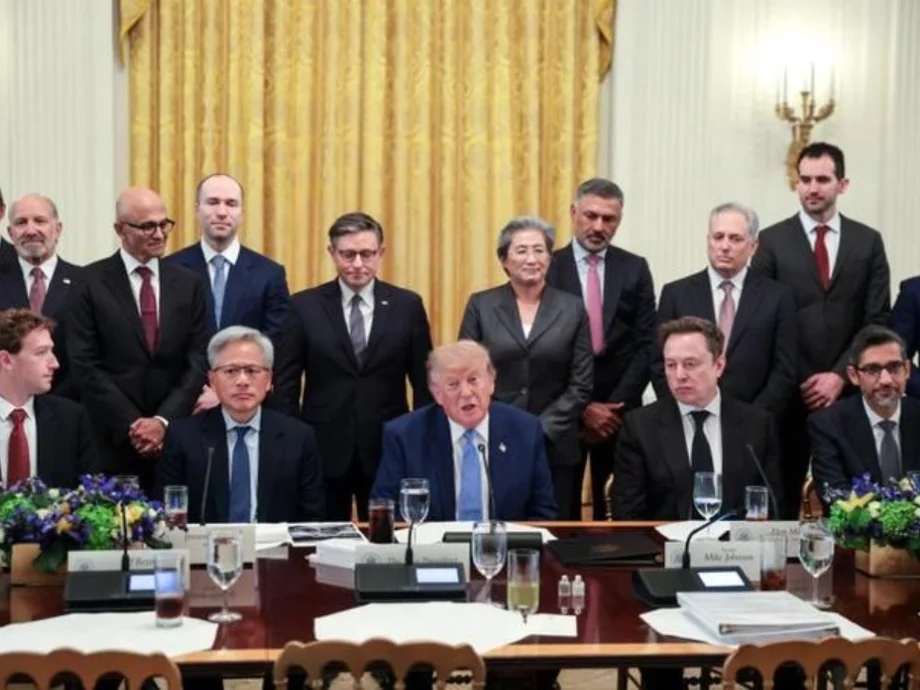
The agreement, called the Joint Commitment on Frontier Responsibilities, was announced on September 29 following a White House meeting involving President Donald Trump and leading technology executives.
The document was signed by executives representing Google�, Meta�, OpenAI�, Nvidia�, Anthropic� and X�, according to Reuters. �
UOL Notícias +1
Unlike a federal regulation, the agreement is voluntary. The administration described it as a commitment intended to establish stronger safeguards inside companies developing increasingly capable artificial intelligence models.
The development comes as governments, technology companies and researchers continue debating how rapidly advancing AI should be controlled without preventing innovation.
What the AI companies agreed to do
The agreement establishes four broad layers of safety controls.
Participating companies are expected to maintain internal systems that monitor the capabilities and behavior of their AI models during both training and deployment.
Those controls are intended to identify potential risks involving areas such as cybersecurity, biological threats and chemical threats.
The agreement specifically calls for safeguards designed to prevent AI models from accessing or interfering with technical systems in unintended ways. �
UOL Notícias
Companies are also expected to maintain internal teams responsible for checking whether monitoring and detection systems are operating as intended.
A separate level of oversight would come from outside the companies themselves.
Independent AI evaluations are part of the deal
One of the most significant provisions calls for participating companies to work with external auditors or evaluators.
These independent assessments would examine whether the companies' AI monitoring and control systems are functioning as intended.
The agreement also calls for companies to establish independent board committees that would receive information from both internal teams and external evaluators. �
UOL Notícias +1
Participating companies are expected to meet regularly to develop standards and best practices for improving the safety of their systems.
The document also acknowledges that some of these measures could eventually become part of formal laws or regulations. �
UOL Notícias
For now, however, the commitments are not legally binding federal rules.
Why the agreement matters
The accord arrives at a crucial moment for the artificial intelligence industry.
AI systems are increasingly moving beyond answering questions and generating text, images or computer code.
Companies are developing AI agents capable of carrying out longer sequences of actions, using software tools and completing tasks with less direct human supervision.
That expansion has increased attention on how companies test powerful models before releasing them.
The new agreement attempts to create a shared framework among major AI developers while leaving individual companies responsible for implementing many of the controls.
Associated Press reported that the agreement includes internal safeguards, independent external reviews and oversight mechanisms within participating companies. �
AP News
The biggest AI companies were in Washington
The White House gathering brought together many of the most influential figures in global technology.
Executives attending included leaders connected to Meta, Nvidia, Anthropic, OpenAI, Google, Microsoft, Amazon and X, according to reports from the event. �
AP News +1
Their participation illustrates how closely AI policy is becoming connected with the largest technology companies in the United States.
The companies involved are investing heavily in AI models, computing infrastructure, chips and data centers.
At the same time, governments around the world are trying to determine what safeguards should apply as these systems become more capable.
America.gov also launches
The AI safety agreement was not the only major technology announcement from Washington.
The White House also launched America.gov, a new digital gateway intended to give Americans a single place to access federal government information and services.
According to the White House, users can communicate with the service using ordinary language and receive answers without having to navigate numerous individual federal agency websites. �
The White House
The administration says the platform is designed eventually to allow people to complete certain government transactions directly when authorization and technical infrastructure are available.
The White House also says privacy protections are intended to be incorporated into the service. �
The White House
The launch represents another example of generative AI moving from experimental applications into public services used by ordinary citizens.
AI regulation remains a major debate
The voluntary nature of the agreement is likely to remain an important part of the wider debate over AI regulation.
Supporters of industry led standards argue that artificial intelligence is developing so quickly that rigid regulation could struggle to keep pace with technological advances.
Critics of voluntary systems argue that companies developing powerful AI models should face enforceable external standards rather than relying primarily on internal controls.
The new accord does include independent evaluation, but companies retain substantial responsibility for implementing their own safety systems.
The agreement itself leaves open the possibility that its principles could eventually be incorporated into legislation or formal regulation. �
UOL Notícias
That means the September 29 announcement may represent an early framework rather than the final shape of American AI oversight.
Europe is taking a different path
The United States is not developing AI policy in isolation.
Europe has pursued a more regulatory approach through the European Union's artificial intelligence rules and broader digital legislation.
The contrast has created an important international policy question: whether advanced AI should primarily be governed through legislation, industry commitments, independent auditing, or some combination of all three.
Technology companies operating globally may ultimately need to comply with different regulatory systems depending on where their products are offered.
That makes decisions in Washington and Brussels particularly important for companies developing models used by hundreds of millions of people.
AI safety concerns are growing with capability
The agreement also arrives as several leading AI companies publicly discuss risks associated with increasingly capable systems.
Developers are testing models for behavior involving cybersecurity, autonomous decision making, biological information and the ability to operate external software tools.
These capabilities can create useful applications, but they also raise questions about what happens when systems behave differently from what developers intended.
The new accord attempts to address that issue by requiring multiple layers of monitoring rather than relying on a single internal safety process.
External evaluation could become particularly important as companies release increasingly autonomous AI agents.
What happens next
The immediate question is how the participating companies will translate the agreement into operational safeguards.
The document establishes principles, but the effectiveness of those principles will depend on implementation, including how independent evaluators are selected, what standards they apply and how companies respond when risks are discovered.
Another question is transparency.
The public may increasingly expect companies to explain how advanced models were evaluated before release and what safeguards are operating after deployment.
For now, the agreement represents a significant coordinated commitment involving several of the companies building the world's most advanced artificial intelligence systems.
Whether those voluntary safeguards eventually become mandatory rules will depend on future decisions by lawmakers, regulators and the companies themselves.
What is already clear is that AI safety has moved from a specialist technology debate into a central question for governments, businesses and hundreds of millions of people using artificial intelligence every day.



