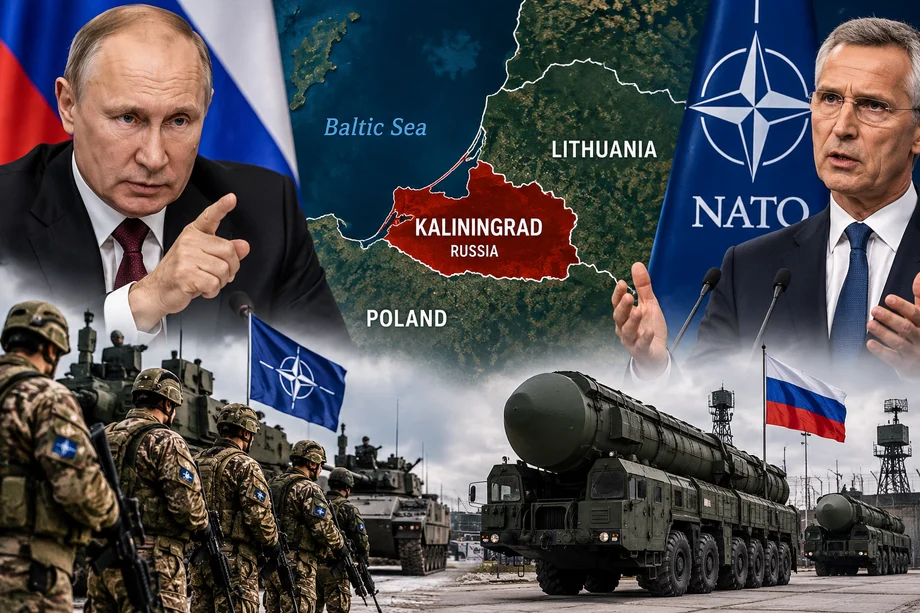
Russia has issued an unusually explicit nuclear warning to NATO over Kaliningrad, sharply raising tensions around one of Europe's most strategically sensitive territories.
In a diplomatic document sent to NATO and seen by Reuters, Moscow said it would be prepared to use its full military capabilities, including nuclear weapons, if alliance members attempted to isolate Kaliningrad from the rest of Russia.
Russia also warned that a direct conflict could involve attacks against decision making centers in NATO member states.
NATO has strongly rejected the threat.
The alliance says its exercises and military activities are defensive and do not threaten Russian territory. NATO also condemned what it called irresponsible nuclear rhetoric.
The exchange has placed Kaliningrad back at the center of European security concerns.
What exactly did Russia threaten?
The Russian document accused NATO of pursuing what Moscow described as a dangerous course around Kaliningrad.
According to Reuters, Russia said it would be ready to use its entire available arsenal, including nuclear weapons, to defend its territory if NATO countries attempted to isolate the region.
Russia also warned of a high risk of direct armed conflict.
The document was described as a diplomatic "non paper," meaning an informal communication rather than a formal treaty document.
The language nevertheless attracted immediate attention because it explicitly connected the possible use of nuclear weapons with a confrontation involving Kaliningrad.
Russian diplomatic missions have repeated similar warnings publicly.
Russia's embassy in London said any military action by Britain or NATO against Russian territory could produce a response using all available means, including nuclear weapons.
NATO condemns the warning
NATO rejected Moscow's accusations and emphasized that it is a defensive alliance.
A NATO spokesperson said alliance activities and exercises do not represent a threat to any part of Russia.
The alliance condemned threats of force and specifically criticized nuclear rhetoric.
NATO also reiterated that it has the military capabilities required to defend the territory of its members.
Secretary General Mark Rutte separately emphasized NATO's commitment to defending every part of allied territory during a meeting with Lithuania's prime minister on September 29.
NATO has not announced a blockade of Kaliningrad.
That distinction is important because Russia's warning describes what Moscow says it would do if such an attempt were made.
Why is Kaliningrad so important?
Kaliningrad is a small Russian territory on the Baltic Sea that is physically separated from mainland Russia.
It sits between Poland and Lithuania, both members of NATO and the European Union.
The region became part of the Soviet Union after World War II and remained Russian territory following the collapse of the Soviet Union.
Its location gives Kaliningrad enormous strategic importance.
Russia maintains substantial military infrastructure there, allowing Moscow to project military power into the Baltic region from a territory surrounded largely by NATO countries.
Kaliningrad also hosts Russia's Baltic Fleet.
The region has long been associated with missile systems capable of carrying conventional or nuclear warheads, making any military confrontation around the exclave particularly sensitive.
The Suwalki Gap makes the geography even more important
Immediately southeast of Kaliningrad lies one of NATO's most discussed strategic vulnerabilities.
The Suwalki Gap is the relatively narrow land corridor along the Polish and Lithuanian border between Kaliningrad and Belarus.
It provides the principal land connection between Poland and the Baltic states of Lithuania, Latvia and Estonia.
Military planners have long paid close attention to this corridor because disruption there during a conflict could complicate NATO's ability to reinforce the Baltic states by land.
That geography explains why military activity around Kaliningrad attracts far more international attention than the territory's relatively small size might suggest.
A NATO exercise appears to have contributed to the dispute
Russia's warning follows NATO military activity in the Baltic region.
According to German reporting based on information from military sources, an air exercise in August was intended to demonstrate NATO's ability to respond rapidly if Russia attacked alliance territory and to establish control around Kaliningrad in such a scenario.
Poland's defence ministry described the exercise as demonstrating NATO's rapid response capabilities.
Moscow interpreted military activity and public discussion surrounding Kaliningrad very differently.
Russia accused NATO countries of escalating the military and political situation around the territory.
The disagreement illustrates a persistent problem in relations between Russia and NATO.
Actions one side describes as deterrence and defensive preparation can be interpreted by the other as preparation for offensive operations.
Baltic security has become increasingly tense
The Kaliningrad confrontation is occurring against a much broader deterioration in security across the Baltic region.
NATO has increased its military presence along its eastern flank since Russia's invasion of Ukraine.
Finland and Sweden have also joined NATO, dramatically changing the strategic geography of northern Europe.
Russia now faces NATO territory across a much larger section of its northwestern frontier.
The Baltic Sea is also surrounded almost entirely by NATO members, apart from Russia.
At the same time, European governments have accused Moscow of hybrid operations including sabotage, cyberattacks, GPS interference and other disruptive activity.
Russia denies allegations that it conducts sabotage against NATO countries.
NATO is strengthening its eastern flank
The alliance continues to increase its military capabilities in the region.
NATO Secretary General Mark Rutte said this week that the alliance is strengthening integrated air and missile defence while expanding its ability to counter drones.
NATO maintains Forward Land Forces in Lithuania and operates Baltic Air Policing missions from bases in the region.
Lithuania is also developing the Rūdninkai training area to support allied forces.
These deployments are presented by NATO as deterrence intended to prevent an attack on alliance territory.
Moscow has repeatedly criticized NATO's military expansion near Russian borders.
Lithuania sits directly beside Kaliningrad
Lithuania has a particularly important role in the dispute because it shares a border with Kaliningrad.
The country has dramatically increased defence spending and strengthened military cooperation with other NATO members.
According to NATO, Lithuania is expected to spend approximately 5.38 percent of GDP on core defence in 2026.
NATO also maintains forces in the country.
The alliance says Italian aircraft operating from Šiauliai recently downed a drone that violated Lithuanian airspace on September 15.
Incidents like these have increased concerns about accidental escalation as military activity grows on both sides.
Why nuclear rhetoric changes the situation
Russia has repeatedly referenced its nuclear capabilities since the beginning of the Ukraine war.
The Kaliningrad warning is notable because it describes a specific scenario in which Moscow says nuclear weapons could become part of its response.
That does not mean nuclear weapons are about to be used.
It also does not establish that NATO intends to isolate or attack Kaliningrad.
The warning is conditional on a scenario Russia says would threaten its territory.
Nevertheless, explicit references to nuclear weapons increase concern because both Russia and several NATO members possess nuclear arsenals.
Russia and the United States hold the world's largest nuclear stockpiles.
Britain and France are also nuclear armed NATO members.
Avoiding miscalculation between nuclear powers has therefore become one of the most important dimensions of the confrontation.
NATO says it will continue supporting Ukraine
The dispute over Kaliningrad is closely connected to the wider confrontation created by Russia's war against Ukraine.
NATO says Moscow's warning will not change its support for Kyiv.
The alliance has continued providing military, financial and political assistance to Ukraine while simultaneously strengthening defences across NATO's eastern territory.
Russia argues that Western military support for Ukraine and NATO deployments close to Russian territory threaten its security.
NATO governments reject that argument and say their military posture is intended to deter further aggression.
Those competing interpretations have become increasingly difficult to reconcile.
Could NATO blockade Kaliningrad?
There is currently no NATO announcement establishing such a blockade.
Russia's warning concerns a hypothetical attempt to isolate the territory.
A military blockade would represent an extraordinary escalation and would raise major questions under international law.
It would also be fundamentally different from sanctions, customs restrictions or other economic measures.
For that reason, headlines suggesting NATO has already blockaded Kaliningrad would be inaccurate.
The current story is about Russia warning what it could do if NATO attempted such an action, followed by NATO condemning Moscow's threat.
Why Kaliningrad could remain a flashpoint
Kaliningrad combines several of Europe's most dangerous security issues in one small territory.
It is Russian land separated from Russia itself.
It is surrounded by NATO countries.
It hosts important Russian military capabilities.
It sits beside the Baltic Sea and close to the strategically important Suwalki Gap.
And it exists in a region where NATO and Russian military forces increasingly operate in close proximity.
Those factors make communication particularly important.
A deliberate attack is not the only scenario capable of producing escalation. An aircraft incident, drone intrusion, naval confrontation or misunderstanding during a military exercise could also create a rapidly developing crisis.
The latest exchange does not mean a Russia NATO conflict is imminent.
It does, however, demonstrate how quickly a dispute involving Kaliningrad can move from conventional military planning to explicit discussion of nuclear weapons.
For Europe, that is what makes the latest warning significantly more consequential than another exchange of hostile rhetoric between Moscow and NATO.



