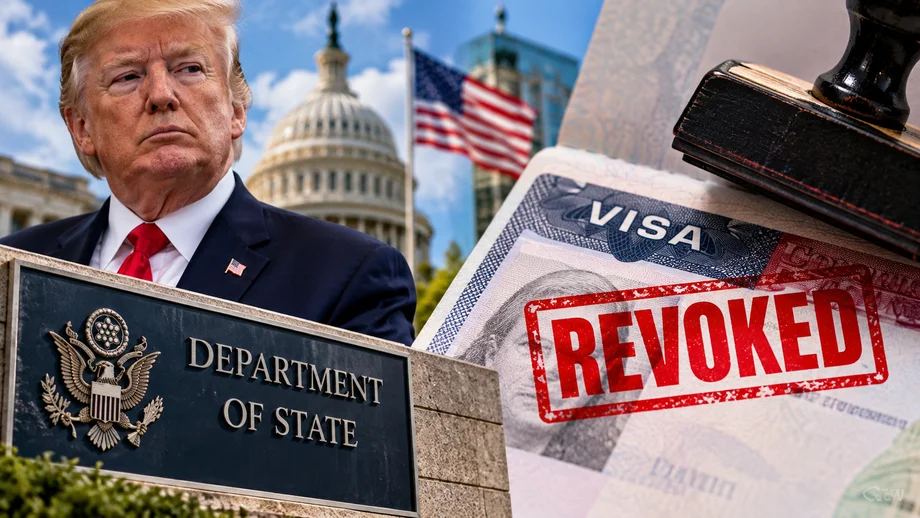
The United States has revoked more than 250,000 visas since President Donald Trump returned to the White House, marking a major expansion of visa enforcement under his administration.
The figure was confirmed by State Department spokesperson Tommy Pigott in comments published September 30.
According to the department, the revocations cover a broad range of cases involving alleged criminal activity, violations of visa conditions, fraud, abuse of the immigration system and national security concerns.
The announcement is likely to draw significant attention among foreign travelers, students and other visa holders, particularly as the administration continues expanding the screening of people authorized to enter the United States.
However, the 250,000 figure does not mean that 250,000 ordinary tourist visas were suddenly canceled in a single operation. It represents cumulative revocations since Trump returned to office and covers different circumstances and categories.
Why were more than 250,000 visas revoked?
The State Department says there is no single reason behind all of the revocations.
A department official told Fox News Digital that visas had been revoked in cases involving people accused of committing crimes, violating the conditions of their visas, defrauding Americans, abusing the immigration system or posing national security concerns.
The administration has increasingly emphasized what it calls continuous vetting.
Under that approach, obtaining a US visa does not necessarily end the government's review of the holder.
Information that emerges after a visa has been issued can potentially trigger additional scrutiny and, depending on the circumstances, revocation.
The State Department had already said in August that more than 175,000 visas had been revoked since Trump returned to office. The new total of more than 250,000 therefore represents a substantial increase.
Criminal activity is a major focus
According to information provided by the State Department, criminal and law enforcement related cases account for a significant portion of the revocations.
The department has cited offenses including assault, driving under the influence, theft and drug related crimes among the reasons for canceling visas.
Other cases have involved reckless driving, sexual assault, child abuse, fraud and embezzlement, according to the administration's account.
The existence of an arrest or allegation does not itself establish guilt, and the precise legal and administrative circumstances can differ between individual visa cases.
Visa revocation is also an immigration and consular action, rather than a criminal conviction.
Birth tourism is also being targeted
One particularly notable part of the new figures involves birth tourism.
The State Department says approximately 2,300 visas have been revoked in connection with birth tourism enforcement.
The term generally refers to foreign nationals traveling to the United States primarily to give birth there.
The Trump administration has intensified enforcement in this area and says visas can be denied or revoked when authorities determine that applicants misrepresented the purpose of their travel or otherwise violated visa requirements.
The administration has presented the initiative as an effort to prevent abuse of the US immigration system.
What does this mean for existing US visa holders?
The announcement does not mean that all existing visa holders need to reapply.
It also does not amount to a general cancellation of US tourist, student or business visas.
Instead, the State Department is emphasizing that a visa can be reviewed after issuance and potentially revoked if officials determine that the holder is no longer eligible.
A US visa allows a foreign national to travel to a US port of entry and request admission. It does not guarantee entry into the country.
Customs and Border Protection ultimately determines whether a traveler can enter when that person arrives at the border or airport.
For existing visa holders, the new announcement demonstrates that vetting can continue after a visa has been issued.
Could tourist visas be affected?
Yes, depending on the circumstances.
The administration has separately been considering a much larger action involving B1 and B2 business and tourist visas held by some foreign nationals who subsequently applied for asylum.
In August, the Associated Press reported that the administration was preparing to revoke visas belonging to as many as 200,000 people who had applied for or were seeking asylum in the United States.
The proposal involved B1 and B2 visas issued between 2016 and 2026.
That initiative should not be confused with the newly announced total of more than 250,000 visa revocations.
The 250,000 figure covers the administration's broader visa enforcement activity rather than only asylum related cases.
Visa rules have changed in other ways
The State Department has introduced several other changes affecting international travelers and visa applicants.
Since July, most applicants for US nonimmigrant visas have been instructed to schedule interviews at the US embassy or consulate in their country of nationality or residence.
The State Department warns that people applying outside their country of nationality or residence may find it more difficult to qualify.
The administration has also expanded visa restrictions and financial requirements in certain cases.
In August, Reuters reported that the State Department would make a visa bond program permanent for nationals of dozens of countries. The administration says such measures are intended to discourage visitors from overstaying their authorized period in the United States.
Some earlier visa restrictions have faced court challenges
Not every immigration measure introduced by the administration has remained in place.
Earlier in 2026, the State Department paused immigrant visa issuance for nationals of 75 countries while reviewing screening policies.
That list included countries such as Brazil, Egypt, Nigeria, Thailand, Albania and Kosovo.
However, the State Department's current guidance says that the January pause is no longer in effect following a federal court order. As of August 21, immigrant visa issuance under that specific policy was no longer suspended.
The department also explicitly states that no immigrant visas were revoked as part of that particular guidance.
This distinction matters because several different visa policies have been introduced during 2026, and they do not all affect the same travelers or visa categories.
Latin American officials also lost visas this week
The latest announcement comes shortly after another high profile visa action.
The Trump administration revoked visas belonging to 27 current and former officials from Bolivia, Colombia, Ecuador and Peru, along with some family members.
The State Department cited allegations involving corruption and obstruction of efforts to combat drug trafficking and other crimes.
The Associated Press reported the action on September 28 as part of the administration's broader use of visa restrictions as a foreign policy and enforcement tool.
Those cases represent a separate action from the broader 250,000 total.
State Department signals that scrutiny will continue
The administration is making clear that the current number is unlikely to represent the end of its visa enforcement campaign.
Pigott said the department views every visa decision through a national security lens and will continue reviewing foreign nationals who hold permission to travel to the United States.
For international travelers, the most important takeaway is that the United States is applying more extensive scrutiny not only when people apply for visas, but in some circumstances after those visas have already been issued.
The precise consequences will depend heavily on the type of visa, the holder's circumstances and the reason for any government review.
With more than 250,000 visas now revoked since Trump returned to office, US visa policy has become one of the most closely watched elements of the administration's wider immigration strategy.



