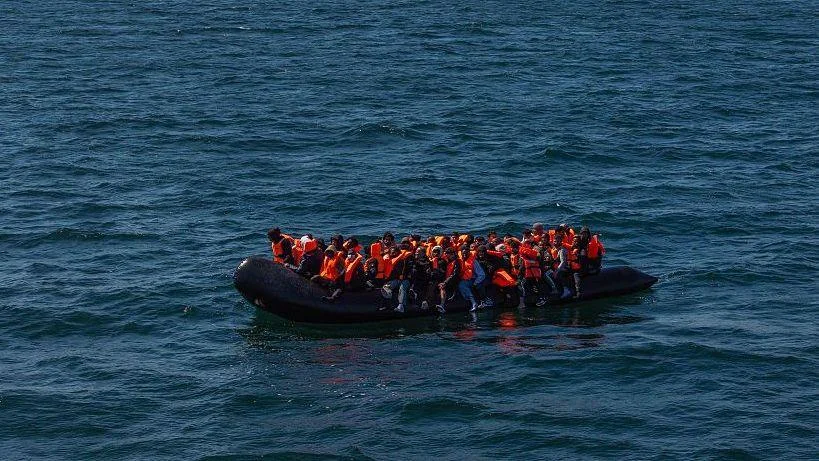
People crossing a border may appear in the same photograph while having very different reasons for travelling. Some may be seeking protection from persecution, others joining family or taking up employment. A route, a means of transport or an image alone cannot establish a person's legal status. That is why the language used in migration reporting matters.
Under the 1951 Refugee Convention, the refugee definition concerns people outside their country who cannot or will not seek its protection because of a well-founded fear of persecution connected to race, religion, nationality, political opinion or membership of a particular social group. The Convention and its 1967 Protocol form a central foundation of international refugee protection. UNHCR guide to the Refugee Convention
Refugee protection is therefore more specific than a general description of someone experiencing hardship abroad. At the same time, the international protection framework is not limited to reading that definition in isolation. UNHCR's glossary describes additional refugee definitions and protection concepts relevant to different legal and regional settings. Particular cases require attention to the applicable framework and individual circumstances. UNHCR glossary
An asylum-seeker is someone seeking international protection whose claim has not yet been finally decided. The expression describes the stage of the process; it does not tell readers what the outcome will be. Reporting that a person has applied for asylum should not be interpreted as announcing either acceptance or rejection of the claim. UNHCR explanation of asylum-seekers
The term “migrant” is broader and used differently across organizations and contexts. There is no single universally accepted international definition. Migration can involve employment, education, family circumstances and other reasons for moving. Consequently, a report should explain which population it is describing instead of assuming that every reader understands the term in exactly the same way. IOM publication on migration terminology
UNHCR cautions against using “refugee” and “migrant” interchangeably where doing so would obscure refugee protection needs. That distinction is particularly useful when a news story describes a mixed group. A shared journey does not mean everyone has the same status, motivation or claim to protection. UNHCR explanation of refugee and migrant terminology
Another important term is “internally displaced person,” often shortened to IDP. Internally displaced people have been forced to leave their homes but remain within their own country. Crossing an international border is therefore a key distinction between internal displacement and the circumstances addressed by refugee protection. UNHCR identifies refugees, asylum-seekers and internally displaced people as separate populations in its work. Who UNHCR protects
A hypothetical family escaping violence might first move to another town inside its country and later seek protection abroad. A news report following that journey could use different terms at different stages. The changing description would reflect changing circumstances, rather than necessarily indicating that an earlier report was wrong.
Statistics need the same care. Before comparing figures, readers should check whether a number describes new applications, decisions, arrivals or people present at a particular time. Those are different measurements. Two totals can both be accurate while answering different questions, and a headline may not provide enough detail to compare them responsibly.
Precise terminology makes public discussion clearer without reducing people to labels. The most informative reporting explains what is known, attributes legal classifications to appropriate sources and avoids guessing an individual's status from appearance or travel route. For readers, that approach offers a firmer basis for understanding both the human story and the policy debate.



