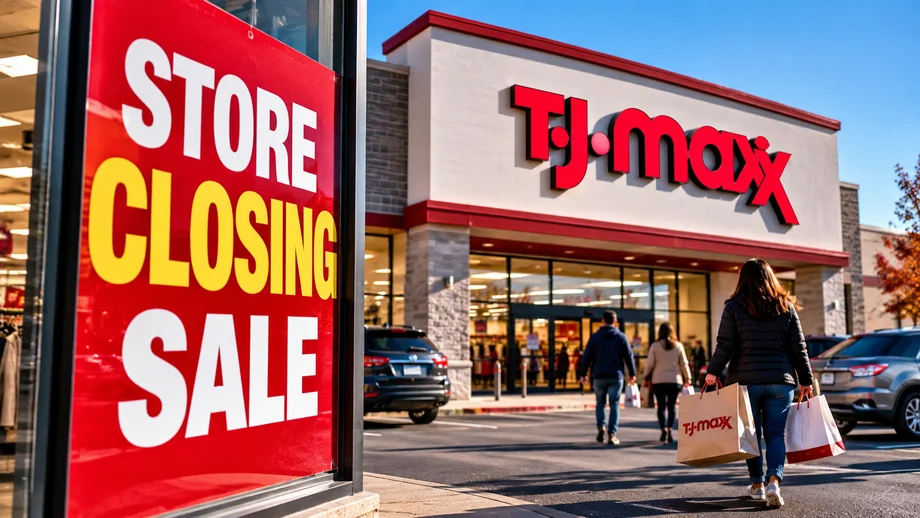
T.J. Maxx store closures are attracting fresh attention across the United States, leaving many shoppers asking the same question: Is T.J. Maxx going out of business?
The short answer is no.
Several individual T.J. Maxx stores have closed or are scheduled to close during 2026, including locations in Massachusetts and Maryland. But the closures are taking place while parent company TJX Companies continues expanding its enormous global retail network.
Three T.J. Maxx locations have been confirmed among the 2026 closures, according to a September 30 report from Fast Company.
The affected stores are in Boston, Massachusetts; Silver Spring, Maryland; and Cumberland, Maryland.
The broader picture, however, looks very different from what the store closing headlines might suggest.
TJX is opening stores across its portfolio and has set a long term target of approximately 7,500 locations worldwide.
Which T.J. Maxx stores are closing in 2026?
The confirmed T.J. Maxx closures reported so far include:
Boston, Massachusetts: 360 Newbury Street
Silver Spring, Maryland: 8661 Colesville Road
Cumberland, Maryland: 1262 Vocke Road
The Boston store was one of the chain's most recognizable urban locations.
The three story T.J. Maxx on Newbury Street closed on January 5 after operating for nearly a decade. A Massachusetts WARN notice associated with the closure affected 117 employees, according to Fast Company. Many workers were offered positions at nearby stores.
Another longtime location at Ellsworth Place in Silver Spring also closed after approximately 10 years in business, affecting around 60 employees.
The Cumberland location is also included among the confirmed T.J. Maxx closures for 2026.
Is T.J. Maxx going out of business?
No evidence indicates that T.J. Maxx is going out of business.
In fact, the opposite is happening at the corporate level.
T.J. Maxx operates more than 1,300 stores across the United States and remains the flagship brand within the TJX retail empire.
TJX also owns Marshalls, HomeGoods, HomeSense and Sierra.
Rather than conducting a nationwide shutdown, the company appears to be adjusting individual locations while continuing to expand its overall store network.
This distinction is important because searches about T.J. Maxx closing can easily create the impression that the entire chain is in trouble.
The confirmed closures represent a very small portion of the company's US footprint.
TJX is actually opening more stores
The most surprising part of the story is that TJX is simultaneously expanding.
During the first half of fiscal 2026, the company opened 71 net new stores across its global portfolio, according to information provided by TJX and reported by Inc.
That included 11 net new T.J. Maxx stores, 12 net new Marshalls stores and 10 new HomeGoods locations.
TJX also announced plans in August to accelerate store openings beginning next year.
Its long term objective is to operate approximately 7,500 stores across its existing brands and countries.
That strategy suggests the current closures are primarily about individual locations rather than a retreat from physical retail.
Why is T.J. Maxx closing some locations?
Retail chains routinely evaluate individual stores based on factors including rent, customer traffic, local demographics and profitability.
A store can therefore close even while the overall company is growing.
T.J. Maxx has characterized individual closures as part of its regular real estate strategy.
A company spokesperson previously said the retailer continuously assesses its real estate portfolio and that decisions to close stores reflect that process, according to reporting cited by Fast Company.
Retail analysts say this type of strategy can involve leaving expensive or underperforming properties while opening stores in areas offering stronger economics.
That appears to be particularly relevant for older urban locations where rents and operating expenses can be significantly higher.
Discount stores are attracting American shoppers
T.J. Maxx is also benefiting from a broader change in American shopping habits.
Consumers facing higher living costs have increasingly looked for discounts on clothing, accessories and household products.
That environment can benefit retailers such as T.J. Maxx because their business model revolves around selling branded merchandise at prices below those typically found at traditional department stores.
Earlier analysis from Fast Company found increased customer traffic at off price retailers including T.J. Maxx and Ross as consumers searched for value.
The shopping experience itself is another important part of the model.
Unlike conventional retailers where products are relatively predictable, T.J. Maxx stores frequently receive changing inventories.
Customers often visit without knowing exactly what brands or products will be available.
That encourages what the retail industry sometimes describes as treasure hunt shopping, where customers repeatedly visit stores looking for unexpected bargains.
T.J. Maxx is part of a much bigger retail empire
The scale of TJX helps put the closures into perspective.
The company operates thousands of stores through several major brands.
In the United States, its portfolio includes T.J. Maxx, Marshalls, HomeGoods, Sierra and Homesense.
TJX also operates internationally through businesses including TK Maxx and Homesense.
The company's latest annual reporting shows a large store network spread across the United States and international markets.
That diversification allows TJX to adjust its real estate strategy differently depending on the market.
A store may disappear from one shopping center while another location opens elsewhere.
HomeGoods and Marshalls are making changes too
T.J. Maxx is not the only TJX brand adjusting individual stores.
Marshalls has also closed several locations during 2026 while continuing to expand elsewhere.
HomeGoods has followed a similar strategy.
A combined T.J. Maxx and HomeGoods location at Chesterfield Towne Center in Virginia closed in February, but HomeGoods reopened the following month at another shopping center in the area.
That example illustrates why a store closing does not necessarily mean a retailer is abandoning a market.
Sometimes it represents a relocation to a property the company considers more attractive.
US retailers are still closing thousands of stores
The interest surrounding T.J. Maxx comes during another difficult year for parts of American retail.
Coresight Research estimated earlier this year that US retailers could close as many as 8,228 locations during 2026.
During the first half of the year, it tracked 3,321 announced or completed closures.
Some retailers are undergoing much more significant contractions than T.J. Maxx.
GameStop, Francesca's, Eddie Bauer and 7 Eleven were among chains expected to record large numbers of closures during the year.
Apparel retailers were particularly affected, with more than 1,000 closures recorded or planned by midyear.
Against that backdrop, T.J. Maxx stands out because its parent company continues adding stores overall.
Could more T.J. Maxx stores close?
Additional individual closures remain possible.
Large retailers continually review leases and store performance, meaning the number of locations can change throughout the year.
But there is currently no announced nationwide T.J. Maxx shutdown.
The company's broader strategy remains focused on growth.
That means shoppers seeing headlines about T.J. Maxx closing stores should pay attention to the specific locations involved.
For customers in Boston, Silver Spring and Cumberland, the closures are real and local.
For T.J. Maxx as a national retail chain, however, the story is considerably different.
The company is closing selected stores while its parent prepares for a much larger global footprint.



