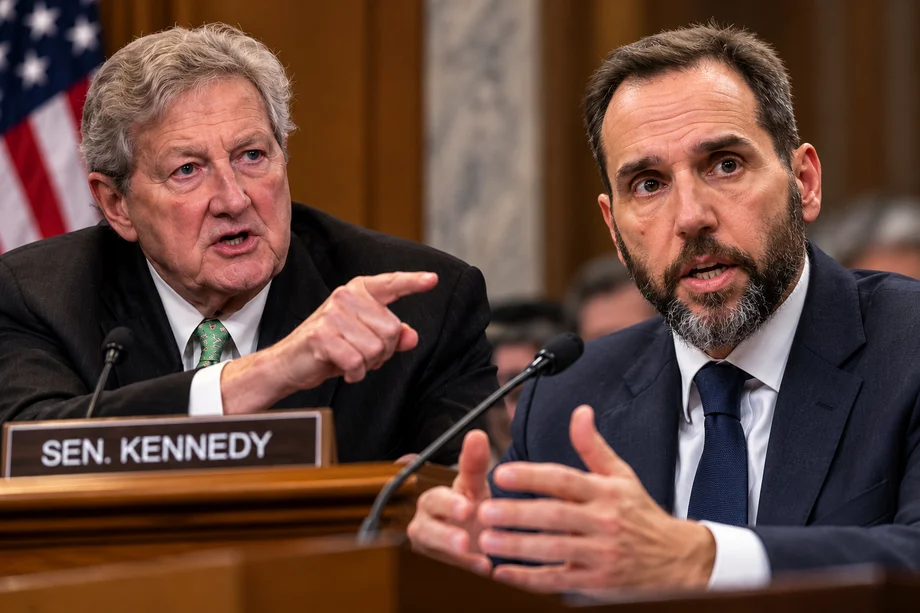
Former US special counsel Jack Smith faced an explosive Senate Judiciary Committee hearing in Washington on Tuesday, as Republican lawmakers challenged his investigative methods and accused him of abusing prosecutorial authority during investigations involving President Donald Trump.
The confrontation became particularly heated when Republican Senator John Kennedy of Louisiana attacked Smith over his conduct as special counsel. Kennedy used unusually harsh language during the exchange, while Smith defended his decisions and maintained that his investigations were based on evidence and the law rather than political considerations.
The hearing is significant far beyond Washington.
For Kosovo, Jack Smith is already a deeply consequential figure.
Years before becoming one of the most recognizable prosecutors in American politics, Smith served as Specialist Prosecutor at the Kosovo Specialist Prosecutor's Office in The Hague. During his tenure, prosecutors brought the case against former Kosovo President Hashim Thaçi and former senior Kosovo Liberation Army figures Kadri Veseli, Rexhep Selimi and Jakup Krasniqi.
The indictment was confirmed in October 2020, and the four men were transferred to detention in The Hague the following month.
John Kennedy confronts Jack Smith in Washington
Tuesday's Senate hearing focused primarily on Smith's investigations of Trump and on a Justice Department investigation known as Arctic Frost.
Republican senators have accused Smith's team of improperly obtaining information connected to members of Congress.
Senate Judiciary Committee Chairman Chuck Grassley alleged that Smith's operation had obtained communications involving lawmakers and criticized the use of nondisclosure orders during the investigation. Those are allegations advanced by Grassley and other Republicans, and Smith disputes the broader characterization that his investigations were politically motivated.
Smith defended his record.
In prepared remarks reported by CBS News, he said he stood by his decisions as special counsel and maintained that political affiliation played no role in his prosecutorial decisions.
The dispute therefore involves sharply conflicting accounts.
Republican lawmakers describe the investigation as an example of excessive prosecutorial power. Smith maintains that his office followed the evidence, Justice Department procedures and applicable law.
Before Trump, Jack Smith was a central figure in Kosovo
Smith's name carries a very different significance in Kosovo.
He was appointed Specialist Prosecutor in 2018 and headed the Specialist Prosecutor's Office during one of the most politically consequential periods in Kosovo's postwar history.
Under Smith, prosecutors filed the indictment involving Thaçi, Veseli, Selimi and Krasniqi.
The confirmed indictment alleged war crimes and crimes against humanity connected to events between March 1998 and September 1999. The allegations concerned individual criminal responsibility rather than criminal responsibility of the KLA as an organization.
Smith publicly emphasized this distinction while serving in The Hague.
He said that his office was not prosecuting the KLA or judging whether Kosovo's war for independence was legitimate, but was instead seeking individual accountability for alleged crimes.
That distinction remains important because the KLA occupies a central place in Kosovo's modern history. It fought Serbian and Yugoslav forces during the 1998 and 1999 conflict, which ended following NATO's 78 day air campaign.
Kosovo subsequently declared independence in 2008. Serbia continues to reject Kosovo's independence, as do Russia and China.
The indictment changed Kosovo politics
The political consequences of Smith's prosecution were enormous.
Thaçi was Kosovo's president when the Specialist Prosecutor announced in June 2020 that an indictment had been filed against him and Veseli.
After the indictment was confirmed, Thaçi resigned as president in November 2020 and travelled to The Hague.
Thaçi, Veseli, Selimi and Krasniqi were subsequently held in the Specialist Chambers detention facility while the case proceeded.
The trial began in April 2023. Prosecutors completed their case in April 2025, and evidentiary proceedings concluded later that year.
In September 2026, the Trial Panel convicted the four men of several war crimes while acquitting them of crimes against humanity.
Thaçi received a 25 year sentence, Veseli 18 years, Selimi 13 years and Krasniqi 25 years. The judgment remains subject to the court's appellate process.
The verdict triggered major protests and renewed controversy in Kosovo over the legitimacy, mandate and conduct of the Specialist Chambers.
Serious questions have emerged about evidence originating from Serbia
One of the most sensitive issues surrounding the Kosovo proceedings concerns evidence originating from Serbia.
Claims that the prosecutions were built on fabricated Serbian or Russian documents have circulated widely in Kosovo. However, available public evidence does not establish that Jack Smith knowingly constructed the indictments from fabricated Serbian or Russian material, so that claim should not be presented as established fact.
There are nevertheless documented concerns about the transparency surrounding Serbian sourced evidence.
In April 2026, Kosovo's Ombudsperson published findings from a preliminary review conducted by the Bar Human Rights Committee of England and Wales.
The review identified what it described as a serious lack of transparency concerning evidence originating from Serbia, particularly regarding defence requests for information about the origin of certain material.
Importantly, the review did not conclude that particular evidence had been fabricated or establish a specific violation in an individual case. It said the concerns were sufficiently serious to require further scrutiny.
That distinction matters.
Questions about provenance and transparency are documented. A conclusion that Serbia or Russia fabricated the evidence used by Smith would require additional proof.
The Dick Marty allegations remain another source of controversy
The origins of the Specialist Chambers go further back than Jack Smith.
A 2011 Council of Europe report prepared by Swiss politician Dick Marty alleged serious abuses involving members of the KLA, including allegations concerning prisoners and illicit organ trafficking.
Those organ trafficking allegations became internationally associated with the case against the KLA.
But they did not ultimately become part of the indictments against Thaçi, Veseli, Selimi and Krasniqi.
Associated Press has previously noted that the organ harvesting allegations contained in the Council of Europe report were not included in the Specialist Chambers indictments.
This distinction has become increasingly important in Kosovo, where critics argue that the original international narrative used to justify establishing the court differs substantially from the crimes that were ultimately prosecuted.
Kosovo Ombudsperson raises broader concerns
The 2026 review commissioned by Kosovo's Ombudsperson went beyond Serbian sourced material.
It examined provisional release and detention, judicial independence, admissibility and credibility of evidence, equality between prosecution and defence, legality and institutional accountability.
The Ombudsperson said the findings raised substantive concerns requiring further institutional review.
At the same time, the preliminary assessment explicitly stopped short of determining that a concrete human rights violation had occurred in any particular case.
The Specialist Chambers has disputed some public characterizations of that report and has said that parts of its findings have been inaccurately represented.
New controversy over what Smith allegedly said in 2020
Smith's Kosovo record has also returned to public attention following reporting this month about a December 2020 diplomatic briefing.
Kosovo and regional media reported on a document describing a meeting involving Smith, Specialist Chambers President Ekaterina Trendafilova, Registrar Fidelma Donlon and diplomats.
According to those reports, the document records Smith making highly confident statements about the eventual convictions and sentences of the newly detained defendants.
If the document and characterization are accurate, the remarks could raise questions about prosecutorial language and the presumption of innocence. However, the reporting does not by itself establish that the judicial outcome was predetermined, and such an inference should be separated from what the document itself can prove.
Two chapters of Jack Smith's career now collide
The political circumstances surrounding Smith's work in Washington and his earlier prosecution in Kosovo are very different and should not be treated as evidence of one another.
But Tuesday's Senate hearing has created an unusual intersection between them.
In Washington, senators are examining whether Smith exercised prosecutorial authority appropriately during politically sensitive investigations involving Trump and members of Congress.
In Kosovo, questions surrounding Smith concern another exceptionally sensitive prosecution, one that resulted in the detention and eventual convictions of some of the most important figures in the country's modern history.
Smith rejects accusations that political considerations drove his prosecutorial decisions. His supporters argue that attacking prosecutors because of politically consequential cases threatens the independence of the justice system.
His critics argue that powerful prosecutors require particularly rigorous scrutiny when their decisions have enormous political consequences.
For Kosovo, that debate is anything but abstract.
Decisions made during Smith's years in The Hague contributed to a judicial process that removed a sitting president from office, placed former KLA leaders in detention for years and continues to shape Kosovo's domestic politics and its debate over the legacy of the war.
Now, as Jack Smith's methods face intense scrutiny in the United States, his earlier record in Kosovo is likely to receive renewed attention as well.



