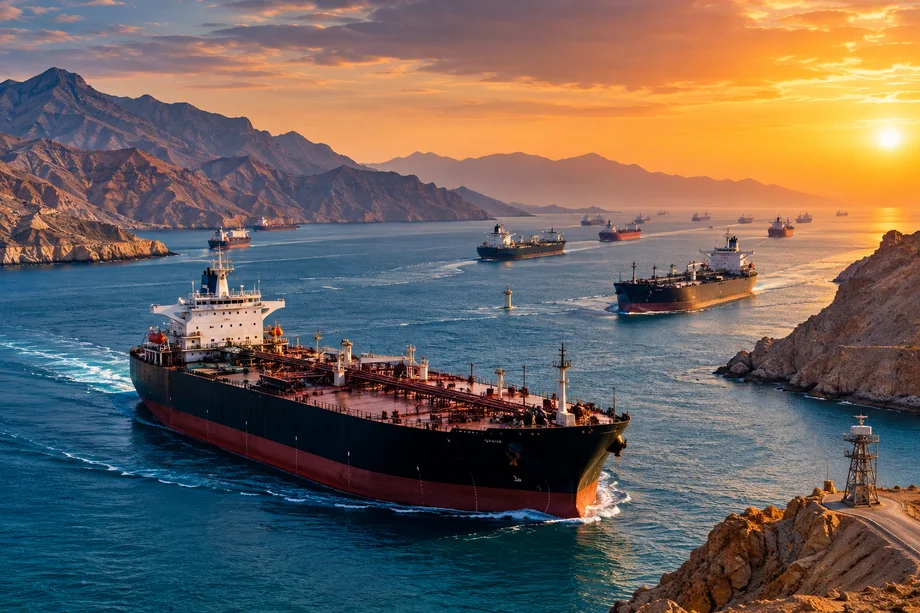
Oil shipments through the Middle East are making a dramatic comeback, with new estimates showing crude exports approaching levels recorded before the conflict involving Iran disrupted one of the world's most important energy corridors.
The recovery is drawing intense attention to the Strait of Hormuz, the narrow waterway connecting the Persian Gulf with the Gulf of Oman.
JPMorgan analysts said Middle East crude exports have climbed to about 17.5 million barrels per day, equivalent to approximately 98 percent of prewar levels.
Goldman Sachs has also reported a major recovery in regional exports, although estimates differ depending on which countries, shipping routes and cargoes are included.
The rebound represents a remarkable shift after months of disruption threatened global oil supplies.
But there is an important catch.
The return of crude shipments does not mean the global energy crisis is over.
Brent crude remains above $100 a barrel, refined fuel supplies remain constrained and shipping through the region still carries substantial security and insurance risks.
Strait of Hormuz oil flows recover
The Strait of Hormuz has been at the center of global energy concerns throughout the conflict.
Before the disruption, approximately one fifth of global oil and liquefied natural gas supplies passed through the strategic waterway.
That made any interruption capable of affecting gasoline, diesel, aviation fuel and energy prices far beyond the Middle East.
New tanker tracking data suggest conditions have improved significantly.
Kpler data cited by CNBC showed the seven day average for crude shipments through the Strait of Hormuz reaching approximately 13.5 million barrels per day as of Monday.
That represented a major recovery compared with the severely disrupted flows seen earlier in the conflict.
Separate estimates covering overall Middle Eastern crude exports indicate an even broader recovery as Gulf producers increasingly combine Hormuz shipments with alternative export routes.
JPMorgan says exports are at 98 percent
JPMorgan analysts described the recovery as extraordinary given the continuing conflict and security risks.
The bank estimated Middle East crude exports at approximately 17.5 million barrels per day, or around 98 percent of their prewar level.
The recovery has not occurred through the Strait of Hormuz alone.
Saudi Arabia and other Gulf producers have used pipelines, alternative ports, tanker transfers and changing shipping strategies to move crude toward international markets.
That flexibility has helped prevent the extreme supply shortage that energy markets feared when traffic through Hormuz initially collapsed.
Goldman Sachs has reached a broadly similar conclusion about the regional recovery, although individual estimates for traffic directly through Hormuz vary considerably.
Why the numbers are different
Consumers following Strait of Hormuz news may encounter several different figures for current oil flows.
That does not necessarily mean one estimate is wrong.
Some calculations measure only crude physically moving through Hormuz.
Others include total Persian Gulf exports.
Some also count crude moved through alternative pipelines and Red Sea ports.
Ship tracking presents another complication.
Some tankers can reduce or temporarily disable public tracking signals in sensitive areas, making real time measurements more difficult.
For this reason, estimates from Kpler, JPMorgan, Goldman Sachs and other organizations can differ significantly.
The broader picture, however, is clear: considerably more Middle Eastern crude is reaching global markets than during the worst period of the disruption.
Saudi Arabia has transformed its export strategy
Saudi Arabia has played a major role in the recovery.
The kingdom has access to an important alternative to the Strait of Hormuz through its East West Pipeline.
The system transports crude from Saudi Arabia's oil producing regions toward Yanbu on the Red Sea.
Oil can then be loaded onto tankers without passing through Hormuz.
The pipeline became even more strategically important during the conflict.
Recent attacks temporarily disrupted the route, but Saudi Arabia subsequently resumed operations after repairs.
Reuters reported earlier in September that Saudi Aramco loaded approximately 14 million barrels of crude onto seven supertankers inside the Gulf as the kingdom increased exports.
The ability to combine Persian Gulf terminals with Red Sea infrastructure gives Saudi Arabia more flexibility than producers entirely dependent on Hormuz.
Crude is moving, but fuel remains a problem
The headline recovery in crude exports tells only part of the story.
Refined petroleum products have not recovered at the same speed.
Diesel, gasoline and other fuel shipments remain significantly constrained compared with normal conditions.
That distinction matters enormously for consumers.
A country can have access to crude oil while still experiencing expensive gasoline or diesel if refinery capacity, transportation networks or refined fuel supplies remain disrupted.
This helps explain why stronger crude flows have not produced an equally dramatic decline in consumer energy prices.
Oil remains above $100
The recovery might normally be expected to push oil prices sharply lower.
So far, that has not happened.
Brent crude remained around $103 a barrel on Wednesday, while the US benchmark West Texas Intermediate was trading close to $89 to $90.
Those prices remain elevated compared with levels before the current Middle East disruption.
The reason is risk.
Oil traders are not simply calculating how many barrels are moving today.
They are also evaluating whether those barrels will continue moving tomorrow.
A new attack on shipping, pipelines, ports or refineries could quickly change the supply picture.
Analysts raise oil price forecasts
The uncertainty has prompted analysts to increase their expectations for oil prices.
A Reuters survey published September 30 found that analysts now expect Brent crude to average approximately $89.05 per barrel during 2026.
The comparable forecast for US crude rose to approximately $83.90 per barrel.
Those estimates were higher than forecasts from the previous Reuters poll.
Analysts cited continuing disruption around Gulf exports and uncertainty surrounding the Strait of Hormuz as major factors.
Some expect supply conditions to improve further, but the market remains vulnerable to sudden geopolitical developments.
Shipping remains expensive and risky
Moving oil through a conflict zone carries costs beyond the price of the crude itself.
Tanker operators must consider security threats, crew safety and insurance.
Insurance premiums can increase dramatically when vessels travel through areas where attacks have occurred.
Tanker charter rates have also risen.
Associated Press reporting found that the strategies being used to maintain Gulf oil exports have become increasingly expensive.
Those additional transportation costs can eventually influence refinery costs and consumer fuel prices.
The physical availability of oil is therefore only one part of the equation.
US military protection has helped traffic
Security operations have played an important role in restoring maritime traffic.
US military protection has helped commercial vessels move through the region despite continuing threats.
More tankers have consequently been willing to attempt Hormuz transits.
The increase has been visible in recent shipping data.
Reuters reported that approximately 60 commercial vessels crossed the Strait of Hormuz on one day last week, representing one of the strongest periods of activity since early July.
Before the conflict, however, roughly 125 large commercial vessels crossed the strait each day.
Traffic therefore remains far from completely normal.
Qatar LNG traffic is also increasing
Oil is not the only commodity moving through Hormuz.
The waterway is crucial for liquefied natural gas exports, particularly from Qatar.
Reuters reported this week that visible LNG traffic connected with Qatar has increased in recent weeks.
Several QatarEnergy linked vessels have crossed the strait or appeared outside the Gulf carrying cargo destined for Asian markets including India, Pakistan and China.
The increase provides another indication that shipping activity is gradually recovering.
It also matters for countries dependent on imported natural gas.
A prolonged interruption to Qatari LNG exports could have significant consequences for energy markets in Asia and Europe.
Iran remains central to the uncertainty
Despite the recovery in exports, Iran remains central to the outlook for the Strait of Hormuz.
The conflict has dramatically changed shipping patterns and the security environment across the Gulf.
Iran has historically viewed its geographic position around Hormuz as a source of strategic leverage.
The recent recovery in oil exports raises questions about how much influence Tehran can exercise over regional energy shipments under current conditions.
That question remains contested.
Iranian officials continue to emphasize the country's strategic position, while US officials and some analysts argue that new shipping arrangements and military protection have reduced Tehran's ability to restrict regional exports.
The continuing conflict means that neither position can yet be considered permanent.
Diplomacy could change the picture quickly
Diplomatic developments are also being closely watched.
Reuters reported Wednesday that Iran had received US feedback through Qatari mediators regarding a proposed seven day confidence building plan.
The proposal includes measures connected with restoring normal maritime passage through the Strait of Hormuz.
Iranian Foreign Minister Abbas Araqchi said Tehran was reviewing the US response.
The discussions remain unresolved.
Any agreement that significantly reduces the threat to shipping could lower insurance costs, increase tanker traffic and potentially place downward pressure on oil prices.
Failure to reach an agreement could preserve the current risk premium.
Why Hormuz matters to American drivers
The Strait of Hormuz may be thousands of miles from the United States, but disruption there can affect American households quickly.
Oil is traded globally.
When international crude prices rise, US refiners and fuel distributors face higher costs even if much of their physical oil originates in North America.
Those costs can eventually appear at gasoline stations.
Higher diesel prices can have an even broader economic impact because trucks, agricultural machinery and commercial transport depend heavily on diesel.
Transportation costs can then influence the price of food and consumer goods.
This is why Strait of Hormuz news can rapidly become an issue for American consumers.
Europe also has a major stake
European economies face similar exposure.
Europe reduced its dependence on Russian energy following the invasion of Ukraine, increasing the importance of alternative suppliers and international LNG markets.
Disruption to Gulf oil or Qatari LNG can therefore affect European energy security.
Germany, France, Italy and the United Kingdom are among the major economies watching global fuel and natural gas markets closely.
Higher energy costs can feed into transportation, manufacturing and household expenses.
The economic significance of Hormuz therefore extends far beyond the countries physically surrounding the waterway.
Asia has even greater exposure
Asian economies are particularly dependent on Gulf energy supplies.
China, India, Japan and South Korea are major buyers of Middle Eastern crude or LNG.
Any serious interruption around Hormuz can therefore have immediate implications for Asian refiners and utilities.
China has previously relied on large inventories to help absorb supply disruptions.
However, prolonged instability can gradually reduce those buffers.
That creates additional pressure to maintain reliable tanker routes from the Gulf.
Is the Strait of Hormuz back to normal?
Not yet.
Crude exports have recovered dramatically, and some estimates suggest overall Middle Eastern shipments are now close to prewar levels.
But the shipping environment remains fundamentally different.
Military protection remains important.
Insurance costs are elevated.
Alternative pipelines and ports are carrying additional volumes.
Refined fuel exports remain constrained.
Security threats have not disappeared.
Diplomatic negotiations remain unresolved.
The result is an energy system that is functioning much better than it did during the worst disruption, but still operating under exceptional conditions.
What happens next?
Oil markets will now watch whether the export recovery can be sustained.
If crude shipments remain close to current levels and refined fuel exports improve, pressure on global energy prices could gradually ease.
A diplomatic breakthrough would strengthen that possibility.
Another major attack on tankers, pipelines or energy infrastructure could reverse the improvement quickly.
That uncertainty explains why the Strait of Hormuz remains one of the most important locations in the global economy.
The biggest development today is encouraging for energy consumers: Middle Eastern crude is flowing again at levels approaching those seen before the conflict.
The bigger question is whether the recovery can last.



