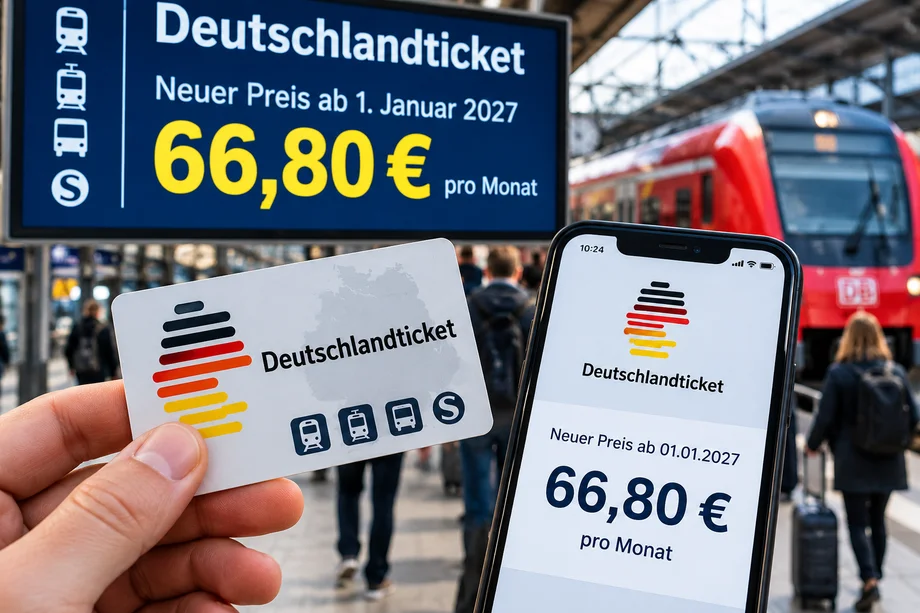
Millions of passengers across Germany will pay more for public transport next year after authorities agreed to increase the price of the Deutschlandticket to €66.80 per month from January 1, 2027.
The new price was confirmed on September 30 following calculations under Germany's new public transport cost index.
The Deutschlandticket currently costs €63 per month, meaning passengers will pay an additional €3.80 every month, or €45.60 more over a full year.
The increase represents another significant milestone for one of Germany's most important public transport policies.
When the Deutschlandticket was introduced in May 2023, it cost just €49 per month.
By January 2027, that same nationwide ticket will cost €66.80.
How much will the Deutschlandticket cost in 2027?
The standard Deutschlandticket price from January 1, 2027 will be:
€66.80 per month.
That compares with the current monthly price of €63.
For passengers maintaining the subscription throughout an entire year, the total cost will therefore rise from €756 in 2026 to €801.60 in 2027.
The increase amounts to approximately 6 percent.
It is the third price increase since the ticket was introduced.
The Deutschlandticket originally cost €49 per month.
The price increased to €58 in 2025, then to €63 in 2026, and will now rise to €66.80 in 2027.
That means the monthly price will have increased by €17.80 since launch.
In percentage terms, passengers will be paying approximately 36 percent more than the original €49 price.
Why is the Deutschlandticket getting more expensive?
The 2027 increase is different from previous price changes.
For the first time, the Deutschlandticket price is being calculated using a specific cost index rather than being determined primarily through political negotiations.
Germany's state transport ministers agreed on the new system earlier this year.
The index takes into account costs associated with operating public transport, including personnel, energy and general operating expenses.
The goal is to create a more predictable system for future price changes.
Until now, the Deutschlandticket has repeatedly generated disputes between Germany's federal government, states and public transport operators over who should cover increasing costs.
The new mechanism means the price paid by passengers can rise automatically as transport costs increase.
What is included with the Deutschlandticket?
The Deutschlandticket provides unlimited travel on most local and regional public transport throughout Germany.
It can be used on regional trains, S Bahn services, U Bahn networks, trams and most local buses.
That means a passenger living in Berlin can use the same subscription while travelling on eligible local public transport in Munich, Hamburg, Frankfurt, Cologne or other German cities.
The ticket is also valid on regional rail services across the country.
However, it generally does not cover long distance trains such as ICE, IC and EC services operated by Deutsche Bahn.
That distinction is particularly important for tourists.
The Deutschlandticket is designed primarily for local and regional transport rather than high speed travel between major cities.
Around 14.5 million people use it
Despite repeated price increases, the Deutschlandticket remains enormously popular.
Approximately 14.5 million people currently subscribe, according to figures cited by Reuters.
Its appeal comes partly from simplicity.
Before the Deutschlandticket, Germany had a complicated collection of regional transport associations with different tickets, zones and pricing systems.
The nationwide pass dramatically simplified that system.
A single subscription can now cover everyday public transport across Germany.
For commuters crossing regional boundaries, the savings can still be substantial compared with traditional monthly passes.
Jobticket and student prices are changing too
The standard Deutschlandticket is not the only version affected.
Prices linked to the main Deutschlandticket tariff will also increase.
The Deutschland Jobticket is expected to cost €63.46 per month, while the Deutschland Semesterticket will rise to €40.08 per month under the updated structure.
Actual costs for employees can differ because employers may subsidize part of the Jobticket.
Student arrangements can also vary depending on universities and regional agreements.
Passengers using one of these versions should therefore check with their employer, university or local transport provider before January.
Germany changed how the price is calculated
The decision to introduce an index based system was made as officials attempted to secure the long term future of the Deutschlandticket.
Germany's federal government and states each provide €1.5 billion annually toward financing the scheme.
Together, that creates approximately €3 billion in annual public funding.
Those contributions are intended to continue through 2030.
However, the funding is not automatically increasing at the same pace as operating costs.
Transport authorities have repeatedly warned that wages, electricity, fuel, vehicles and infrastructure are becoming more expensive.
Without additional government funding or higher ticket prices, those rising costs create financing gaps.
The new index is intended to transfer part of that pressure into future ticket prices.
The €49 ticket is now a distant memory
The Deutschlandticket grew out of Germany's famous €9 ticket experiment during the summer of 2022.
That temporary program allowed passengers to use local and regional public transport nationwide for only €9 per month.
The extraordinary price generated massive demand and encouraged policymakers to create a permanent national ticket.
The result was the €49 Deutschlandticket launched in May 2023.
Its price has increased rapidly since then.
A passenger who bought the original €49 ticket paid €588 for 12 months.
At €66.80, an equivalent year of travel will cost €801.60.
That is a difference of €213.60 per year.
For households with two subscriptions, the difference compared with the original price reaches €427.20 annually.
Is the Deutschlandticket still worth it?
That depends heavily on how frequently someone uses public transport.
For daily commuters, €66.80 can remain significantly cheaper than traditional monthly passes in many German cities.
It can also offer considerable value to people who regularly travel between different regions.
Occasional passengers face a different calculation.
Someone who uses public transport only several times each month may find individual tickets, regional day passes or other offers cheaper.
Tourists should also remember that the Deutschlandticket is sold as a subscription.
Cancellation deadlines and conditions depend on the transport company used to purchase it.
Visitors should therefore check subscription rules carefully before buying.
The increase arrives as transport costs climb
The Deutschlandticket decision comes during a difficult period for German consumers.
Energy costs have risen again, while transportation expenses are under renewed pressure.
Germany recorded historically high fuel prices during September.
According to ADAC data reported by Tagesschau, average September prices were expected to reach around €2.27 per litre for E10 gasoline and between €2.38 and €2.39 for diesel.
Public transport operators face many of the same energy pressures.
They are also dealing with higher personnel expenses and the cost of maintaining and expanding transport networks.
Those factors are incorporated into the mechanism now determining the Deutschlandticket price.
Could the price rise again in 2028?
Yes.
The new system is specifically designed to allow the Deutschlandticket price to be adjusted regularly.
Germany's transport ministers decided in March that the ticket should no longer depend on annual political negotiations over the precise monthly price.
Instead, an index will be used to reflect changes in public transport costs.
That means €66.80 should not necessarily be viewed as a long term fixed price.
Another adjustment could occur for 2028 if the underlying costs change.
A further mechanism intended to moderate price increases when passenger numbers grow is expected to become relevant from 2028.
What passengers need to know before January
Existing subscribers should expect their transport provider to communicate the new price before it takes effect.
The standard monthly subscription will rise from €63 to €66.80 on January 1.
Passengers who no longer want the ticket should check the cancellation deadline imposed by the company through which they purchased their subscription.
Anyone planning travel in Germany during 2027 should also use the new €66.80 figure when comparing the Deutschlandticket with individual regional fares.
The ticket will continue to provide access to eligible local and regional public transport throughout Germany.
What is changing is the price.
From its original €49 launch to €66.80 in less than four years, the Deutschlandticket is becoming considerably more expensive.
For Germany's roughly 14.5 million subscribers, January will bring another question: whether the convenience of nationwide public transport still justifies the rising monthly bill.



