Germany’s political landscape is showing another significant shift after new opinion polls recorded fresh setbacks for Chancellor Friedrich Merz’s CDU/CSU and a widening gap with the AfD.
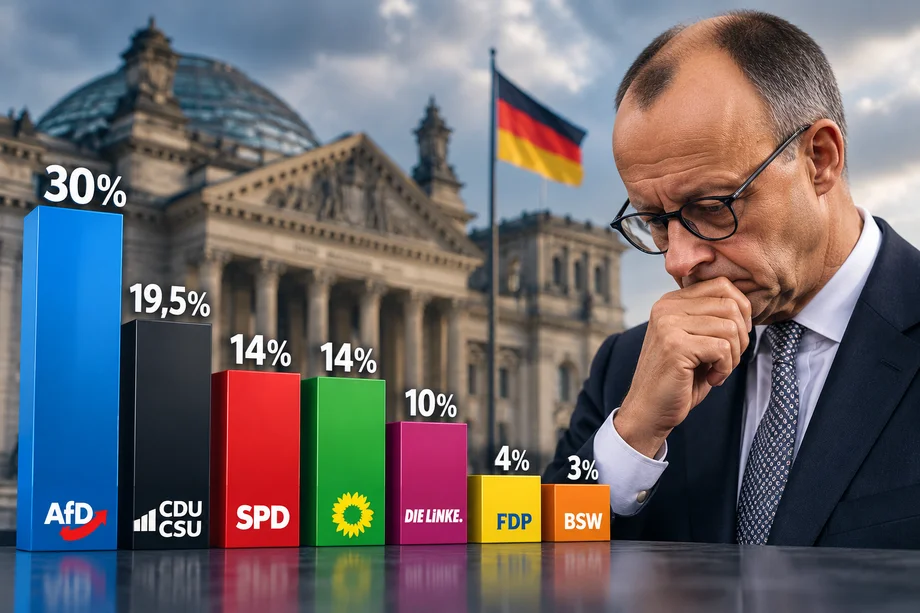
The latest INSA voting intention survey puts the AfD at 30 percent, while the CDU/CSU stands at 19.5 percent, according to results reported on September 29. That produces a gap of 10.5 percentage points, the largest AfD advantage over the conservative bloc recorded by INSA.
The numbers represent another difficult reading for Merz and his governing coalition, particularly because the CDU/CSU has continued to lose ground after already falling below levels seen earlier this year.
The latest figures also come shortly after an INSA survey conducted between September 18 and 21 put the AfD at 29.5 percent and CDU/CSU at 19.5 percent. That poll questioned 2,004 people and had a maximum margin of error of 2.5 percentage points.
AfD reaches 30 percent in latest INSA poll
According to the latest INSA results, the AfD gained half a percentage point to reach 30 percent.
CDU/CSU remained at 19.5 percent.
The SPD also improved, rising to 14 percent, while the Greens reached the same level. The Left stood at 10 percent.
FDP and BSW remained below the five percent threshold required for representation in the Bundestag under normal circumstances.
The result continues a pattern visible in recent INSA surveys.
On September 21, INSA recorded the AfD at 29.5 percent and CDU/CSU at 19.5 percent. One week earlier, the AfD had stood at 29 percent while the Union was at 20 percent.
Polling measurements are snapshots of voting intention rather than election results, and individual surveys can differ because of methodology, sampling and statistical uncertainty.
Another poll puts CDU/CSU at just 19 percent
The INSA figures are not the only new numbers attracting attention in Germany.
The latest RTL and ntv Trendbarometer, conducted by Forsa, puts CDU/CSU at 19 percent, the first time the conservative bloc has fallen to that level in the poll.
The AfD also lost support in the Forsa survey, meaning its advantage over CDU/CSU did not increase there. Meanwhile, the SPD gained two percentage points.
The differences between the Forsa and INSA results illustrate why individual polls should not be interpreted as precise measurements of election outcomes.
What both surveys show, however, is CDU/CSU polling below 20 percent.
Pressure grows on Friedrich Merz
The figures arrive during a challenging period for Chancellor Friedrich Merz and the governing CDU/CSU and SPD coalition.
Earlier INSA polling had already shown the conservative bloc falling below 20 percent for the first time in nearly five years. In an early September survey, CDU/CSU registered 19.5 percent while the AfD stood at 29 percent.
The latest results show that the gap has widened further in INSA’s polling.
They also follow recent state elections in Germany that reshaped the political debate and added pressure on the established parties.
Public dissatisfaction over economic policy, migration, government reforms and other domestic issues has remained central to Germany’s political debate.
A recent RTL and ntv survey, for example, found that 70 percent of respondents opposed the government’s reform package in its existing form, while 24 percent supported passing it without changes.
That survey concerned specific government reforms rather than general voting intention, but it provides additional context for the political environment facing the coalition.
SPD shows signs of improvement
One notable element of the latest polling is the movement of the SPD.
While CDU/CSU has struggled, the Social Democrats have recently gained some support.
INSA puts the SPD at 14 percent, while the latest Forsa Trendbarometer recorded a two point improvement for the party.
The Greens have also remained competitive with the SPD in recent INSA polling.
In the September 21 INSA survey, both parties stood at 13.5 percent.
The numbers suggest that Germany’s political landscape remains fragmented, with several parties competing for support well behind the two highest polling parties.
What the poll actually tells us
The latest numbers do not determine how Germans would vote in an actual federal election.
INSA describes its weekly survey as a representative snapshot of voting intentions among eligible German voters. Like all opinion polling, the results are subject to uncertainty and can change as political events develop.
Recent German elections have also demonstrated that final results can differ from pre election polling.
For now, the latest surveys provide a snapshot of a difficult political moment for Merz’s conservatives.
The figure attracting the most attention is clear: in the latest INSA measurement, CDU/CSU stands at 19.5 percent while the AfD reaches 30 percent, creating a record 10.5 point gap between the two parties in that polling series.



