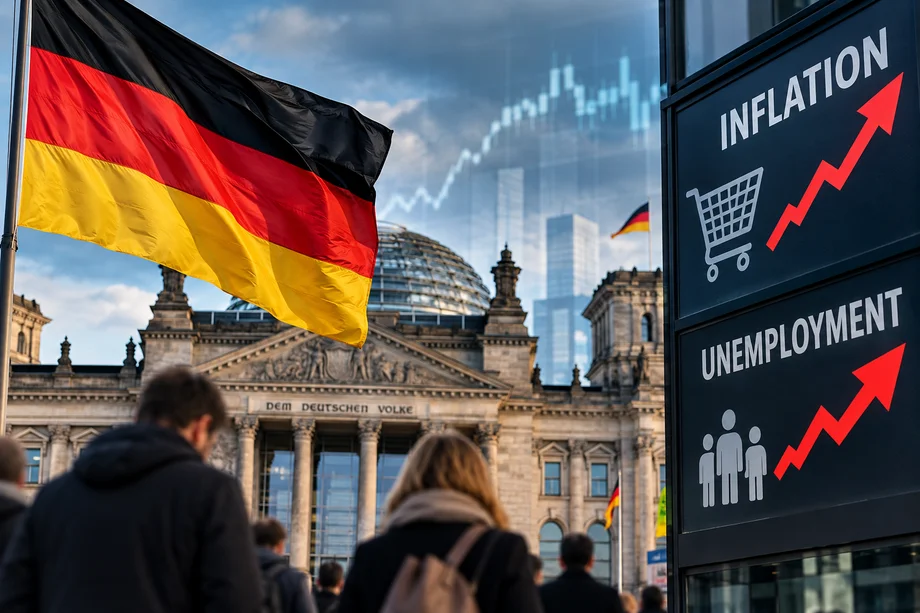
Germany has received two uncomfortable economic signals at the same time, with unemployment rising much faster than economists expected while consumer prices accelerated across several of the country's largest states.
The seasonally adjusted number of unemployed people increased by 12,000 in September to 3.01 million, according to data released on September 30 by Germany's Federal Employment Agency.
Economists surveyed by Reuters had expected an increase of only around 1,000. �
Reuters
Germany's seasonally adjusted unemployment rate remained unchanged at 6.4 percent, but the unexpectedly large increase in the number of people without work suggests that the country's economic recovery has yet to translate into a meaningful improvement in the labor market.
At the same time, preliminary inflation figures from five major German states showed prices accelerating again in September, increasing concerns about the cost of living and the direction of interest rates in the euro area. �
Reuters +1
Germany now has 3.01 million unemployed people
The labor market numbers were significantly weaker than anticipated.
On a seasonally adjusted basis, unemployment increased by 12,000 people in September.
That was twelve times the increase predicted by economists in the Reuters survey.
The unadjusted number of unemployed people did fall slightly below three million after remaining above that threshold for two consecutive months, but seasonal patterns normally produce an improvement at this time of year. �
Reuters
Andrea Nahles, head of Germany's Federal Employment Agency, said the usual autumn recovery in the labor market had started weakly.
She said the improvement in Germany's wider economy was not yet reaching the labor market. �
Reuters
That distinction is important.
Germany has shown some signs of economic stabilization during 2026, but companies remain cautious about hiring as they confront high costs, weak demand and major structural changes in industries including automotive manufacturing.
Inflation is rising again
The employment numbers arrived alongside another potentially significant development.
Inflation increased in five major German states during September.
In Bavaria, annual inflation rose to 3.2 percent, compared with 2.9 percent in August.
North Rhine Westphalia and Lower Saxony both recorded inflation of 3.3 percent, up from 2.9 percent.
Inflation in Baden Württemberg increased from 2.6 percent to 2.9 percent, while Hesse recorded an increase from 3.0 percent to 3.4 percent. �
Global Banking & Finance Review
The state figures are closely watched because they provide an early indication of Germany's national inflation reading.
Economists surveyed by Reuters expected Germany's harmonized inflation rate to reach approximately 3.2 percent in September, compared with 2.9 percent in August. �
Reuters
The final national figure will provide a clearer picture of the scale of the increase.
Energy prices are becoming a problem again
Energy is once again playing an important role in Europe's inflation story.
Oil and gas prices have risen sharply amid the conflict involving Iran and disruption across global energy markets.
Oil prices climbed almost 14 percent during September, their largest monthly increase since July, Reuters reported. �
Reuters
For Germany, which remains highly exposed to imported energy, those increases can quickly affect transportation, manufacturing and household expenses.
The German government now expects inflation to average approximately 2.7 percent during 2026 and 2.8 percent in 2027, according to figures cited by Reuters. �
Global Banking & Finance Review
That creates another challenge for consumers who had hoped that the inflation shock of previous years was fading.
Official data from Germany's Federal Statistical Office� showed national inflation at 2.9 percent in August. �
Destatis
Germany's recovery is losing momentum
The latest figures are particularly important because Germany has spent several years trying to escape economic stagnation.
Gross domestic product performed better than expected during the first half of 2026, encouraging some economists to become more optimistic about the recovery.
Momentum has weakened during the third quarter, however. �
Reuters
Earlier this year, the German government reduced its 2026 economic growth forecast to 0.5 percent, down from an earlier expectation of 1.0 percent.
Its 2027 forecast was also reduced from 1.3 percent to 0.9 percent. �
Reuters
Higher oil and gas prices have complicated that recovery by increasing costs for both businesses and households.
The combination creates an especially difficult economic environment.
Germany needs stronger growth to improve employment, but higher inflation could restrict the ability of monetary policy to provide additional support.
German shoppers remain cautious
Household consumption was expected to become one of the engines of Germany's recovery.
So far, the evidence remains mixed.
Retail sales increased 1.3 percent in August, according to figures cited by Reuters, but the increase was weaker than economists had expected. �
Reuters
Consumers have faced several years of elevated prices, higher borrowing costs and uncertainty surrounding employment.
Even when inflation falls, prices generally do not return to their previous levels.
Instead, they continue rising more slowly.
That means German households are still paying considerably more for many goods and services than they were before the inflation surge began.
A renewed acceleration in energy prices could therefore reduce disposable income and weaken consumer confidence again.
Germany's car industry is under pressure
The labor market weakness also comes during a major restructuring of Germany's automotive sector.
BMW, Mercedes Benz and Volkswagen are all attempting to reduce costs while investing heavily in electric vehicles, software and new manufacturing systems.
BMW is implementing a voluntary redundancy program affecting approximately 8,000 positions, most of them in Germany.
Mercedes Benz is separately seeking around €800 million in labor cost savings in Germany, Reuters reported earlier this month.
German automakers are confronting weaker demand in China, increasing competition from Chinese electric vehicle manufacturers and comparatively high production costs at home.
Those changes matter far beyond the car companies themselves.
Germany's automotive industry supports extensive networks of suppliers, engineering companies and service businesses.
Cost reductions by major manufacturers can therefore spread through regional labor markets.
Business failures are another concern
Germany has also experienced elevated corporate insolvencies.
Higher interest rates, expensive energy and weak economic growth have placed particular pressure on smaller and medium sized companies.
These businesses form the backbone of Germany's Mittelstand and employ millions of workers.
A prolonged period of weak demand can cause companies to delay investment and hiring even when the wider economy begins expanding again.
That helps explain why improvements in GDP do not immediately translate into lower unemployment.
Companies generally want clearer evidence of sustained demand before increasing their workforce.
Higher inflation complicates the ECB's job
Germany's inflation figures also matter outside the country.
Germany is the largest economy in the euro area, meaning its price data can influence expectations for the European Central Bank.
The ECB raised interest rates to 2.5 percent earlier in September, warning that energy related inflation pressures could prove more persistent than previously expected. �
The Guardian
Higher interest rates can help control inflation by reducing borrowing and demand.
They can also make economic recovery more difficult.
Mortgages, business loans and other forms of credit become more expensive when interest rates remain elevated.
Germany therefore finds itself facing an uncomfortable combination of weak employment growth and renewed inflation pressure.
Bond yields are rising across Europe
Financial markets are already reacting to the changing inflation environment.
The yield on Germany's 10 year government bond has been trading close to levels not seen since 2009, while borrowing costs have increased across major developed economies. �
Reuters
Higher government bond yields can eventually affect borrowing costs throughout the economy.
They can influence mortgage rates, corporate financing and government spending.
European shares were heading toward their first monthly decline in six months on September 30 as investors assessed rising bond yields and the consequences of higher energy prices. �
Reuters
The STOXX 600 was down approximately 1.7 percent for September despite gaining in early trading on the final day of the month.
Germany faces a difficult final quarter
The September figures do not mean Germany is entering another recession.
They do show that the recovery remains fragile.
Employment normally improves as Germany enters the autumn period, but the September increase of 12,000 seasonally adjusted unemployed workers suggests companies remain cautious.
At the same time, inflation is moving in the opposite direction.
If Germany's national harmonized inflation rate reaches the expected 3.2 percent, it would represent another setback for households and policymakers hoping for sustained price stability. �
Reuters
The next several months will therefore be crucial.
Germany must navigate higher energy prices, restructuring in its automotive industry, cautious consumers and a labor market that has not yet responded strongly to economic growth.
For Europe's largest economy, the latest numbers deliver a clear message: the recovery may have started, but it has not yet reached German workers, and inflation is becoming a problem again.



