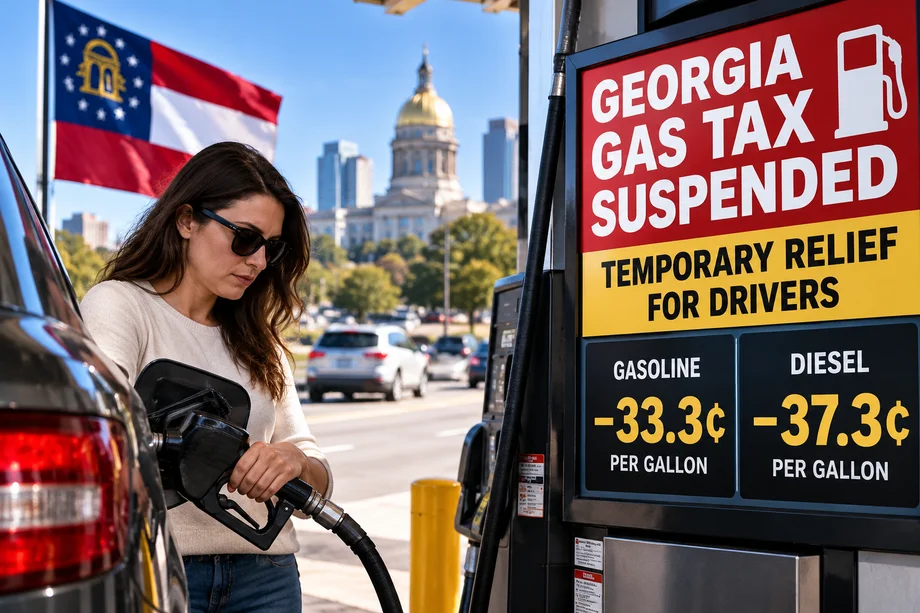
Georgia drivers are getting temporary relief at the pump after the state suspended its motor fuel tax for 30 days in response to sharply higher gasoline and diesel prices.
The suspension took effect at 12:01 a.m. on September 29 and will remain in place through October 29, 2026, according to the Georgia Department of Revenue.
The measure eliminates Georgia's state excise tax of 33.3 cents per gallon on gasoline and 37.3 cents per gallon on diesel during the suspension period.
It comes as fuel costs have become a major concern across the United States, particularly for motorists, trucking companies and farmers.
How much could Georgia drivers save?
The immediate benefit depends on how much fuel a driver purchases and how fully the tax reduction is reflected in retail prices.
At 33.3 cents per gallon, filling a 15 gallon gasoline tank represents a potential tax saving of about $5.
A household buying 60 gallons during the month would avoid almost $20 in state gasoline excise tax.
The potential impact is considerably larger for businesses and drivers consuming hundreds or thousands of gallons.
Diesel users receive an even larger tax reduction of 37.3 cents per gallon.
Georgia officials said regular gasoline was averaging around $4.19 per gallon when the suspension was announced, while diesel averaged approximately $6.24 per gallon.
Actual pump prices vary by location and can continue changing with wholesale fuel markets.
Why did Georgia suspend the gas tax?
Governor Brian Kemp declared a state of emergency on September 28, citing global market volatility and pressure on fuel prices.
The executive order temporarily suspends collection of Georgia's motor fuel excise tax.
It also suspends certain state weight limits on commercial vehicles, a step the governor's office says could help reduce transportation costs for everyday goods.
The Georgia Department of Revenue said the action was taken amid continued volatility in global markets and petroleum supply disruptions.
Georgia is not alone.
Several US states have introduced or considered emergency measures as gasoline and particularly diesel prices have risen.
Reuters reported that Georgia, Indiana and Massachusetts have taken steps involving fuel tax suspensions, while other states have relaxed fuel rules or transportation restrictions.
Diesel prices are creating an even bigger problem
While gasoline prices directly affect millions of motorists, diesel is creating another layer of economic pressure.
US diesel prices recently reached a record $6.53 per gallon, according to Reuters.
Diesel powers much of the country's trucking, agricultural and heavy equipment fleet.
When diesel becomes more expensive, the impact can spread through the economy because businesses pay more to move food, construction materials, manufactured products and other goods.
Those costs can eventually reach consumers through higher retail prices.
That is one reason the current fuel price surge matters even to Americans who do not drive diesel vehicles.
Georgia farmers are feeling the pressure
The timing is particularly difficult for Georgia's agricultural industry.
Farmers are entering an important harvest period while diesel costs remain exceptionally high.
CBS News Atlanta reported that Georgia farmers are facing record diesel prices as they fuel tractors, harvesting equipment and trucks.
A 37.3 cent tax reduction provides some relief, but fuel expenses can still be substantial for agricultural businesses consuming large quantities of diesel.
Farmers also face fuel costs indirectly through transportation, fertilizer, equipment and other inputs.
For agricultural operations working with narrow profit margins, prolonged high energy prices can significantly affect profitability.
Why are US gas prices so high?
The current fuel shock is being driven by several international factors.
Reuters reports that supply disruptions connected to the US and Iran conflict, attacks on Russian refining infrastructure and declining global fuel inventories have contributed to higher gasoline and diesel prices.
Oil markets also remain volatile.
Brent crude was trading above $103 per barrel on September 30, while US West Texas Intermediate was around $90 per barrel.
Brent is on course for a monthly increase of approximately 14 percent.
Crude oil is only one component of gasoline and diesel prices, but sustained increases can feed through to refineries, distributors and eventually fuel stations.
Diesel markets have faced additional pressure from tight supplies and high transportation costs.
The US is releasing more emergency oil
Washington is also attempting to ease pressure on energy markets.
The US government announced on September 29 that it will offer energy companies loans of up to 40 million barrels of crude oil from the Strategic Petroleum Reserve.
The release forms part of a larger international effort coordinated through the International Energy Agency.
Around 30 countries committed to making approximately 400 million barrels available under the broader plan.
The United States pledged 172 million barrels.
Unlike a permanent sale, the latest US measure operates primarily as a loan.
Companies receiving oil will eventually be required to return crude to the reserve, including an additional premium under the terms described by the government.
What happens at Georgia gas stations?
The state tax suspension does not mean every station must immediately reduce its displayed price by exactly 33.3 cents.
Retail fuel prices are determined by multiple factors, including wholesale costs, existing inventory, transportation expenses and individual retailer pricing.
Georgia officials provided retailers with time to incorporate the tax adjustment.
Consumers should therefore compare prices between stations rather than assuming every location will offer identical savings.
The state's prepaid local sales tax has also not been suspended, according to the Georgia Department of Revenue.
The measure specifically targets the state motor fuel excise tax.
Commercial trucks also receive temporary relief
The executive order goes beyond fuel taxes.
Georgia has temporarily relaxed state weight restrictions on commercial vehicles.
The goal is to make it easier and potentially cheaper to transport fuel and other goods.
The governor's office argues that reducing transportation costs could also help contain prices for products sold in grocery stores and other businesses.
That connection matters because high fuel prices affect much more than drivers.
Transportation is embedded in the price of almost every physical product moving through the economy.
Other states are taking action
The fuel crisis is increasingly producing different responses across the United States.
Reuters reports that some states are suspending taxes, while others are changing fuel regulations or transportation rules.
California and Michigan have relaxed certain fuel blend requirements.
Alabama, Louisiana, Oklahoma and Texas have taken steps involving red dyed diesel, which is normally restricted to specific uses.
Georgia, South Dakota, Nebraska and Texas have eased vehicle weight limits to help transportation networks respond to higher costs and supply pressure.
The measures demonstrate how rapidly the fuel price problem has moved from global energy markets into state level policy.
Germany is cutting fuel taxes too
The pressure is not limited to the United States.
Germany has approved a temporary fuel tax discount worth approximately €0.17 per litre for gasoline and diesel from October through December.
The measure is expected to cost German federal and state governments approximately €2.5 billion.
European countries are facing many of the same global energy pressures affecting American consumers.
That makes the current fuel price surge an international economic story rather than simply a US gasoline problem.
How long will Georgia's gas tax suspension last?
Unless the policy changes again, Georgia's current suspension expires at 11:59 p.m. on October 29, 2026.
After that date, the state's gasoline and diesel taxes would normally return.
Georgia has used fuel tax suspensions before when energy prices increased sharply.
An earlier suspension ended in June, causing the gasoline tax of roughly 33 cents per gallon to return.
Whether the latest suspension is extended will likely depend on fuel prices, global energy supplies and conditions during October.
For now, Georgia drivers have one month of tax relief at a moment when gasoline costs more than $4 per gallon and diesel prices have reached extraordinary levels across the United States.
The bigger question is whether global fuel prices begin falling before the tax returns.



