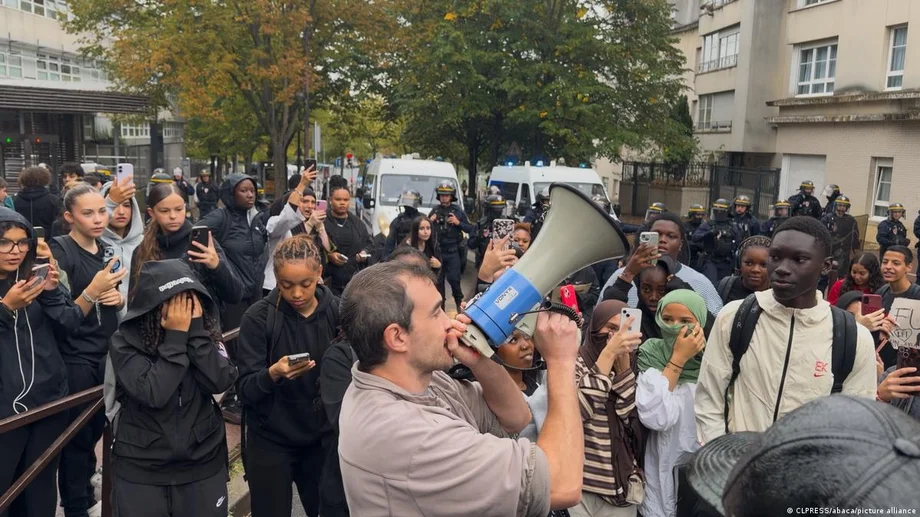
France is facing a rapidly expanding wave of student protests after demonstrations at high schools spread across the country, triggering clashes with police, hundreds of arrests and significant disruption to schools.
The protests intensified on Tuesday, September 29, as teenagers blocked entrances to high schools and demonstrated over teacher shortages, overcrowded classrooms, demanding timetables and deteriorating conditions in some school buildings.
More than 330 high schools were affected by student actions on Tuesday, according to Reuters, marking a significant expansion from approximately 180 schools affected a day earlier.
The demonstrations have spread beyond the Paris region to cities including Lille, Lyon, Grenoble and Nice.
In several locations, demonstrations escalated into confrontations. Rubbish bins were set on fire and projectiles were thrown at police, while officers responded in some areas with tear gas and batons.
More than 160 arrests as school protests intensify
French authorities said 164 people were arrested during Monday's demonstrations, when approximately 180 schools were affected by blockades or attempted blockades.
Interior Minister Laurent Nuñez said 12 members of the security forces were injured. Students and education staff were also among those hurt during the unrest.
By Tuesday, the movement had expanded significantly.
The Guardian reported that more than 200 arrests had been made as the latest demonstrations unfolded, while protests and blockades continued at hundreds of schools.
Authorities have distinguished between peaceful student demonstrations and incidents involving violence and property damage.
Education Minister Edouard Geffray has acknowledged that some of the students' concerns are legitimate, while arguing that violent individuals have become involved in some demonstrations.
Why are students protesting in France?
The protests are driven by a combination of concerns about conditions inside French high schools.
Students have complained about overcrowded classes, missing teachers, staff shortages, demanding schedules and inadequate school facilities.
Some pupils have also raised concerns about classrooms becoming extremely hot during recent heatwaves.
One of the early centres of the movement was the Paris region, where demonstrations emerged over unfilled teaching positions before spreading to other areas.
Social media has helped students coordinate demonstrations and share images and videos from different schools, contributing to the rapid expansion of the movement.
The Union Syndicale Lycéenne, which represents high school students, called for wider school blockades as the movement expanded.
Teachers and public sector workers join nationwide protests
The unrest at French schools is unfolding alongside a much broader day of industrial action.
Teachers, firefighters and other public sector employees joined nationwide demonstrations on Tuesday over government spending plans and working conditions.
Unions are opposing elements of the government's proposed 2027 budget, including plans affecting public sector pay and spending. Reuters reported that public employees are particularly concerned about plans to freeze state salaries next year.
Tens of thousands of people were expected to participate in demonstrations in Paris and other French cities.
The combination of student demonstrations and public sector strikes has transformed what began as protests over individual schools into a broader national challenge for the French government.
Political tensions rise over the protests
The demonstrations have also developed into a political dispute.
Prime Minister Sébastien Lecornu's government has criticised violent incidents connected to some of the school blockades.
Government officials have also accused figures from the left wing La France Insoumise party of encouraging or attempting to politically exploit the demonstrations.
La France Insoumise and its leader Jean Luc Mélenchon have rejected that interpretation and criticised the government's handling of the protests. Local officials in Saint Denis have argued that students are capable of organising independently around concerns about their education.
Interior Minister Nuñez described some of Monday's incidents as urban violence and said authorities would not tolerate violent excesses.
Student organisations, however, maintain that the central issue remains conditions within French schools.
Protests could put further pressure on the French government
The scale of the demonstrations means the situation is being closely watched across France.
What began with protests at a relatively small number of schools around Paris has quickly developed into disruption affecting hundreds of educational institutions.
The government now faces demands from students seeking better school conditions while simultaneously confronting unions opposing planned budget measures.
With teachers and other public sector employees joining demonstrations, pressure could continue if negotiations fail to address the underlying disputes.
For students, the central demands remain focused on everyday education: more teachers, manageable class sizes, better facilities and improved working conditions inside schools.
For the French authorities, the immediate challenge is to prevent further violence while responding to a protest movement that has expanded dramatically within days.



