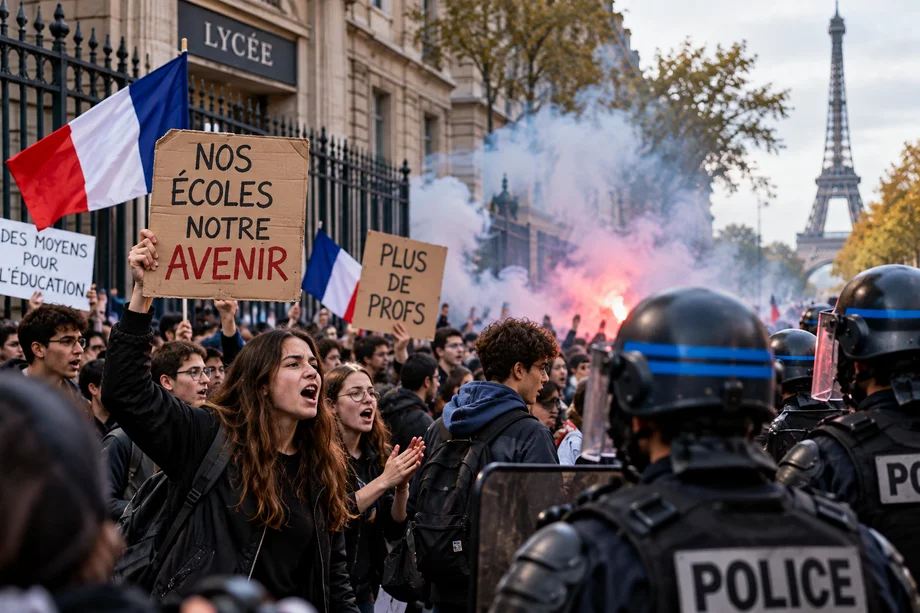
A rapidly expanding wave of student protests is disrupting schools across France, with demonstrations over teacher shortages and poor classroom conditions escalating into clashes, fires, injuries and mass arrests.
The unrest began last week around the Paris region but has since spread across the country, reaching major cities including Paris, Lyon, Lille, Rennes, Marseille, Bordeaux and Nantes.
By Wednesday, September 30, protests had affected 356 high schools, according to officials cited by Reuters. �
Reuters
More than 1,000 arrests have been recorded over two days, most involving teenagers, while officials reported 119 injuries among students, teachers and other school staff. �
Reuters
The demonstrations have become one of France's most closely watched domestic stories as the government prepares to unveil its 2027 national budget on Thursday.
Why are French students protesting?
The protests began with complaints familiar to students across many parts of France.
Young people say their schools are struggling with teacher shortages, overcrowded classrooms, aging buildings and inadequate equipment.
Students in some schools have also complained about lengthy daily schedules and classrooms that became extremely hot during France's severe summer heat.
At schools in the Paris suburbs, students have described broken infrastructure, missing teachers, insufficient computer facilities and significant differences between the resources available to schools in poorer areas and those in central Paris. �
Le Monde.fr +1
The demonstrations initially emerged in the Île de France region surrounding Paris.
They quickly spread through social media.
Within days, students in hundreds of schools were participating in blockades, demonstrations or other forms of disruption.
Around 400 schools disrupted in a single day
The scale of the movement became particularly clear on Tuesday.
France's Education Ministry reported that approximately 400 of the country's roughly 3,700 high schools experienced protests, disruptions or cancelled classes on September 29. �
The Straits Times
The ministry recorded dozens of complete school blockades and attempted blockades.
Students gathered outside school entrances, erected makeshift barriers and displayed signs criticizing conditions inside the education system.
At one Paris demonstration, students carried signs complaining that they spent more hours in lessons than sleeping. �
The Straits Times
Many demonstrations remained peaceful.
Others became violent.
More than 1,000 arrests in two days
Police made hundreds of arrests as confrontations intensified.
French authorities reported more than 1,000 arrests over two days, according to Reuters, with most of those detained believed to be minors. �
Reuters
On Tuesday alone, Interior Minister Laurent Nuñez said 440 people had been detained nationwide. �
AOL
Police used tear gas in some locations after groups threw projectiles and set fires.
Authorities also reported incidents involving fireworks and other objects being thrown toward police.
In several cities, television footage showed confrontations between groups of young protesters and officers in riot equipment.
Acid reportedly thrown at police
Some of the most serious incidents involved dangerous substances.
Nuñez said authorities recorded seven incidents involving hydrochloric acid being thrown at police officers during Tuesday's unrest. �
AOL
Forty eight police officers were reported injured that day.
Officials have repeatedly distinguished between students demonstrating peacefully over school conditions and individuals involved in violence.
The government says legitimate complaints about education do not justify attacks on police, vandalism or arson.
Student representatives, meanwhile, have argued that violent incidents should not be used to dismiss the broader grievances driving the protests.
Dozens injured as unrest spreads
Injuries have also been reported among students and education workers.
Reuters reported Wednesday that the total number of injured students and staff had reached 119. �
Reuters
Education Minister Édouard Geffray earlier said he was concerned primarily about the level of violence surrounding some of the demonstrations.
He acknowledged that students have genuine concerns while condemning attacks and disorder.
The distinction is increasingly important as the protest movement expands.
Images from France show both peaceful student demonstrations and separate scenes involving burning objects, projectiles and confrontations with police.
Saint Denis becomes a focal point
Some of the strongest frustration has emerged in Seine Saint Denis, the densely populated department immediately north and east of Paris.
The area contains some of France's most economically disadvantaged communities.
Students interviewed in places such as Saint Denis, Aubervilliers and Montreuil have complained that their schools do not receive the same resources as institutions in wealthier areas of the capital. �
Le Monde.fr
Some described absent teachers and deteriorating facilities.
Others said computer rooms lacked functioning equipment.
The protests have therefore developed into a wider debate about educational inequality in France.
Students argue that where a child lives can influence the quality of education available to them.
Teacher shortages are a central complaint
France has struggled with the attractiveness of teaching as a profession.
Teacher recruitment has become an important policy issue, with authorities introducing reforms intended to strengthen recruitment and training.
France's Education Ministry previously acknowledged concerns surrounding the declining attractiveness of the profession and announced changes to teacher recruitment beginning in 2026. �
Ministère de l'Education nationale
For protesting students, however, the issue is immediate.
When teachers are absent for extended periods and replacements cannot be found, students can lose significant classroom time.
Those concerns have helped turn staffing shortages into one of the main demands of the current protests.
Overcrowded classrooms add to anger
Class sizes are another major grievance.
Students participating in the demonstrations have complained about overcrowded classrooms that make learning more difficult and place additional pressure on teachers.
The complaints are particularly intense in heavily populated urban areas.
Some protesters have connected classroom overcrowding with a broader sense that public services have failed to keep pace with local population needs.
The movement has consequently attracted attention beyond education policy.
It has become part of a wider French debate about public spending, inequality and the quality of government services.
Extreme heat also became an issue
France's extraordinary 2026 summer has added another dimension to the protests.
Students have complained about classrooms becoming unbearably hot during heatwaves.
France experienced record breaking temperatures earlier this year, with schools forced to close or modify schedules during periods of extreme heat.
Temperatures exceeded 40°C in parts of the country during June, while infrastructure and public services came under severe pressure. �
Reuters +1
Many French school buildings were constructed long before extreme heat became a recurring concern.
Air conditioning is not universally available.
For students already frustrated by aging buildings, the summer heat became another symbol of inadequate infrastructure.
Protests collide with a national public sector strike
The student movement has also coincided with broader unrest among French public sector workers.
Teachers, firefighters, healthcare workers and other civil servants participated in nationwide demonstrations on Tuesday.
French unions said more than 300,000 people participated nationally, while the Interior Ministry estimated approximately 206,000. �
Le Monde.fr
Government figures showed that approximately 13.7 percent of teachers participated in the strike.
Public sector workers are demanding better pay and opposing measures they fear could reduce purchasing power or public spending.
The overlap between the strike and student protests created a particularly difficult day for authorities.
France prepares to unveil its 2027 budget
Timing has made the demonstrations politically significant.
The French government is expected to unveil its 2027 budget on Thursday.
The budget is expected to include measures aimed at reducing pressure on France's public finances.
That has generated concern among public sector unions and students who fear spending restraint could further affect schools and other services. �
Global Banking & Finance Review
France faces significant fiscal challenges, making the debate over spending particularly sensitive.
Student protesters are demanding more resources at the same time the government faces pressure to control expenditure.
That tension could determine whether the demonstrations continue.
Macron condemns violence
President Emmanuel Macron has condemned violence connected with the school protests while acknowledging that the education system faces challenges.
The demonstrations have also become entangled in France's increasingly intense political environment ahead of the 2027 presidential election.
Government officials have accused some political groups of encouraging or exploiting the unrest.
Opposition politicians have rejected those accusations and defended the right of students to protest.
Reuters reported that the demonstrations have become a political flashpoint as the movement has expanded. �
Reuters
The underlying demands, however, began with conditions inside schools rather than national electoral politics.
Government and opposition trade accusations
The political dispute intensified after figures associated with the left expressed support for student demonstrations.
Government officials accused some members of La France Insoumise of legitimizing disorder.
Opposition figures accused the government of focusing on violent incidents instead of addressing students' complaints.
Students interviewed in the Paris suburbs have also rejected suggestions that political parties created the movement.
Some said their protests were based on personal experiences inside schools rather than instructions from politicians. �
Le Monde.fr
Authorities have not identified foreign interference behind the demonstrations, according to reporting by Le Monde. �
Le Monde.fr
Social media helped protests spread
The speed at which the demonstrations expanded reflects the role of social media.
Videos of school blockades, poor classroom conditions and confrontations with police have circulated rapidly among French teenagers.
Students have used online platforms to organize demonstrations and share information between schools.
A protest that began around a relatively small number of schools near Paris therefore became a national movement within days.
This decentralized structure also makes the movement difficult to predict.
There is no single organization capable of ending demonstrations across every school.
Most protests have not been violent
The images of fires and clashes have attracted the greatest attention, but they do not represent every demonstration.
Many school protests have involved peaceful gatherings, signs, speeches and temporary blockades.
Le Monde reported that although some incidents became violent, many demonstrations remained peaceful. �
Le Monde.fr +1
That distinction matters when interpreting the arrest and injury figures.
Some locations experienced serious confrontations while others saw students simply gather outside their schools.
The situation can therefore differ significantly from one city or school to another.
Which cities are affected?
The movement began around Paris but has now reached communities across France.
Demonstrations or disruptions have been reported in Paris and its suburbs, Lyon, Lille, Rennes, Nantes, Marseille and Bordeaux, among other locations. �
The Straits Times
In Rennes, protesters threw objects during confrontations outside Lycée Bréquigny, one of Brittany's largest high schools.
In Lyon and Lille, footage showed projectiles being thrown toward police lines.
In the Paris region, several schools have experienced repeated blockades.
The geographic spread suggests the protests are no longer simply a local dispute.
Could French schools close?
There is currently no national order closing French high schools.
Most schools continue operating.
However, individual institutions can experience cancelled classes or temporary closures when entrances are blocked or authorities determine that conditions are unsafe.
Parents and students should therefore check information from their individual schools and local education authorities.
The situation is evolving rapidly and disruptions can emerge with little warning.
What happens next?
The immediate focus will turn to Thursday's 2027 budget announcement.
Students, teachers and public sector unions will be watching closely for decisions affecting education funding, staffing and public services.
Authorities will also be monitoring whether school blockades continue into October.
The scale of arrests could itself influence the next phase of the protests.
With many of those detained reportedly teenagers, police tactics and the treatment of minors are likely to face increased scrutiny.
At the same time, the government is under pressure to prevent further violence around schools.
France therefore enters October facing two related challenges.
Authorities must restore calm around hundreds of schools while responding to complaints about teacher shortages, overcrowding and deteriorating infrastructure that helped ignite the demonstrations in the first place.
Whether the movement begins to fade or expands further could depend on what students hear from the government in the coming days.



