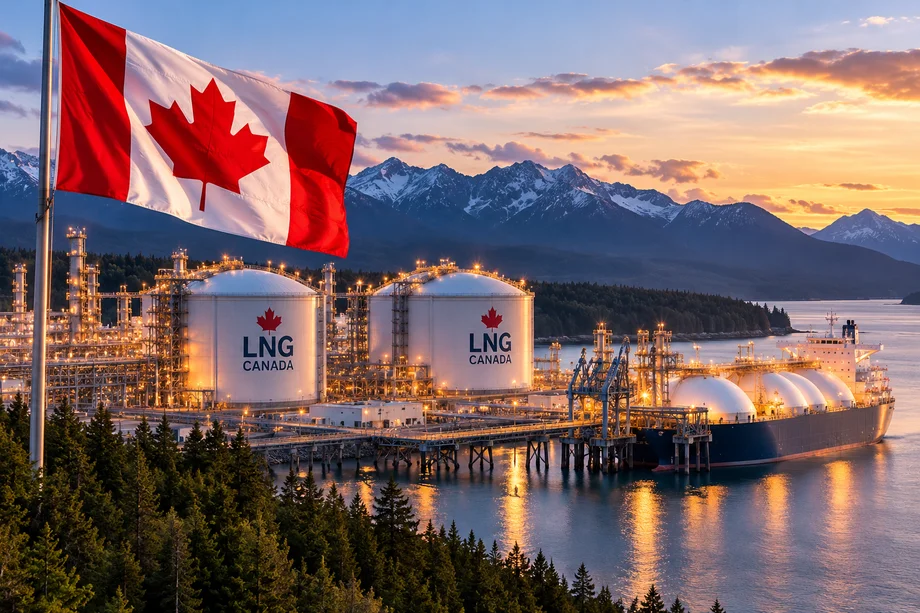
Canada is moving ahead with one of the largest energy investments in its history after the owners of LNG Canada approved a massive expansion of the liquefied natural gas export facility in Kitimat, British Columbia.
The Phase 2 project is expected to cost approximately C$33 billion, according to reporting by Reuters and the Associated Press, and will double LNG Canada's production capacity from 14 million tonnes to 28 million tonnes of LNG per year. �
Reuters +1
The final investment decision was announced on September 29 by Shell�, which owns 40 percent of the project.
Commercial operations from the expanded facility are expected to begin in the early 2030s. �
Shell
The decision represents a major step in Canada's attempt to become a much larger global LNG exporter and reduce its historical dependence on the United States as the primary destination for Canadian energy.
What will LNG Canada Phase 2 build?
The expansion will effectively double the scale of the existing Kitimat facility.
Two additional LNG processing units, known as trains, will be constructed alongside the two already operating at the site.
The project will also add another LNG storage tank, a condensate tank, an additional loading berth and expanded utility and processing systems. �
Shell +1
Once completed, LNG Canada's total production capacity will reach 28 million tonnes annually.
The existing first phase began exporting LNG from Canada's Pacific coast in June 2025. �
Shell
That location gives the project an important geographical advantage.
Ships leaving Kitimat can reach major Asian markets without passing through the Panama Canal, providing Canada with a direct Pacific route to some of the world's largest LNG consumers.
Shell leads a global group of investors
LNG Canada is controlled by a consortium of major international energy companies.
Shell holds the largest stake at 40 percent.
Malaysia's Petronas owns 25 percent, while PetroChina and Mitsubishi Corporation each hold 15 percent. Korea Gas Corporation owns the remaining 5 percent. �
Shell
Shell expects to receive nearly six million additional tonnes of LNG annually from Phase 2.
The company said the investment supports its strategy of connecting Canadian natural gas resources with customers in Asia and its wider global LNG portfolio. �
Shell
Shell has significantly expanded its Canadian energy position this year.
On September 2, the company completed its acquisition of ARC Resources, adding substantial oil and natural gas production in British Columbia and Alberta. �
Shell
Thousands of jobs are expected
The scale of the expansion means its economic impact will extend far beyond the LNG terminal itself.
The Associated Press reported that construction could create as many as 4,000 jobs. �
AP News
The first phase already generated substantial employment and contracting activity.
Shell says more than 50,000 Canadians worked on the original LNG Canada development, while more than C$5.8 billion in contracts and subcontracts went to local, Indigenous owned and other businesses in British Columbia. �
Shell
Phase 2 will build on much of the infrastructure already established during that development.
That is significant because LNG megaprojects often require enormous investments in ports, pipelines, storage facilities, roads, power systems and other supporting infrastructure before exports can begin.
Coastal GasLink will also expand
Doubling LNG production requires significantly more natural gas to reach Kitimat.
That means the Coastal GasLink pipeline will also need additional capacity.
TC Energy announced that it will proceed with the next stage of the pipeline expansion following LNG Canada's final investment decision. �
Reuters
The existing Coastal GasLink system stretches approximately 670 kilometres across British Columbia.
Five new compressor stations are planned to increase the amount of natural gas that can travel through the pipeline to the LNG terminal. �
Shell +1
The Associated Press reported that the pipeline expansion could create approximately 2,100 additional jobs at peak construction. �
AP News
Why Asia matters to Canada
Canada is one of the world's largest natural gas producers, but geography has historically limited its access to overseas customers.
Most Canadian natural gas exports have traditionally moved south into the United States through pipelines.
LNG Canada changes that equation.
Natural gas arriving in Kitimat is cooled to approximately minus 162 degrees Celsius, converting it into liquid and dramatically reducing its volume.
It can then be loaded onto specialized LNG carriers and shipped across the Pacific.
The West Coast location means Asian customers can be reached in roughly eight to ten days, according to the Associated Press. �
AP News
That creates a new export option for Canadian producers and increases Canada's exposure to global energy prices.
Canada wants to diversify its exports
The project also fits into a broader Canadian effort to diversify trade.
Canada has spent decades building an energy system closely connected to the United States.
While the US remains Canada's largest trading partner, governments and businesses have increasingly looked for additional international markets.
LNG exports provide one of the clearest opportunities because Canada possesses enormous natural gas resources and has direct access to the Pacific.
LNG Canada itself says Phase 2 could help move the country toward becoming one of the world's five largest LNG exporting nations. �
LNG
Whether Canada reaches that position will also depend on other LNG projects, future global demand and competition from established exporters including the United States, Qatar and Australia.
Indigenous investment could reach C$1 billion
Another notable part of the project involves First Nations communities located near LNG Canada's operations.
In July, LNG Canada announced an equity option agreement with MNT Investments LP, a partnership involving the economic development organizations of five First Nations.
Those are the Gitga'at Nation, Gitxaała Nation, Haisla Nation, Kitselas First Nation and Kitsumkalum First Nation.
The Phase 2 decision allows that option to proceed through an investment of up to C$1 billion in an entity that will purchase the future LNG storage tank being constructed as part of the expansion. �
LNG
The project itself is located in the traditional territory of the Haisla Nation.
Global LNG demand remains central to the investment
The expansion represents a long term bet that global demand for liquefied natural gas will remain strong.
Shell estimates worldwide LNG demand could increase from approximately 422 million tonnes annually in 2025 to nearly 700 million tonnes by 2050. �
Shell
The company expects much of that growth to come from Asia.
Countries in the region are attempting to balance rising electricity demand, industrial growth, energy security and emissions targets.
Natural gas is frequently used as an alternative to coal in electricity generation, although LNG remains a fossil fuel and its climate impact continues to be debated.
Shell cites International Energy Agency analysis indicating that electricity produced from LNG has lower average life cycle greenhouse gas emissions than coal. �
Shell
Environmental groups have argued that expanding LNG infrastructure risks locking in fossil fuel consumption for decades and have raised concerns about methane emissions associated with natural gas production and transportation.
Marine protection spending is also increasing
Canada announced another major investment alongside the expansion.
The federal government said it would spend an additional C$1.2 billion on marine protection, including improved seabed mapping, weather forecasting and monitoring of marine traffic. �
Reuters
The measures come as LNG and other energy exports increase tanker traffic along Canada's Pacific coast.
Managing that growth will be an important part of the project's long term environmental and political impact.
A major bet on Canada's energy future
LNG Canada Phase 2 is much more than an expansion of a single industrial facility.
It requires additional gas production, pipeline capacity, processing infrastructure, storage facilities and marine transportation.
It also connects Western Canada's enormous natural gas resources directly with international markets at a scale that was not possible before LNG exports from Kitimat began.
The first LNG Canada cargo left British Columbia only in June 2025. �
Shell
Little more than a year later, its owners have committed to doubling the facility.
If construction proceeds as planned, the expanded Kitimat terminal will be capable of producing 28 million tonnes of LNG every year in the early 2030s, transforming Canada's position in the global LNG market and creating a major new energy corridor between Western Canada and Asia. �



