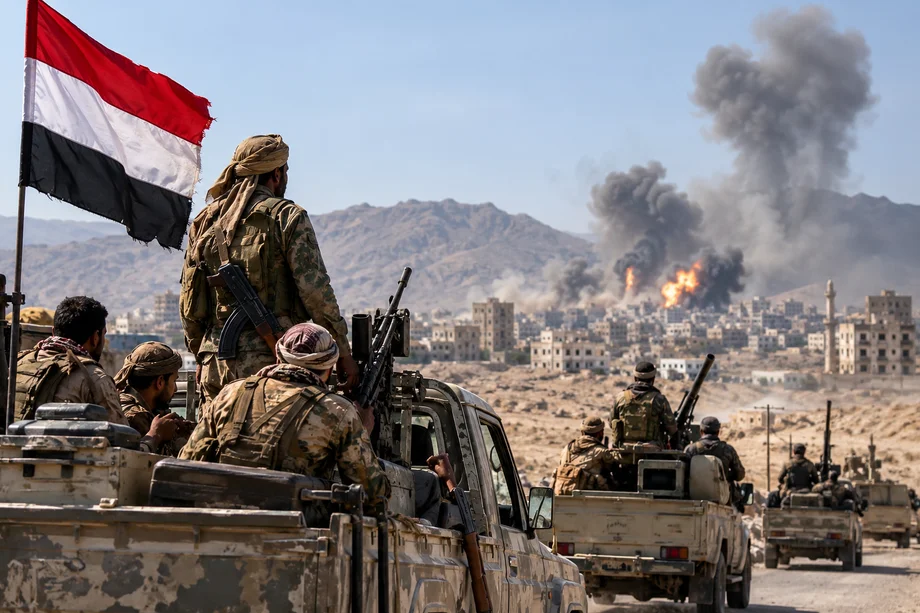
Yemen's internationally recognized government launched a major military offensive on Sunday aimed at retaking territory controlled by the Iran backed Houthis, formally widening a conflict that had remained comparatively contained for several years.
Rashad al Alimi, chairman of Yemen's Presidential Leadership Council, announced the operation in a televised address on October 4, saying government forces had been ordered to begin implementing an approved military plan across the country.
“I announce today the launch of military operations to restore the remaining territory of the Republic,” al Alimi said, according to an official statement from his office.
The announcement represents one of the clearest attempts by Yemen's government in years to fundamentally change the territorial balance of the country's long running civil war.
Reuters reported that the Saudi backed government intends to recapture all areas held by the Houthis, who control the capital Sanaa and large parts of northern and western Yemen.
The offensive follows major Houthi advances during recent fighting, including gains along Yemen's Red Sea coast and around the strategically critical Bab el Mandeb Strait.
The narrow waterway connects the Red Sea with the Gulf of Aden and ultimately the Indian Ocean. It is one of the world's most important maritime passages, carrying commercial vessels traveling between Europe and Asia through the Suez Canal.
Control of territory around the strait therefore has implications far beyond Yemen.
The Associated Press reported that the Houthis made their largest territorial gains in years last month when they seized stretches of the Red Sea coast and the Bab el Mandeb area.
Fighting has also intensified around Taiz, one of Yemen's largest cities.
Houthi forces have pushed toward the outskirts of the southwestern city and disrupted a major road connecting Taiz with Aden, where Yemen's internationally recognized government is based.
Taiz has been at the center of the conflict for more than a decade. Its location makes the city strategically important for both sides because control of surrounding routes can influence movement between northern and southern Yemen.
Government forces carried out 20 airstrikes against Houthi positions in Taiz province within three hours on Friday, according to a Yemeni military spokesperson quoted by Reuters.
The strikes targeted Houthi personnel, vehicles, military equipment and troop movements. Yemeni authorities also designated approximately 19 roads leading toward Taiz as military zones as the fighting intensified.
Al Alimi said Sunday that Yemen had moved from a period of preparation into what he described as a phase of liberation.
His office said the decision followed meetings of the National Defense Council and came after the government concluded that opportunities for de escalation had been exhausted.
The Houthis have not indicated that they intend to withdraw.
Instead, the group has continued military operations against both Yemeni government forces and targets inside Saudi Arabia.
Houthi military spokesperson Yahya Saree said the group had fired missiles and drones at Saudi Aramco facilities, including sites in Riyadh and the Kurais area southeast of the capital.
The Houthis did not provide evidence supporting their claims, and independent confirmation of damage was not immediately available.
A fire was reported at a Saudi Aramco refinery on Saturday, but authorities have not publicly established its cause, the Associated Press reported.
The renewed confrontation threatens to fully revive a civil war that devastated Yemen for years.
The Houthis seized Sanaa in 2014 and forced the internationally recognized government from the capital. A Saudi led military coalition intervened in 2015 in support of the government.
Years of fighting followed, killing civilians, destroying infrastructure and producing one of the world's most severe humanitarian crises.
A United Nations brokered truce in 2022 dramatically reduced major fighting even after the formal agreement expired.
That period of relative calm has now collapsed.
The broader regional conflict involving Iran, Saudi Arabia, the United States and Israel has increasingly pulled Yemen back into active confrontation.
The Houthis have longstanding political and military links with Iran, although Tehran has rejected claims that it directly controls the group's decisions.
Saudi Arabia, meanwhile, has renewed military support for forces aligned with Yemen's government.
The escalation has also created new concerns for international shipping.
The Houthis have repeatedly demonstrated their ability to strike vessels and launch missiles and drones across the region. Their expanded presence around Bab el Mandeb could give the group greater leverage over one of the world's busiest shipping corridors.
The Council on Foreign Relations notes that Houthi attacks on Red Sea shipping in recent years have already drawn US military responses and expanded Yemen's role in wider regional tensions.
Commercial shipping companies closely monitor security around Bab el Mandeb because disruptions can force vessels to avoid the Red Sea and instead sail around Africa's Cape of Good Hope.
That route can add thousands of kilometers to voyages between Asia and Europe, increasing fuel expenses, insurance costs and delivery times.
The military escalation is also worsening conditions for Yemeni civilians.
Recent fighting has displaced tens of thousands of people, according to Reuters, while communities around Taiz face renewed threats to transportation routes and access to essential supplies.
Al Alimi sought to distinguish Sunday's campaign from a broader conflict against Yemenis living under Houthi control.
His office said the operation was directed at the armed group's control of state institutions rather than civilians, tribes or religious communities.
Whether government forces can achieve the sweeping objectives announced Sunday remains uncertain.
The Houthis have controlled Sanaa for more than a decade and developed significant missile, drone and ground combat capabilities during that period.
But the government's declaration marks a significant shift in the war.
Instead of attempting primarily to contain Houthi advances, Yemen's internationally recognized leadership is now publicly committing itself to retaking Houthi controlled territory across the country.
The immediate battles around Taiz and the Red Sea coast will offer the first indication of whether that objective is militarily achievable.
The consequences could extend far beyond Yemen. With Bab el Mandeb at the center of the fighting and attacks again threatening Saudi territory, the renewed war is becoming another major flashpoint for Middle East security, global shipping and energy markets.



