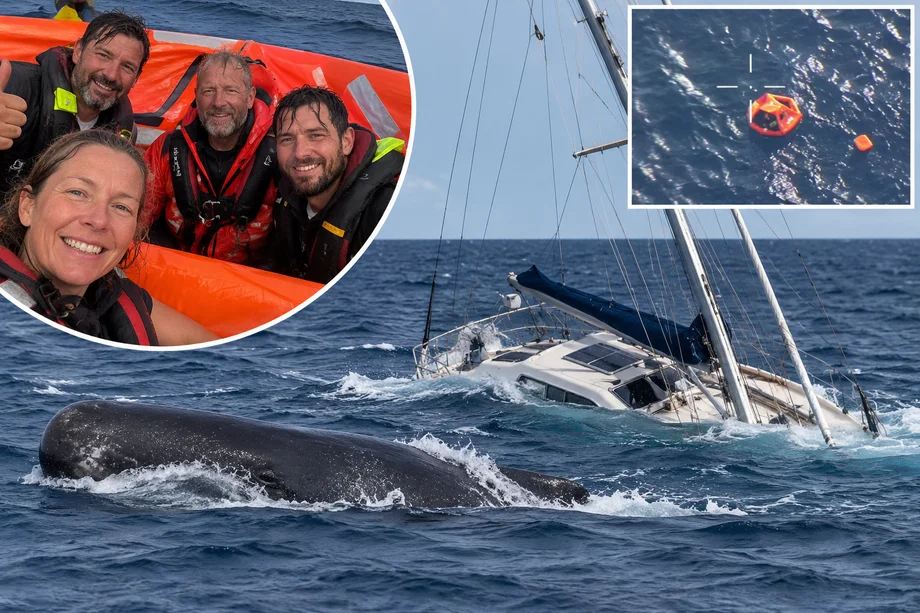
Four sailors have survived a remarkable ordeal in the South Pacific after a sperm whale struck their yacht, causing catastrophic damage that eventually sent the vessel to the bottom of the ocean.
The crew of the 52 foot yacht Tai Tam was sailing approximately 250 nautical miles north of Norfolk Island when the collision occurred on Saturday, September 26.
The impact damaged the yacht's hull and destroyed its steering system, leaving the sailors fighting for hours to prevent the vessel from sinking.
After eventually abandoning Tai Tam and moving into a life raft, the four sailors spent the night at sea before being rescued by a container ship early Sunday morning.
All four survived without serious injuries.
A huge impact came without warning
Australian sailor Jemma Cooper was at the helm when the collision happened.
The conditions had been relatively calm when the yacht was suddenly hit with enormous force.
Cooper told AFP there was a loud thud before the entire boat was pushed sideways.
The impact was powerful enough to throw her away from the steering position.
Initially, the crew did not know what they had struck.
Then they looked into the surrounding water.
Cooper said they could see a group of sperm whales nearby, with estimates ranging from about four to eight animals depending on the crew member's account.
The sailors concluded that their yacht had collided with one of the whales.
Damage quickly became catastrophic
Jeremy Cooper, Jemma's husband, was sleeping below deck when the impact woke him.
The seriousness of the situation quickly became apparent.
The steering equipment on the starboard side had been destroyed and water was pouring into the yacht.
French crew member Martin Jaffre later said the collision had left several gashes in the hull and cracked the fiberglass structure.
With the steering system badly damaged, the crew could no longer properly control Tai Tam.
Their sailing trip had suddenly become a fight for survival.
Crew issued a mayday
About 30 minutes after the collision, the sailors activated their emergency beacon.
New Zealand crew member Terry Hetherington said they declared a full mayday as the situation deteriorated.
The early activation of the Emergency Position Indicating Radio Beacon, commonly known as an EPIRB, would become critical to their survival.
The distress signal alerted rescue authorities and provided information about the yacht's location in a remote part of the South Pacific.
Rescue Coordination Centre New Zealand began organizing a response.
The crew, meanwhile, continued trying to save their boat.
Sailors desperately tried to stop the flooding
The four sailors spent hours attempting to keep Tai Tam afloat.
They pumped and manually removed water while trying to repair the damaged hull.
Jaffre used materials available on board, including expansion foam, in an attempt to slow the flooding.
He even entered the water to inspect the underside of the yacht and assess the damage.
The crew also worked to prevent the engine from becoming clogged as water continued entering the vessel.
But the damage was simply too severe.
Jeremy Cooper later said it became clear that the situation could not be recovered.
New Zealand sent a military aircraft
The rescue operation involved the New Zealand Defence Force.
A Royal New Zealand Air Force P 8A Poseidon maritime surveillance aircraft was dispatched to the area.
The aircraft helped establish radio communications with the sailors and coordinate the rescue from above.
Images released by the New Zealand Defence Force showed the damaged yacht in the open ocean and later documented the sailors' rescue.
The military aircraft remained involved as rescuers worked to direct a commercial vessel toward the stranded crew.
For the four people aboard Tai Tam, however, the immediate challenge remained staying alive until help arrived.
They finally abandoned the yacht
The sailors tried to remain aboard their damaged yacht for as long as possible.
A yacht, even one taking on water, offered more protection than a small life raft in the middle of the Pacific.
But by late Saturday night, they had no realistic alternative.
The four sailors abandoned Tai Tam and transferred into their emergency life raft.
Conditions were fortunately relatively calm and the crew had the benefit of moonlight.
Their yacht remained connected to the raft for a period as it continued sinking.
Eventually, the sailors faced another dangerous decision.
They had to cut themselves free.
They feared the sinking yacht could pull them down
As Tai Tam settled lower into the ocean, the crew became concerned that the yacht could drag their life raft underwater.
During the early hours of Sunday morning, they cut the tether connecting the raft to the damaged vessel.
Soon afterward, Tai Tam disappeared beneath the surface.
The four sailors were now alone in a life raft in the South Pacific.
They had survived the collision.
They had survived the sinking.
But they still had to wait for rescuers to reach them.
A container ship finally appeared
Help arrived in the form of the MV Sofrana Surville.
The container ship is approximately 143 metres long, dramatically larger than the tiny life raft carrying the stranded sailors.
New Zealand rescue authorities and the military aircraft helped guide the commercial vessel toward their location.
At approximately 6 a.m. Sunday, the ship reached the sailors.
About 18 hours had passed since the collision with the whale.
But reaching the ship did not immediately end the danger.
Getting aboard was another challenge
The sailors had to move from their small raft onto the enormous container ship.
Jeremy Cooper recalled how intimidating the vessel appeared as it approached them.
The four sailors eventually climbed a pilot ladder and reached the deck safely.
Within roughly half an hour, they were aboard, drinking coffee and speaking with the ship's captain.
Their ordeal was over.
The New Zealand Defence Force confirmed that all four sailors were rescued safely.
Who were the four sailors?
The crew represented three countries.
Australian couple Jeremy and Jemma Cooper were joined by New Zealander Terry Hetherington and French sailor Martin Jaffre.
The Australians had been enjoying an extended Pacific sailing trip.
They had previously sailed their yacht to New Zealand before travelling north to Fiji, where they spent several months cruising around the islands.
They were sailing back toward New Zealand when the collision occurred.
Instead of completing their voyage aboard Tai Tam, they returned home after losing the yacht in the Pacific.
Emergency beacon proved crucial
New Zealand rescue officials emphasized that the sailors' preparation played a major role in the successful outcome.
Rescue Coordination Centre Operations Manager Mike Clulow said the crew did the right things following the collision.
In particular, he highlighted their decision to activate the EPIRB early.
That allowed rescuers to identify their position and begin coordinating assistance before the yacht sank.
Clulow said the incident was an important reminder that preparation at sea can save lives.
The case provides a striking example of why emergency equipment is particularly important when sailing through remote waters.
How big are sperm whales?
Sperm whales are among the largest animals in the ocean.
Adult males can reach approximately 50 to 60 feet in length, meaning a large male can be roughly as long as the 52 foot Tai Tam itself.
They are also the largest toothed predators on Earth.
Sperm whales are famous for their enormous heads and ability to make extremely deep dives while hunting squid and other prey.
The species can travel across vast areas of the world's oceans.
A collision between an animal of that size and a fiberglass yacht can produce enormous forces, even without aggressive behavior by the whale.
There is no evidence that the whale deliberately attacked Tai Tam.
The incident is being described as a collision.
What happened to the whale?
The condition of the sperm whale involved in the collision is unclear.
The sailors saw several whales in the area following the impact, but reports have not established whether the animal that struck the yacht was injured.
Sperm whales are considered vulnerable by the International Union for Conservation of Nature.
Their populations were historically devastated by commercial whaling.
Today they face additional threats including entanglement, underwater noise, plastic pollution and collisions with vessels.
The Tai Tam incident demonstrates that collisions can also create serious risks for people aboard smaller vessels.
Whale collisions with boats do happen
Encounters between whales and vessels are not unprecedented.
Large commercial ships are considered a significant threat to some whale populations because collisions can seriously injure or kill the animals.
But incidents in which a whale causes enough damage to sink a vessel are much less common.
CBS News noted that the Tai Tam incident was at least the second reported case in less than two months in which a whale collision resulted in a boat sinking.
In July, a whale surfaced beneath a New Jersey fire department boat, causing it to sink.
The firefighters aboard that vessel were also rescued.
Why the rescue succeeded
Several factors worked in the sailors' favor.
The crew had emergency equipment.
They activated their distress beacon quickly.
They were able to communicate with rescue authorities.
Weather and sea conditions were relatively manageable.
A military surveillance aircraft was available to coordinate the operation.
And a commercial ship was able to divert toward their position.
Hetherington later acknowledged how different the outcome might have been under worse conditions.
He said that if the collision had occurred approximately 24 hours earlier, when conditions were different, the consequences could have been significantly more serious.
A Pacific adventure ends at the bottom of the ocean
For Jeremy and Jemma Cooper, the loss of Tai Tam brought a dramatic end to what had been an extended Pacific adventure.
Their yacht had carried them through New Zealand and Fiji before beginning the journey south.
Within hours of the collision, the vessel was gone.
But every person aboard survived.
Jeremy Cooper described reaching the container ship as a wonderful moment despite what he called a terrible ending to their voyage.
The yacht could not be saved.
The four people aboard it were.
And in an emergency hundreds of nautical miles from land, a distress beacon, coordinated military response and passing commercial ship turned a potentially deadly collision into a remarkable survival story.



