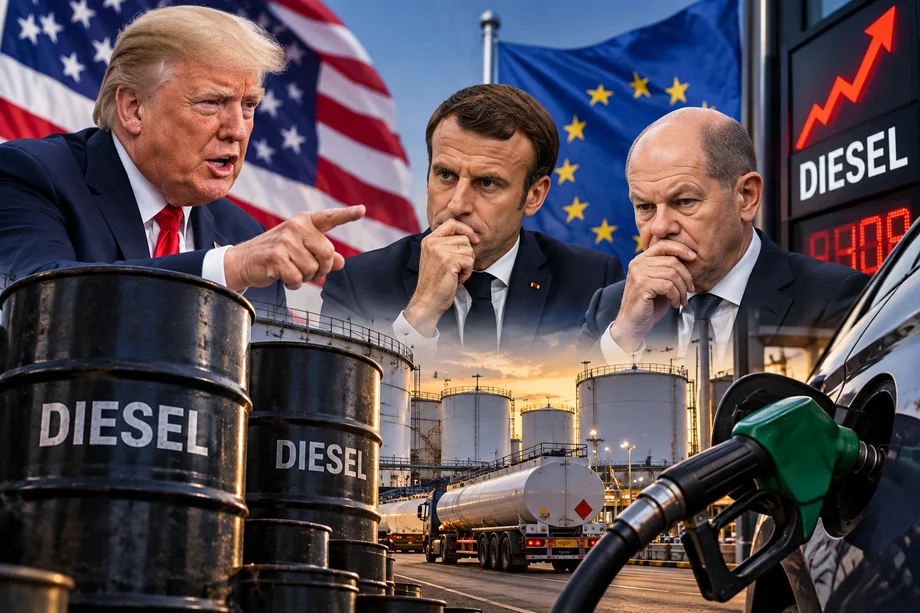
The United States is increasing pressure on France and Germany to release large quantities of emergency diesel reserves as governments struggle with soaring fuel prices and tightening global supplies.
The Trump administration has told the two European countries to draw down strategic diesel inventories or potentially face restrictions on US diesel exports, according to three people familiar with the discussions cited by Reuters on October 1.
Washington is seeking a much broader European response.
One European source told Reuters that the United States has asked the European Union to release about 120 million barrels of diesel over the next six months.
That would represent more than 40 percent of the EU's current emergency diesel and gasoil reserves.
The dispute comes as diesel prices have climbed to record or near record levels in several markets, creating new concerns for motorists, businesses, farmers and governments heading into winter.
Why France and Germany matter
France and Germany hold an unusually large share of Europe's emergency diesel supplies.
The latest Eurostat figures cited by Reuters show that France held approximately 8.2 million metric tons of emergency diesel and gasoil reserves, while Germany held around 5.6 million tons.
Together, the two countries account for roughly 35 percent of the European Union's strategic diesel reserves.
That makes decisions in Paris and Berlin particularly important if Europe decides to release fuel onto the market.
EU countries collectively held around 39 million metric tons of emergency diesel and gasoil in the latest available data.
European rules require member states to maintain emergency oil reserves covering at least 90 days of net imports or 61 days of domestic consumption, whichever requirement is higher.
The EU as a whole currently complies with those rules.
Europe begins emergency talks
European governments are now discussing whether additional reserves should be released.
The European Commission, France, Italy, Ireland and the United Kingdom participated in talks on Thursday about a possible release of emergency diesel stocks, an EU official told Reuters.
Germany has also been central to discussions surrounding Europe's response.
The EU's energy taskforce, which includes the European Commission and all 27 member states, is expected to continue discussions on Friday.
No final decision on another large release had been announced as of October 1.
US considers restricting diesel exports
The possibility of an American diesel export ban could significantly complicate Europe's situation.
Europe has become increasingly dependent on imported diesel after reducing Russian energy imports following Russia's invasion of Ukraine.
European refining capacity has also declined over the past two decades, increasing reliance on supplies from countries including the United States.
A restriction on American diesel exports could therefore tighten European supplies further at precisely the moment governments are attempting to lower fuel prices.
EU trade chief Maroš Šefčovič said Europe wants a coordinated solution with Washington rather than new export restrictions.
Šefčovič said he discussed tight diesel supplies and rising prices with US Trade Representative Jamieson Greer during meetings on Thursday.
Why diesel prices are rising
The global diesel market is being squeezed by several simultaneous supply problems.
Middle Eastern energy supplies have been disrupted by the Iran conflict, while Russia has extended restrictions on diesel exports.
Russia announced that its diesel export restrictions would remain in place through the end of October, further tightening international supply.
Russian President Vladimir Putin said Thursday that Russia would not restore normal diesel supplies to global markets while sanctions remain in place.
China is also adding pressure to the market.
Chinese refiners have suspended fuel exports for October as Beijing attempts to protect domestic inventories, according to four people briefed on the decision who spoke to Reuters.
The combination of reduced Russian exports, disrupted Middle Eastern supplies and China's decision to prioritize domestic fuel stocks has left importing countries competing for fewer available diesel cargoes.
Diesel matters far beyond drivers
Diesel prices affect considerably more than the cost of filling a vehicle.
The fuel remains essential to trucking, agriculture, construction and heavy industry.
Higher diesel prices can therefore spread through an economy by increasing the cost of transporting food, consumer goods and industrial materials.
The timing is particularly sensitive because the Northern Hemisphere is entering colder months.
Diesel and closely related fuels are also used for heating in several countries.
US Energy Secretary Chris Wright said Thursday that the approaching harvest and winter heating seasons make this an important moment for coordinated action.
Wright said he was "highly confident" that Europe would help by releasing emergency diesel inventories and suggested that positive developments could be coming.
Europe faces a difficult decision
Releasing emergency reserves could increase diesel supplies and potentially reduce pressure on prices.
But strategic reserves exist precisely to protect countries against severe supply disruptions.
European governments must therefore decide how much fuel they can safely release while preserving enough reserves if the global energy crisis worsens.
The size of Washington's reported request illustrates the scale of the decision.
A release of 120 million barrels would represent more than 40 percent of the EU's current emergency diesel and gasoil stocks and roughly one month of total EU diesel and gasoil consumption, according to Reuters calculations.
Europe has already participated in a major coordinated emergency release this year.
The International Energy Agency agreed in March to release approximately 400 million barrels of emergency crude oil and fuel stocks globally. The United States committed 172 million barrels, while EU countries were expected to contribute about 20 percent of the overall volume.
Whether Europe now agrees to another major release could have consequences well beyond France and Germany.
With global diesel supplies tightening just as winter approaches, decisions made in Washington, Paris, Berlin and Brussels could influence fuel prices across Europe and the United States in the weeks ahead.



