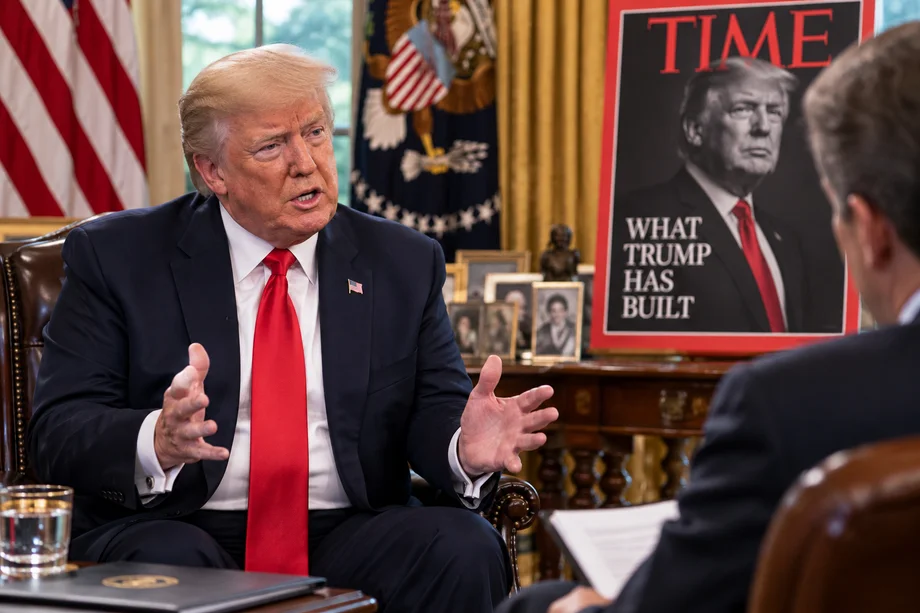
President Donald Trump's latest interview with TIME is drawing widespread attention after the magazine published the full transcript of a lengthy conversation covering some of the biggest issues facing his administration.
The interview took place at the White House on September 28 and was published on October 1 as part of TIME's cover story, "What Trump Has Built."
Over approximately 75 minutes, Trump discussed the war with Iran, November's midterm elections, his relationship with the Supreme Court, the Federal Reserve, immigration enforcement, the media and changes he has made to the White House.
Several of his comments have already generated separate headlines across the United States.
Trump says he regrets three Supreme Court picks
One of the most notable moments concerned three Supreme Court justices Trump nominated during his first presidency.
Trump told TIME that he regretted selecting Neil Gorsuch, Brett Kavanaugh and Amy Coney Barrett after they opposed his administration in recent cases.
Asked specifically whether he regretted nominating the three justices, Trump answered that he did. Reuters reported that the comments followed Trump's recent public criticism of the conservative justices over court decisions that went against his administration.
The remarks are significant because Trump's first term transformed the ideological composition of the Supreme Court.
His appointments of Gorsuch, Kavanaugh and Barrett created a six member conservative majority.
However, Supreme Court justices receive lifetime appointments and do not formally represent the president who nominated them.
Trump leaves open use of Insurrection Act
Another major part of the interview concerned presidential powers and domestic security.
TIME asked Trump whether he would invoke the Insurrection Act, a federal law that can allow a president to deploy military forces domestically under certain circumstances.
Trump did not rule out using it.
CNN highlighted the exchange as one of the notable moments from the interview, particularly as the administration continues to face disputes over federal deployments and immigration enforcement.
Trump also did not categorically rule out the possibility of Immigration and Customs Enforcement personnel being present near polling locations, according to reporting on the interview. When asked about the idea, he said he had not considered it and that officials would "see" what happens.
No announcement was made that such a deployment would occur.
Midterm elections dominate the conversation
The interview comes roughly five weeks before the November midterm elections.
Trump expressed confidence about Republican prospects and rejected unfavorable polling.
He also discussed what could happen if Democrats gain control of the House of Representatives.
CNN reported that Trump said Democrats would "probably go after me" if they won the chamber, adding that he would respond politically.
The midterms will determine control of Congress for the final two years of Trump's current term.
TIME separately fact checked several statements Trump made during the interview, including claims relating to elections, foreign policy and his administration's record.
Iran remains a central issue
Foreign policy occupied another substantial portion of the conversation.
Trump discussed the ongoing war involving Iran and defended his administration's approach.
The conflict has become one of the defining international issues facing his administration, with consequences for energy markets, US foreign policy and the wider Middle East.
TIME questioned Trump extensively about the conflict and his strategy toward Iran.
The interview also covered Israel.
Asked whether he wanted Israeli Prime Minister Benjamin Netanyahu to win Israel's October 27 election, Trump declined to provide a direct endorsement.
Associated Press reported that he avoided several attempts to get him to state whether Netanyahu should be reelected.
Trump lashes out over media coverage
Trump's relationship with the American media produced one of the interview's most widely circulated moments.
Toward the end of the conversation, Trump complained that reporters repeatedly ask him negative questions.
He used an expletive while expressing frustration that he had not received what he considered a positive question during the interview.
Trump also criticized several major news organizations and repeated his longstanding argument that much of the coverage of his administration is unfair.
TIME challenged him during the interview about restrictions imposed on some media organizations and his broader approach toward the press.
White House construction gets attention
The interview was not limited to policy.
Trump also spent time discussing physical changes he has made to the White House.
TIME's cover story opens with Trump showing reporters the new White House helipad, an approximately 80,000 square foot granite installation on the South Lawn.
Trump discussed the materials, construction and design details while explaining his broader approach to renovations at the presidential complex.
Construction and redesign projects at the White House have become an unusually visible part of Trump's second term.
TIME fact checks Trump's claims
TIME accompanied the interview with a separate fact check examining several statements made by the president.
The magazine reviewed claims involving his electoral record, foreign policy and other subjects raised during the conversation.
That distinction is important because the interview transcript records Trump's statements, while some of those statements involve disputed interpretations or factual claims requiring additional context.
TIME published both the complete transcript and its independent assessment, allowing readers to compare Trump's answers with available evidence.
A revealing interview at a critical moment
The timing makes the interview particularly significant.
Trump is dealing simultaneously with an overseas conflict, economic concerns at home, disputes with the courts, tensions with major media organizations and an approaching congressional election.
The Washington Post identified the Supreme Court, the midterms and Trump's approach to executive power among the major themes emerging from the conversation.
Rather than focusing on a single announcement, the TIME interview offers a broad picture of how Trump describes his presidency and the challenges surrounding it.
With the midterm elections approaching in November, many of the issues discussed during those 75 minutes are likely to remain central to US politics in the weeks ahead.



