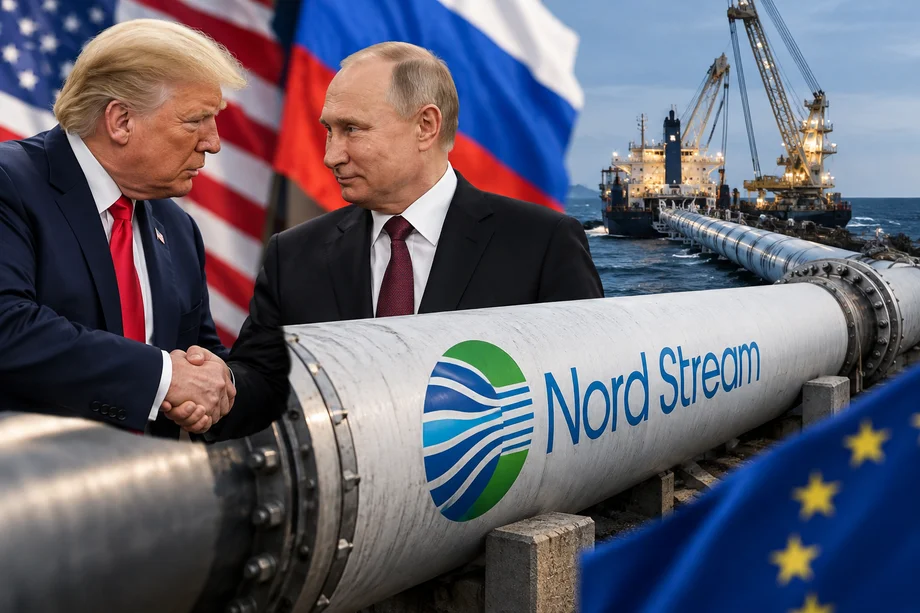
The United States and Russia have held talks on a possible energy deal that could change the way Russian gas supplies Europe.
According to a Reuters investigation published on October 8th, senior American and Russian officials have discussed the possibility that American investors be involved in the Nord Stream project, the gas pipeline carrying natural gas from Russia to Germany.
Information has been confirmed for Reuters by five people with knowledge of the discussions, but so far there is no officially announced agreement.
Trump man in talks with Moscow
At the centre of the discussions are Jared Kouchner, American President Donald Trump's son-in-law, and Kiril Dmitriev, a close adviser to Russian President Vladimir Putin.
Reuters reports that the two officials have met in recent weeks in Moscow and New York. However, it is not clear how concrete Nord Stream is discussed at these meetings.
Kouchner, involved in efforts to mediate a ceasefire between Russia and Ukraine, considers economic co-operation a way to support the peace process.
A possible deal would enable American investors to benefit from Russian gas transport to Europe if supplies were to resume.
The White House gives a reserved answer
A White House official told Reuters that any agreement with Russia should be negotiated with relevant American institutions and bring benefits to American companies and taxpayers.
However, the same official stated that there was no recent discussion about Nord Stream.
This shows that the talks reported by Reuters sources do not yet constitute an official decision by the Trump Administration to reopen the pipelines.
Germany strongly opposes
The German government has reacted by repeating opposition to the return of Russian gas supplies through Nord Stream.
According to the German newspaper Handelsblatt, a spokeswoman for the Ministry of Economy and Energy said the pipelines are subject to European sanctions and that Germany has managed to reduce its dependence on Russian gas.
To resume operation, approvals from German authorities and co-ordination with European institutions would be required.
German MP Michael Kellner warned that an agreement that would give Americans control of the infrastructure, while Russia would provide gas, could harm Europe's strategic interests.
What happened to Nord Stream?
Before the Russian invasion of Ukraine in 2022, Germany relied heavily on Russian gas.
The supplies through Nord Stream 1 were interrupted during the energy crisis of 2022, and Nord Stream 2 never became commercial.
In September of that year, underwater explosions severely damaged three of the four lines of two projects.
The pipeline remains under American and European sanctions, which makes it impossible to resume legitimate supplies without significant political and legal changes.
Still another Russian business under discussion
According to Reuters, Kouchner and Dmitriev have also discussed the possibility of selling some international assets to Russian company Lukoil.
In the reported scenario, a consortium involving American investors, from Qatar and the United Arab Emirates, could buy refinerys and other company businesses.
Even this option would require changes to the sanctions regime.
For the time being, talks about Nord Stream remain at an exploratory stage. But the fact that such a controversial energy project has returned to the agenda of American-Russian contacts shows that economic relations can take place in future negotiations for Ukraine.



