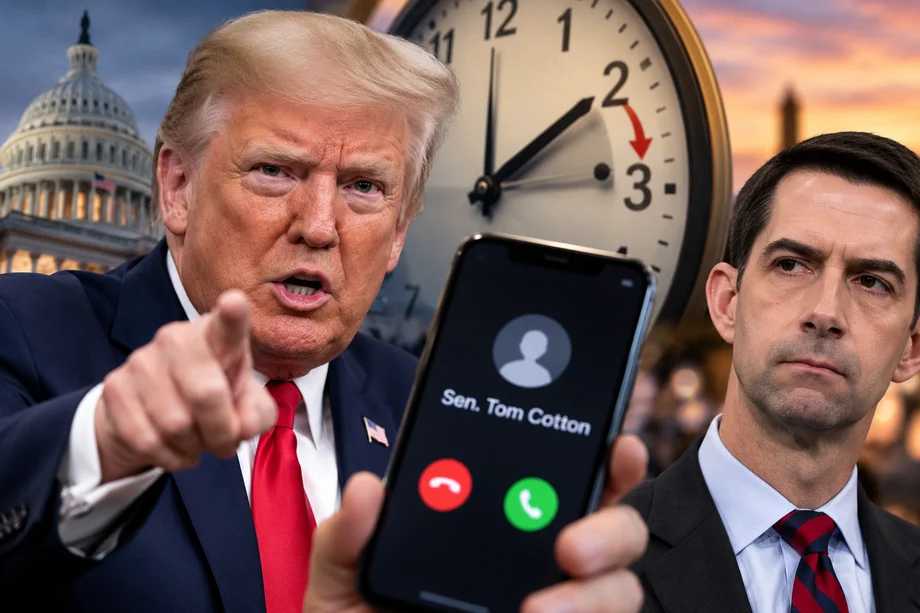
President Donald Trump has turned America's long running debate over changing the clocks into an extraordinary confrontation with a senator from his own party.
Trump publicly shared what he said was Republican Senator Tom Cotton's cellphone number and encouraged people in Arkansas to call him, as the president pushes Congress to make daylight saving time permanent.
Reuters reports that the dispute centers on the Sunshine Protection Act, legislation that would end the twice yearly clock change and keep daylight saving time throughout the year.
The bill passed the House in July but has encountered resistance in the Senate.
Why is Trump angry with Tom Cotton?
Trump has accused Cotton of standing in the way of the legislation.
Cotton, normally a strong Trump ally, opposes permanent daylight saving time because of what it would mean during winter mornings.
His central argument is simple: keeping clocks permanently one hour ahead would mean sunrise comes significantly later during winter in parts of the United States.
Cotton says that could leave children traveling to school while it is still dark.
“Arkansans don't want their kids going to school in the pitch dark,” Cotton said while reiterating his opposition to the proposal.
Trump sees the issue differently.
He argues that Americans would benefit from having more daylight later in the afternoon and evening and has pointed to support from groups including golfers and farmers.
Trump tells Americans to call Cotton
The dispute became far more personal when Trump published a phone number that he said belonged to Cotton.
The Associated Press called the number and reported that nobody answered and that its voicemail box was full.
The Washington Post reported that the number had previously been associated with Cotton in a publicly accessible phone records database.
Cotton has not backed down from his position.
Would Americans stop changing their clocks?
If the legislation ultimately becomes law in its current form, most Americans would no longer move their clocks forward in spring and backward in autumn.
Instead, daylight saving time would effectively become permanent in participating states.
Supporters argue that later sunsets would provide more usable daylight in the evening.
Opponents warn that the tradeoff would be extremely dark winter mornings in some areas.
The United States has tried something similar before.
Permanent daylight saving time was introduced during the energy crisis in the 1970s, but the experiment quickly became unpopular and was reversed after concerns about dark winter mornings.
Medical groups have also questioned permanent daylight saving time. The American Academy of Sleep Medicine has argued that permanent standard time better aligns with human circadian biology.
A surprisingly difficult political battle
Changing the clocks might appear to be a relatively simple issue compared with the major political battles in Washington.
In reality, deciding which time should become permanent has repeatedly divided politicians and the public.
Trump wants the extra evening daylight.
Cotton argues that Americans would regret the consequences when winter arrives.
And despite pressure from the president, the legislation currently remains stalled in the Senate.
For millions of Americans wondering whether they will finally stop changing their clocks twice every year, the answer is therefore still: not yet.



