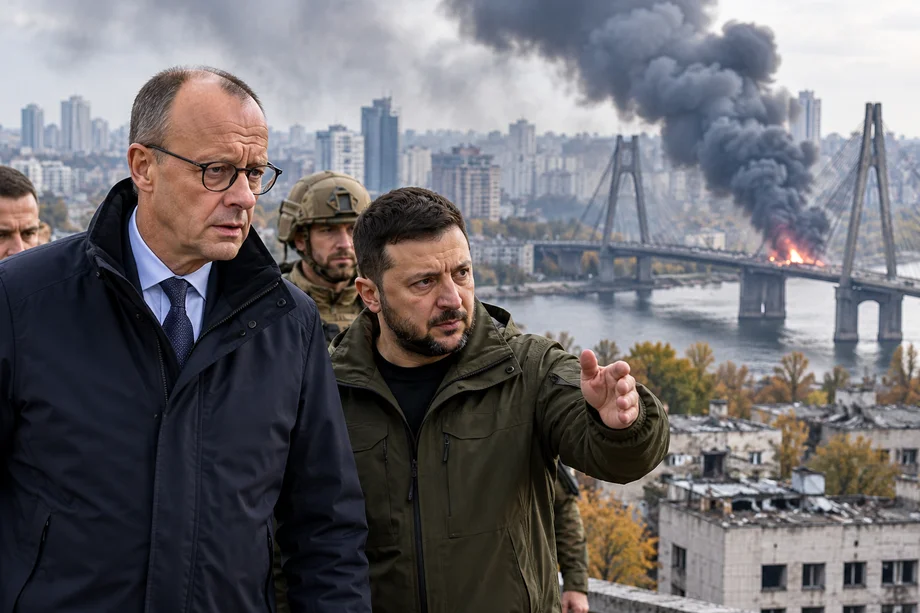
German Chancellor Friedrich Merz arrived in Kyiv for a surprise visit as Russian attacks struck the Ukrainian capital, turning a high profile show of European support into a dramatic reminder of the war’s continuing intensity.
Air raid sirens sounded across Kyiv and explosions were heard as Merz arrived on Sunday for talks with Ukrainian President Volodymyr Zelenskyy.
During the visit, Russia struck Kyiv’s Northern Bridge over the Dnipro River.
Kyiv Mayor Vitali Klitschko said the road surface of the bridge was hit, while emergency services were sent to the area. Debris from an intercepted aerial object also fell onto the roof of a residential building, according to German broadcaster Tagesschau.
Russia later confirmed that it had targeted the bridge, claiming it was being used to transport troops and military cargo. Reuters said those Russian claims had not been independently verified.
Merz used the visit to announce another major package of German assistance.
Reuters reports that Germany will provide an additional €1 billion in military aid, while €350 million will be directed toward repairing Ukraine’s damaged energy infrastructure.
The military package includes support for air defense, drones and other weapons as Ukraine prepares for another winter under sustained Russian attacks.
Germany and Ukraine are also expanding cooperation on weapons production, including interceptor drones designed to counter increasingly sophisticated Russian attack drones.
Merz made clear that Germany would continue backing Kyiv despite the security risks and pressure from Moscow.
“We will do everything we can to help Ukraine until this terrible war finally comes to an end,” Merz said alongside Zelenskyy, according to the German government.
The German chancellor described Ukraine’s defense as an issue affecting the future of Europe, warning that an unchecked Russian war machine could eventually threaten other European countries.
The timing of the Russian attack added significance to his visit.
Russia had warned foreign nationals about remaining in Kyiv, while attacks on Ukrainian infrastructure have intensified in recent days. The Northern Bridge strike was part of a series of attacks affecting transport infrastructure in the capital.
For Germany, the trip also sends a political message.
Berlin has become one of Ukraine’s most important military supporters, and Merz’s visit demonstrates that Germany intends to maintain that role even as the war enters another difficult winter.



