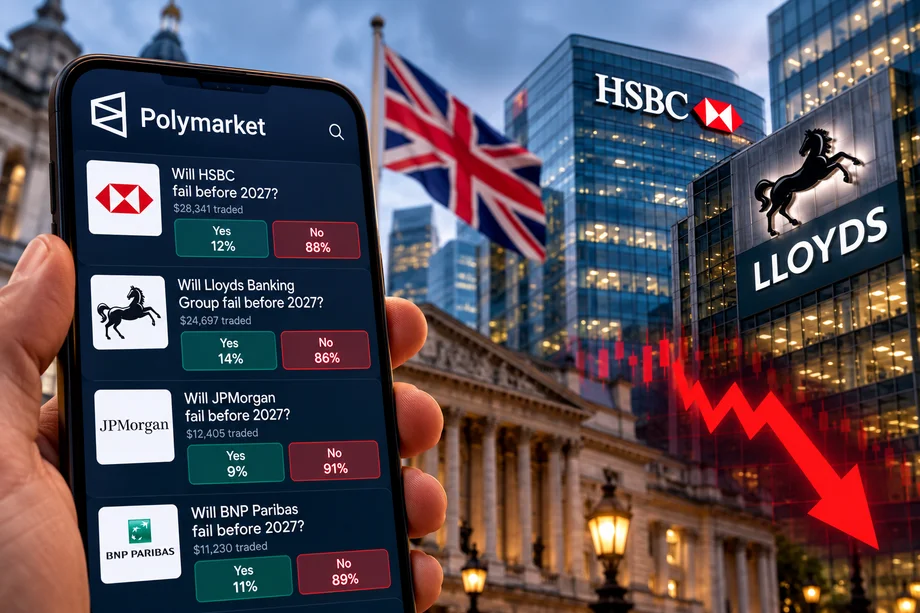
A controversial prediction market involving some of the world's biggest banks is attracting scrutiny in Britain after users were allowed to place money on whether major financial institutions could collapse.
Polymarket has hosted markets covering the possible failure of banks including HSBC, Lloyds Banking Group, JPMorgan and BNP Paribas before the end of 2026.
According to The Guardian, more than $77,000 (£58,000) worth of positions had been placed across markets concerning whether major global banks would fail.
The activity has prompted concerns among politicians and financial experts about whether prediction markets linked to sensitive financial events could create risks for market integrity.
Importantly, the existence of these wagers does not mean that HSBC, Lloyds or the other banks are expected to fail. The contracts represent positions taken by Polymarket users, rather than an official assessment of the financial health of the banks.
Why UK Authorities Are Concerned
The controversy centers on the possibility that prediction markets could create incentives for people to profit from events that could themselves damage confidence in financial institutions.
The Guardian reports that Liberal Democrat MP Bobby Dean has called for UK authorities to examine the issue, warning about potential risks surrounding bets on bank failures.
The Financial Conduct Authority is engaging with international regulators on questions surrounding prediction markets and financial market integrity, according to the report.
The Bank of England is also monitoring developments.
The issue is particularly sensitive because confidence plays a critical role in banking.
Modern bank runs can develop quickly when customers become concerned about an institution and begin withdrawing deposits, especially as mobile banking allows money to be moved almost instantly.
What Exactly Are People Betting On?
Polymarket allows users to take positions on the outcome of real world events.
Unlike a traditional bookmaker, prediction markets generally allow participants to buy contracts tied to whether a particular event will happen.
Prices can move as traders buy and sell those contracts.
The controversial bank markets effectively allow participants to speculate on whether named financial institutions will experience qualifying failures within a specified period.
The Guardian reported that banks appearing in these markets included HSBC and Lloyds in Britain, as well as major international institutions such as JPMorgan and BNP Paribas.
That has raised a difficult regulatory question: should people be able to financially benefit from predicting the collapse of a systemically important financial institution?
The Banks Are Not Being Reported as Failing
The distinction between a prediction market and evidence of actual financial distress is crucial.
There is currently no announcement that HSBC or Lloyds is failing because Polymarket users are wagering on such an outcome.
In fact, HSBC reported strong profitability earlier this year.
The Guardian reported in August that HSBC had generated about £7.5 billion in profits, while HSBC, NatWest, Barclays and Lloyds collectively recorded approximately £29.2 billion in profits during the first six months of 2026.
The controversy therefore concerns the nature of the betting markets and their possible consequences, rather than evidence that these banks are approaching collapse.
Why the Timing Matters
The debate arrives during an unusually nervous period for British financial markets.
UK banking shares fell sharply on Thursday as government borrowing costs increased and investors considered the possibility of additional taxes on banks in the upcoming UK budget.
Reuters reported that NatWest shares dropped 5.2 percent, HSBC fell 4.3 percent, Lloyds declined 4.4 percent and Barclays lost almost 4 percent.
The FTSE 350 banking index fell 4.1 percent during the session, its largest daily decline since May 5.
Separately, Britain's 30 year government bond yield reached its highest level since 1998 amid concerns surrounding inflation, energy prices and government finances.
Those developments do not establish a connection between the Polymarket contracts and the financial condition of individual banks, but they help explain why wagers involving bank failures are receiving additional attention.
Could Prediction Markets Affect Real Banks?
This is the central question regulators and financial experts are now confronting.
Prediction markets are designed to aggregate the expectations of participants. Supporters argue that this can provide useful information about how people assess uncertain future events.
Critics see a different risk when the event being traded involves the survival of a financial institution.
A rapidly changing prediction market could potentially spread across social media, where probabilities can easily be presented without context.
That could be particularly problematic with banks because public confidence is fundamental to their operation.
The collapse of Silicon Valley Bank in 2023 demonstrated how quickly concerns about a bank can accelerate once customers begin withdrawing money electronically.
The debate therefore extends beyond gambling regulation and into questions about financial stability, misinformation and market manipulation.
Access Restrictions Add Another Problem
Polymarket's international structure further complicates the situation.
The Guardian reports that residents of the United Kingdom, United States, Canada and European Union are officially restricted from participating on Polymarket's offshore platform.
However, concerns remain about whether geographic restrictions can be circumvented using technologies such as virtual private networks.
This creates a challenge for regulators because prediction markets can operate globally while financial regulation remains largely national.
A Bigger Test for Prediction Markets
Prediction markets have expanded far beyond elections and sporting events.
Users can now take positions on economic data, corporate developments, geopolitical events and other potentially market sensitive outcomes.
That expansion is forcing regulators to consider where prediction markets end and financial speculation begins.
For British authorities, wagers involving HSBC and Lloyds bring the question directly into one of the world's most important financial centers.
The immediate controversy is about bets on bank failures.
The bigger issue is whether prediction markets have become influential enough that what happens on those platforms could eventually affect the real world events on which their users are betting.



