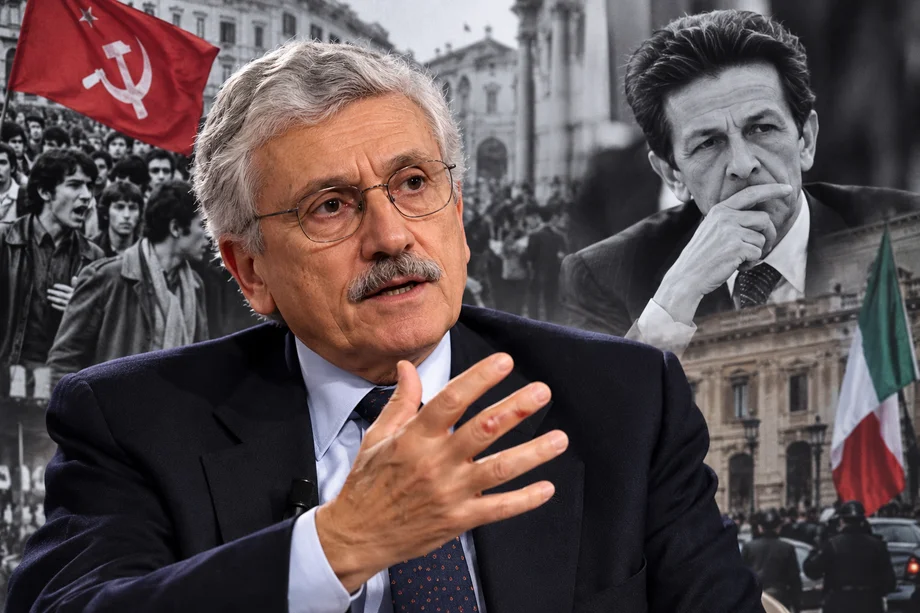
Former Italian Prime Minister Massimo D’Alema has revealed that he was once stabbed during a confrontation with a fascist activist, as he revisits decades of political battles in a striking new account of his life.
Speaking to Corriere della Sera ahead of the release of his book Eravamo comunisti, D’Alema described the violence that surrounded parts of Italian political life during his youth.
A knife attack that left a scar
D’Alema said the stabbing happened during a fight when another man pulled out a knife.
He raised his hand to protect himself and the blade cut one of his fingers, leaving a scar that he still carries today.
The former prime minister said the sight of the blood appeared to frighten his attacker more than it frightened him. He also recalled being beaten during other political confrontations, including clashes connected to the turbulent protest movements of the late 1960s.
His memories provide a personal glimpse into an era when ideological divisions in Italy regularly spilled from political meetings into street violence.
The Berlinguer phone call he never forgot
D’Alema also recalled an unusual encounter with Enrico Berlinguer, one of the most influential leaders in the history of the Italian Communist Party.
According to his account, Berlinguer once called him early in the morning seeking information about a political demonstration in Cosenza. D’Alema initially failed to realize who was speaking and responded sharply before discovering the identity of the caller.
He later described Berlinguer as extremely determined but personally courteous, and said he cried when the Communist leader died in 1984.
From street politics to prime minister
The stories are part of D’Alema’s new book Eravamo comunisti, published by Feltrinelli.
The book traces his journey through the Italian Communist Party, the protests of 1968, the Cold War and the transformation of Italy’s political left.
D’Alema eventually reached the highest level of government, serving as Italy’s prime minister from 1998 to 2000.
His recollections also stretch far beyond Italy. He describes encounters with Fidel Castro and revisits the political decisions surrounding the Kosovo conflict, offering a personal account of a career that moved from militant youth politics to international diplomacy.
Decades later, it is the physical scar from those early political battles that has become one of the most striking details of his story.



