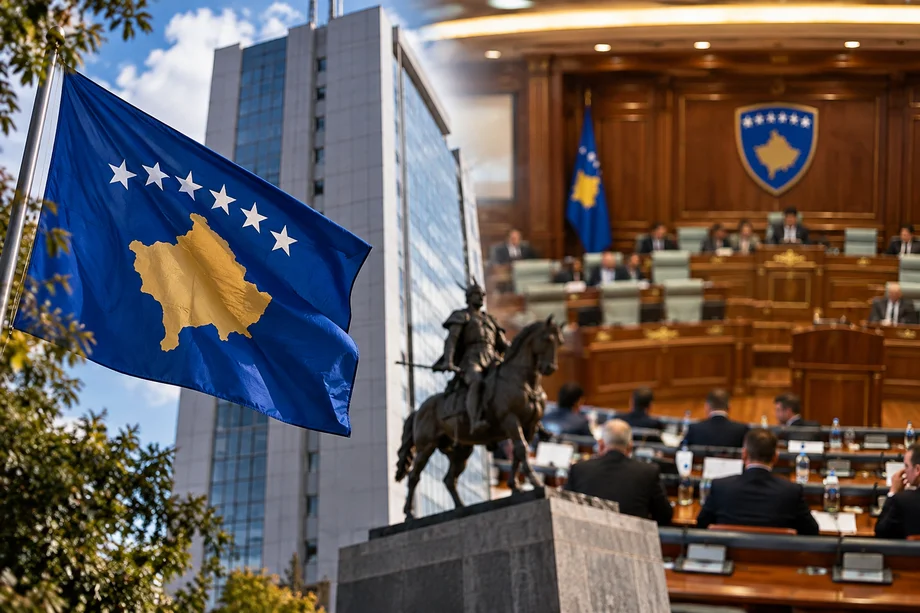
Kosovo has entered the final and potentially decisive 24 hours of its latest political crisis, as parties struggle to find enough votes to elect a new president before a constitutional deadline expires.
The Constitutional Court has ruled that parliament must elect the president by October 6.
The court determined that the 60 day constitutional period began on August 8 and ends on Monday. Failure to elect a president within that period would trigger another parliamentary election.
That would send Kosovars back to the polls for what would be the fourth parliamentary election in less than two years.
Despite the approaching deadline, no presidential candidate currently appears to have secured the necessary parliamentary support.
The most serious attempt to break the deadlock came when Prime Minister Albin Kurti’s Vetëvendosje and the Democratic League of Kosovo agreed in August to support former Constitutional Court judge and law professor Bekim Sejdiu.
But the agreement collapsed after six LDK lawmakers rejected it. Sejdiu subsequently withdrew his candidacy after acknowledging that he did not have sufficient support to be elected.
PDK becomes crucial to the final negotiations
Attention has now shifted toward the Democratic Party of Kosovo.
PDK has indicated that it is prepared to discuss the election of a president, but has linked its cooperation to changes concerning Kosovo’s Specialist Chambers in The Hague.
The issue has gained momentum in parliament. On September 28, a declaration concerning the Specialist Chambers received support from all 99 lawmakers present, although the Serbian List did not participate.
A parliamentary session has been scheduled for October 5 to consider proposed amendments related to the Specialist Chambers. However, the presidential election itself was not initially included on the agenda.
The timing creates another complication.
Under the standard legislative procedure, at least 72 hours are required between the first and second readings of legislation. That means amendments approved in principle on October 5 could not normally complete the legislative process before the presidential deadline expires.
Any attempt to accelerate that procedure could itself face legal challenges.
Kosovo has been here before
The presidential dispute has already sent Kosovo to the polls once this year.
The June 7 parliamentary election was called after lawmakers failed to agree on a successor to Vjosa Osmani.
Kurti’s Vetëvendosje emerged from that election with 53 of the 120 seats in parliament, leaving it dependent on cooperation with other parties to resolve major institutional questions.
The Constitutional Court subsequently confirmed that the new Assembly had been constituted and that the government elected on September 13 was constitutional. But it also established October 6 as the final deadline for choosing the president.
That has left Kosovo facing a familiar choice.
Political leaders can reach a last minute compromise on a president, or voters could once again be asked to decide the composition of parliament.
All major parties have publicly indicated that they would prefer to avoid another election, but as the deadline approaches, no agreement capable of producing the required parliamentary numbers has been publicly confirmed.
The next 24 hours could therefore determine whether Kosovo finally ends months of institutional uncertainty or enters yet another election campaign.



