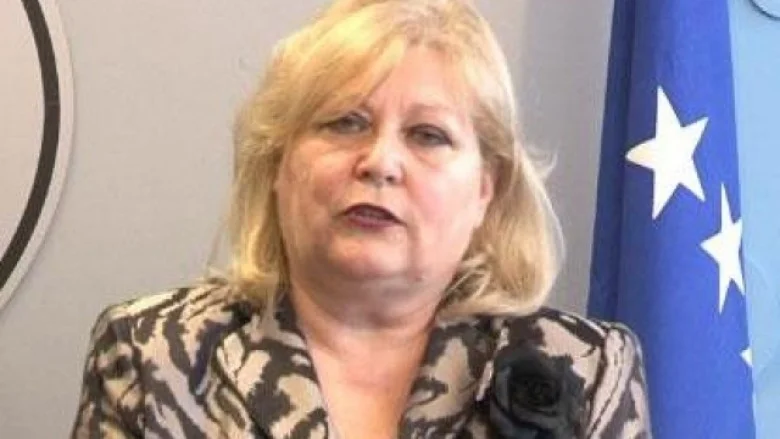
Kosovo’s parliament elected Justina Shiroka Pula as the country’s new president early Wednesday, ending a tense political standoff only minutes around the constitutional deadline and averting another institutional crisis.
Shiroka Pula received 81 votes in the Assembly of Kosovo, securing the support required to become Kosovo’s next head of state. KOHA reported that the parliamentary voting process continued until roughly three minutes after the constitutional deadline.
Her election followed hours of negotiations between Prime Minister Albin Kurti’s Vetëvendosje and the opposition Democratic Party of Kosovo, PDK, over two issues that had become politically intertwined: the election of the president and proposed changes to Kosovo’s law on the Specialist Chambers in The Hague.
Earlier Tuesday evening, Kurti publicly proposed Shiroka Pula as a compromise candidate. He said Vetëvendosje would first support the legislation concerning the Specialist Chambers if PDK lawmakers committed to participating in the presidential vote.
The formula ultimately broke the deadlock.
Parliament approved the changes concerning the Specialist Chambers before moving ahead with the presidential process, according to multiple reports following the late night session. A2 CNN reported that both votes were completed, while Newsmax Balkans also reported the passage of the legal changes alongside Shiroka Pula’s election.
The legislation had become the focus of intense political and public pressure in Pristina.
The Assembly had already approved the bill in principle earlier in the week. The official parliamentary agenda identifies it as amendments to Law No. 05/L 053 on Specialist Chambers and Specialist Prosecutor’s Office.
Its final passage had been demanded by demonstrators who had gathered in central Pristina for 21 consecutive days in support of former Kosovo Liberation Army leaders facing proceedings in The Hague.
The dispute escalated sharply on October 5, when clashes erupted outside parliament. Radio Free Europe reported that police used tear gas after some demonstrators threw fireworks and bottles toward officers. Six police officers were injured and 11 civilians sought medical attention.
Against that backdrop, Tuesday became a race against time.
Kurti initially proposed that parliament elect a president first and address the Specialist Chambers legislation afterward. PDK insisted that the legislation be completed first.
Hours before the deadline, Kurti changed his proposal and put forward Shiroka Pula, telling PDK leader Bedri Hamza that Vetëvendosje would support the Specialist Chambers bill first if PDK lawmakers participated in the presidential process.
Shiroka Pula brought an unusual political profile to the compromise.
She currently leads the Kosovo Academy of Sciences and Arts and became the first woman to head the institution in 2025. She previously served as Kosovo’s minister of energy and mining from 2008 to 2011 and as a member of parliament from 2011 to 2014.
Her earlier government service was particularly significant in Tuesday’s negotiations because she had served as a minister during the government led by former PDK leader Hashim Thaçi.
Kurti explicitly referred to that history when presenting her candidacy, describing Shiroka Pula as a former PDK minister and arguing that she could provide a way through the political impasse.
The consequences of failure would have been substantial. October 6 was the deadline for electing Kosovo’s president. Failure to complete the process risked dissolution of parliament and another round of elections.
Instead, the night ended with both issues that had dominated the confrontation resolved in parliament: changes concerning the Specialist Chambers were approved and Justina Shiroka Pula emerged with 81 votes as Kosovo’s new president.



