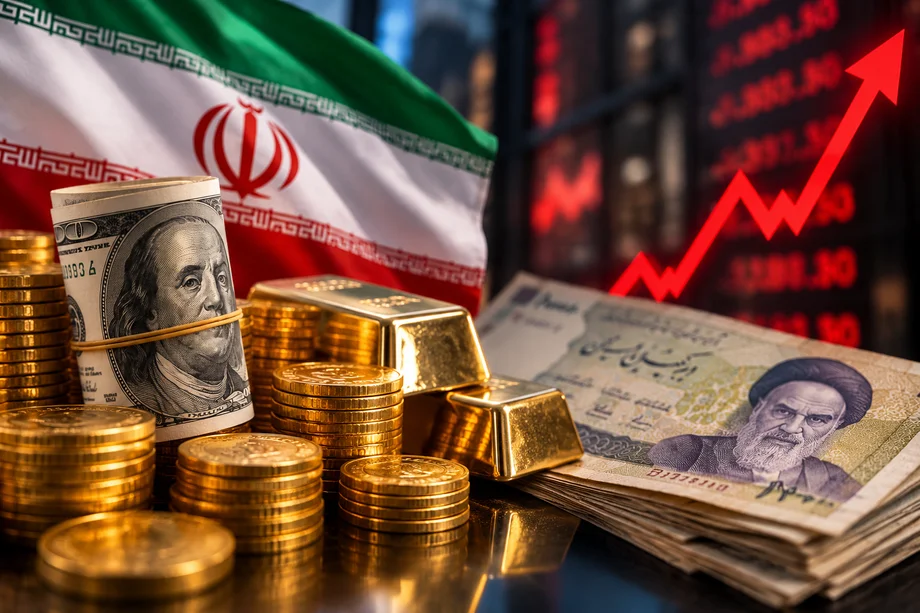
Iran's currency crisis is intensifying, with the rial falling to new lows against the US dollar as consumers and investors seek protection in foreign currency and gold.
The open market dollar reached about 2.593 million Iranian rials on October 1, according to Iran International.
The sharp decline has made the dollar price one of the most closely watched economic indicators in Iran.
Dollar and gold hit new highs
Gold prices have also climbed as Iranians look for ways to protect their savings from inflation and currency depreciation.
Iran International reported record levels for both the dollar and gold, while Iran's stock market also reached a record high.
The moves reflect growing economic uncertainty rather than necessarily indicating stronger economic conditions.
Inflation puts households under pressure
The currency decline comes as Iran struggles with extremely high inflation.
Iran International reported on October 3 that annual inflation was approaching 90 percent, with food prices rising particularly quickly.
A weaker rial can make imported goods more expensive, affecting products ranging from electronics to medicine and food.
Prices for some cheaper mobile phones reportedly jumped between 33 and 42 percent in a single month.
Why is Iran’s rial falling?
Several factors are putting pressure on the currency.
US sanctions have restricted Iran's access to international trade and foreign currency. Washington expanded sanctions again on October 1, targeting Iran's automotive and railway sectors as well as some foreign suppliers.
Geopolitical tensions and uncertainty surrounding Iran's economy have added further pressure.
The US dollar has also strengthened internationally in recent weeks.
Iran tries to stabilize the rial
Iranian authorities are attempting to slow the currency's decline.
The government has announced plans to sell as much as $2 billion in cash dollars, beginning with a $1 billion tranche distributed through banks.
However, currency intervention alone may not resolve underlying problems including inflation, fiscal pressures and broader economic uncertainty.
Why the dollar matters
For ordinary Iranians, the dollar exchange rate directly affects everyday life.
A weaker rial can increase prices for imported goods, electronics, vehicles, medicine and other products dependent on foreign currency.
The rial was already trading around 2.25 million per dollar in early September. By October 1, the reported open market rate had reached approximately 2.593 million.
With inflation remaining extremely high, the dollar and gold prices are likely to remain closely watched across Iran.



