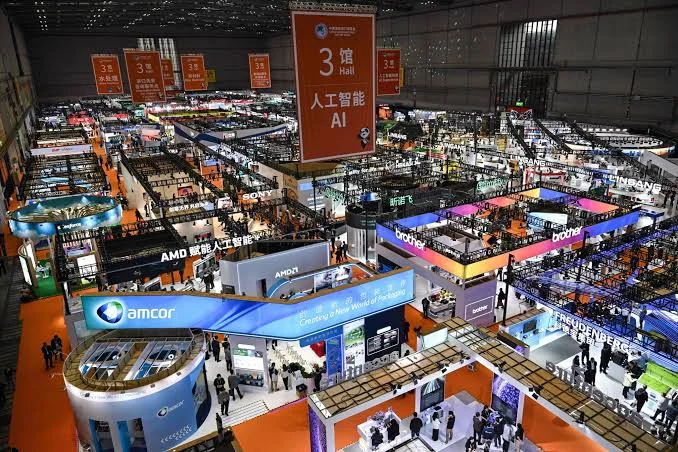
Global manufacturers are continuing to pour billions into advanced production technology despite economic uncertainty.
The 2026 World Manufacturing Convention concluded with 790 project agreements valued at 363.4 billion Chinese yuan, equivalent to approximately $54.2 billion.
The figures were announced following the convention in Hefei, China.
Held from September 20 through September 23, the event focused heavily on intelligent manufacturing.
Its theme, "Intelligent Manufacturing for a Better Future," reflected the rapid integration of artificial intelligence, robotics and automation into industrial production.
Factories Are Becoming Technology Platforms
Modern manufacturing increasingly looks very different from the traditional factory model.
Robotics have been used in industrial production for decades.
Artificial intelligence adds another layer.
AI systems can analyze production data, identify potential equipment failures, optimize supply chains and help manufacturers detect quality problems.
Advanced computer vision can inspect products at speeds impossible for human workers.
Digital twins can simulate factories before companies make expensive physical changes.
The combination could significantly increase productivity.
AI Demand Is Spreading Beyond Software
The artificial intelligence boom is usually associated with technology companies and data centers.
But manufacturing could become one of its biggest real world applications.
Factories require enormous amounts of computing power, sensors, networking equipment and increasingly sophisticated software.
That creates opportunities for semiconductor companies, cloud providers, robotics manufacturers and industrial technology businesses.
Investment in intelligent manufacturing also illustrates why AI related infrastructure spending continues expanding across multiple industries.
China Remains Central to Manufacturing
China continues to play an enormous role in global manufacturing and supply chains.
The scale of agreements announced around the convention shows that companies and regional authorities continue investing heavily in new industrial capacity.
At the same time, global supply chains are becoming more geographically diversified.
Companies are expanding production in Southeast Asia, India, Mexico and other regions.
The next phase of global manufacturing may therefore be defined by two major forces happening simultaneously.
Production is becoming more geographically distributed while factories themselves become more automated and intelligent.
The $54 billion in agreements announced around the convention provides another indication of how much capital is moving toward that transformation.



