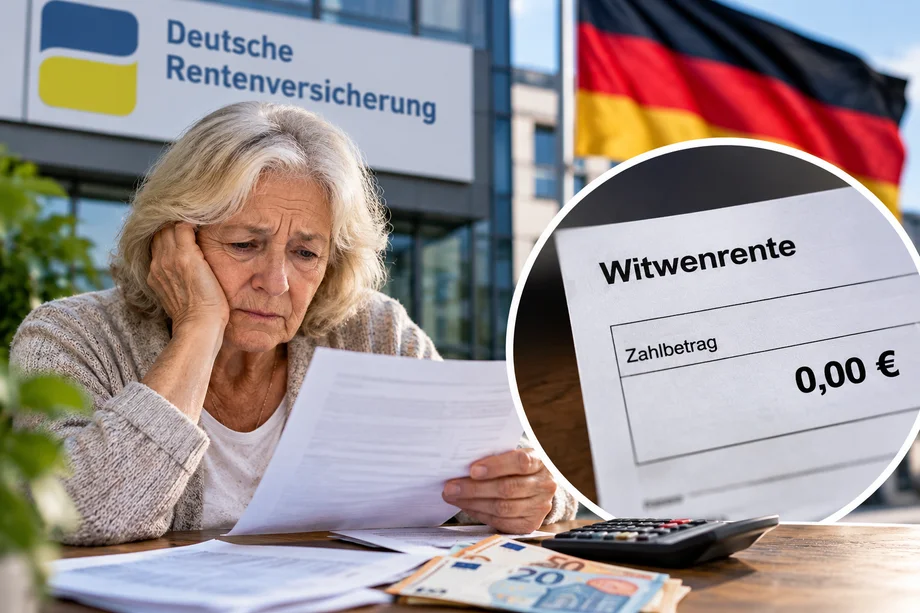
Thousands of people in Germany are receiving no payment from their widow or widower pension because their own income is high enough to completely offset the survivor benefit.
The issue has drawn renewed attention after data from Baden Württemberg showed that 71,743 widow and widower pensions had no payout at the end of 2025 because of income calculations.
Of those cases, 13,230 involved widows and 58,513 involved widowers, according to figures reported by German pension information outlets.
The situation does not mean Germany has abolished widow pensions. Instead, it reflects longstanding rules that determine how a recipient’s own income affects survivor benefits.
Why can a widow pension fall to zero?
Germany’s statutory pension system takes certain personal income into account when calculating widow and widower pensions.
Since July 1, 2026, recipients can have monthly qualifying net income of up to €1,122.53 before it begins reducing their survivor pension.
The allowance increases by €238.11 for each child who qualifies for an orphan’s pension.
When relevant income exceeds the allowance, 40 percent of the amount above the threshold is deducted from the survivor pension.
That rule is established under Section 97 of Germany’s Social Code.
If the calculated deduction becomes large enough, the monthly widow or widower pension payment can effectively reach zero.
A simple example
The German Pension Insurance provides a straightforward example.
Consider a widow without an eligible child whose relevant monthly net income is €1,500.
Her income exceeds the current €1,122.53 allowance by €377.47.
Forty percent of that excess is counted against the widow pension. That produces a reduction of about €150.99 per month.
Someone with substantially higher qualifying income could face a much larger reduction.
If that reduction equals or exceeds the calculated survivor pension, there may be no payment.
What income can affect the pension?
The rules extend beyond a normal salary.
Germany’s pension authority says relevant income can include employment earnings as well as other forms of income, depending on the individual case.
A person’s own pension can also be relevant. Income from investments and rental property may also enter the calculation under applicable rules.
This helps explain why people who still formally have a survivor pension entitlement may nevertheless receive no monthly payment.
The allowance actually increased in 2026
Despite the renewed concern, Germany did not reduce the general income allowance this year.
It increased it.
The monthly threshold rose from €1,076.86 to €1,122.53 on July 1, 2026.
The additional allowance for an eligible child also increased from €228.42 to €238.11.
The thresholds are adjusted annually alongside Germany’s current pension value.
Germany’s statutory pensions themselves also increased by 4.24 percent from July 2026.
Who can receive a widow pension?
Germany distinguishes between small and large widow or widower pensions.
Eligibility depends on several factors, including the deceased spouse’s pension insurance record and the circumstances of the marriage.
For marriages entered into from January 1, 2002, the marriage generally must have lasted at least one year, although exceptions can apply, including certain unexpected deaths.
For deaths occurring in 2026, the age threshold for the large widow or widower pension is 46 years and six months, unless another qualifying condition applies.
Why the issue matters
More than 5.7 million people in Germany receive survivor pensions, making the system an important source of income for millions of households.
The key distinction is that having a legal entitlement to a widow or widower pension does not necessarily guarantee a monthly payment.
Personal income can reduce the amount substantially, and for some recipients it can eliminate the payment entirely.
Anyone affected should therefore check the income calculation shown in their pension notice rather than assuming that a zero payment means the underlying pension entitlement has disappeared.



