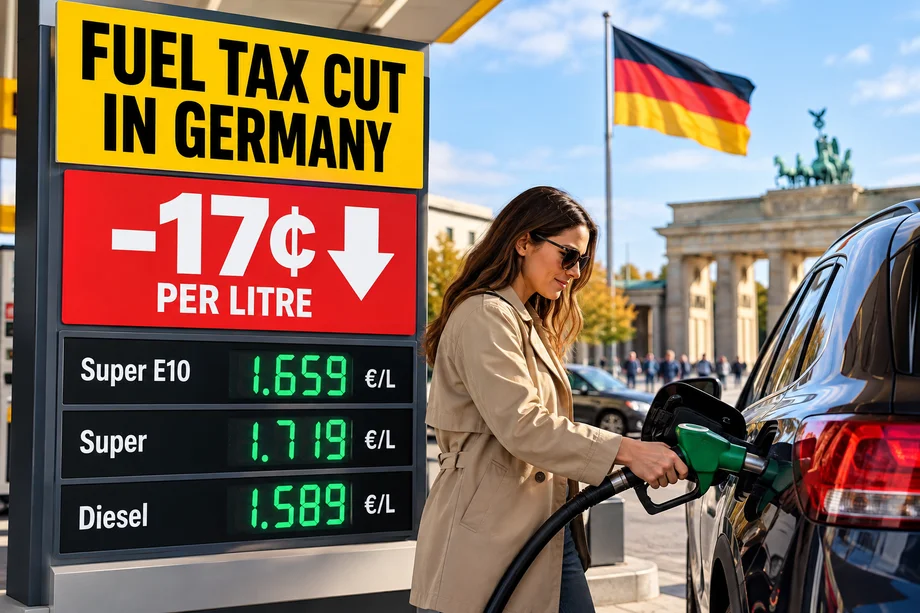
Germany has introduced a major fuel tax cut from October 1, 2026, giving drivers relief at petrol stations after months of volatile energy prices.
The German government has reduced the energy tax on both petrol and diesel by 14 cents per litre.
Once the associated value added tax is included, the total reduction amounts to approximately 17 cents per litre, according to the German Federal Government�. �
Bundesregierung +1
The measure took effect at midnight on Thursday, October 1, and will remain in place until December 31, 2026.
Fuel prices were already falling sharply at many German filling stations on Thursday morning as the tax reduction began reaching motorists. �
Yahoo Finance
For drivers filling a large tank, the savings can quickly become noticeable.
A 50 litre fill could theoretically cost around €8.50 less if the full tax reduction is passed through to customers.
For a 70 litre tank, the difference could approach €11.90.
How much cheaper is fuel in Germany?
The tax reduction itself is straightforward.
Germany is cutting the energy tax by 14 cents for every litre of petrol and diesel sold until the end of 2026.
Because value added tax is also calculated on the underlying fuel price, the effective reduction for consumers is approximately 17 cents per litre. �
Bundesregierung +1
The final price displayed at an individual petrol station will not necessarily fall by exactly 17 cents.
Fuel prices also depend on crude oil prices, wholesale markets, refinery costs, exchange rates, transportation costs and competition between petrol stations.
But the tax component of the price has now been substantially reduced.
How much can drivers save?
The potential saving depends on how much fuel a vehicle uses.
If the entire tax reduction reaches consumers, a driver buying 40 litres could save about €6.80.
A 50 litre fill could save around €8.50.
Someone purchasing 60 litres could save approximately €10.20.
A 70 litre fill could be about €11.90 cheaper.
For drivers who fill their vehicles several times each month, the savings can accumulate quickly.
A household buying 150 litres of petrol or diesel per month could theoretically save around €25.50 monthly compared with the same fuel price before the tax reduction.
Over the three months covered by the measure, that would amount to approximately €76.50.
Actual savings will depend on market prices and how completely fuel retailers pass the tax reduction to customers.
Petrol prices fell as the tax cut began
Early evidence suggests the measure is already affecting prices.
Fuel prices dropped sharply across much of Germany on October 1 as the second fuel tax reduction of 2026 came into effect. �
Yahoo Finance
The government expects the tax cut to provide around €2.5 billion in combined relief for households and businesses.
Germany's federal government and the states will share the financial cost.
The Länder are contributing approximately €1.25 billion through a fixed value added tax allocation. �
Bundesregierung +1
The size of the package demonstrates how seriously Berlin views the renewed energy price pressure facing Europe's largest economy.
Why is Germany cutting fuel taxes again?
The latest measure follows another sharp increase in global energy prices.
The conflict in the Middle East has disrupted energy markets and pushed up the cost of crude oil and refined fuels.
Germany is particularly sensitive to those movements because higher fuel prices quickly affect households, transport companies and industrial businesses.
September inflation figures demonstrated the scale of the problem.
German inflation accelerated to 3.3 percent in September, its highest level since December 2023, according to Reuters.
Energy inflation surged to 14.9 percent, compared with 10.5 percent in August. �
Reuters
Core inflation, which excludes energy and food, remained at 2.4 percent.
That suggests energy has become one of the main forces pushing Germany's headline inflation rate higher.
Germany already tried a fuel discount this year
This is not the first time German drivers have received fuel tax relief in 2026.
The government introduced a previous temporary fuel tax reduction in May and June.
That measure was designed to cushion households from the initial energy price shock created by the conflict involving Iran.
The earlier discount cost approximately €1.6 billion, according to Reuters. �
Reuters
Evidence from Germany's largest automobile association suggested much of that reduction eventually reached drivers.
ADAC reported in May that Super E10 had fallen by 5.2 cents per litre over one week, while diesel dropped by 11.2 cents.
ADAC said the reduction was largely attributable to the fuel tax discount introduced on May 1. �
ADAC Presse
The new October measure is similar in scale but lasts three months.
Will petrol stations pass on the full 17 cents?
That is one of the biggest questions for German motorists.
A tax cut does not legally guarantee that every petrol station immediately lowers its retail price by exactly the same amount.
Fuel retailers continue setting prices according to market conditions.
Germany's experience with the previous fuel tax reduction shows why drivers should watch prices carefully.
When the earlier discount ended on July 1, ADAC accused oil companies of raising prices prematurely.
On June 30, the final day of the previous discount, Super E10 increased by 6.2 cents compared with the previous day.
Diesel jumped by 7.5 cents. �
ADAC Presse
ADAC strongly criticized the increases because fuel that had already been taxed at the lower rate was still present in many petrol station storage tanks.
That experience means consumer organizations are likely to closely monitor prices during the latest tax reduction.
Why fuel prices can change throughout the day
German drivers may notice that even after the tax cut, the price at the same petrol station can vary depending on when they fill their tank.
Fuel prices in Germany change regularly.
ADAC has repeatedly advised drivers to compare prices rather than automatically using the nearest station.
Earlier this year, the automobile club estimated that filling up at the right time of day could produce savings of around 13 cents per litre compared with less favorable times. �
ADAC Presse
That difference is almost as large as the government's new tax reduction.
For a 50 litre tank, a 13 cent price difference equals €6.50.
Combined with the temporary tax relief, careful timing could therefore produce significant savings.
Why diesel has become especially expensive
Diesel drivers have faced particularly severe price pressure during 2026.
In March, ADAC reported that the average diesel price had jumped by 12.6 cents in only one week, reaching €2.288 per litre.
Super E10 reached €2.074 during the same period. �
ADAC Presse
At one point, diesel approached Germany's historic price record from 2022.
That was unusual because diesel benefits from a significantly lower energy tax than petrol.
ADAC noted that diesel taxation is approximately 20 cents per litre lower than petrol taxation, yet diesel was still selling at exceptionally high prices. �
ADAC Presse
The reason lies largely in international diesel markets.
Europe remains heavily exposed to disruptions in global supplies of refined fuel.
Russia has extended its diesel export ban
Global diesel supplies are facing another complication.
Russia extended its diesel export ban through the end of October on September 30.
The country has historically been one of the world's largest diesel exporters.
The restrictions are intended to stabilize Russia's domestic fuel market after refinery disruptions and rising local prices. �
Reuters
The international market is simultaneously dealing with disruptions linked to the conflict in the Middle East.
Those pressures have created a particularly difficult environment for diesel consumers.
Truck operators, logistics companies, farmers and businesses that rely heavily on diesel can face significant increases in operating costs when wholesale prices rise.
The United States is pressuring Germany over fuel reserves
Germany's energy policy is also becoming part of a broader international debate.
The United States has urged Germany and France to release additional emergency diesel stocks to help reduce global prices.
Reuters reported on October 1 that the Trump administration had warned it could consider restricting US diesel exports if European countries did not contribute more emergency supplies. �
Reuters
Washington has asked European countries to release additional fuel reserves as part of international efforts to stabilize markets.
The United States argues that it has already released significant quantities from its own strategic reserves while some European countries have contributed less than expected. �
Reuters
Germany and France had not formally responded to the latest US demand at the time of reporting.
Italy is also trying to cut fuel prices
Germany is not the only major European economy taking action.
Italy has introduced a different approach.
Major fuel suppliers including Eni, Q8 and SOCAR have announced price caps or discounts beginning around October 1.
Eni� has capped diesel at €2.19 per litre and petrol at €1.99 per litre through its Enilive network. �
Reuters +1
The Italian government has also used temporary fuel tax reductions.
Across Europe, governments are trying to prevent higher energy prices from creating another sustained inflation shock.
The approaches differ, but the objective is similar: reduce the amount households and businesses pay for transportation.
German inflation is back above 3 percent
The timing of Germany's fuel tax reduction is particularly important because inflation has accelerated again.
Germany's 3.3 percent September inflation rate was significantly above the European Central Bank's medium term 2 percent objective for the euro area.
Energy costs were a major contributor.
At the same time, Germany's labor market has shown signs of weakness.
Seasonally adjusted unemployment increased by 12,000 in September to approximately 3.01 million, according to Reuters. �
Reuters
That combination creates a difficult economic environment.
Higher inflation reduces household purchasing power.
Higher energy prices increase business expenses.
A weaker labor market makes it harder for wages and employment growth to compensate.
The fuel tax reduction is therefore intended to provide relatively immediate relief.
Businesses will also benefit
The measure is not only aimed at private motorists.
Transport companies can consume enormous quantities of diesel.
A commercial vehicle traveling thousands of kilometres every month can use hundreds or thousands of litres of fuel.
A 17 cent reduction per litre therefore becomes economically significant at scale.
A company purchasing 1,000 litres could potentially save around €170 if the full reduction reaches retail prices.
At 10,000 litres, the theoretical difference reaches €1,700.
Lower transportation costs can also indirectly benefit consumers.
Fuel expenses are built into the cost of moving food, parcels, construction materials and other goods across Germany.
Reducing those costs can limit pressure on retail prices.
How long will the German fuel tax cut last?
The new tax reduction applies from October 1 through December 31, 2026. �
Bundesregierung
That means motorists have three months of temporary relief.
What happens on January 1, 2027 is less certain.
The government has indicated that it is working on a broader approach for next year, but the current 17 cent relief is specifically temporary.
Unless additional measures are approved, the reduced energy tax will expire at the end of December.
That could create another significant change in pump prices around New Year.
Drivers should therefore not assume that today's lower tax rate will continue permanently.
Should drivers wait before filling their tank?
The tax reduction is already in force.
However, the full impact may not appear simultaneously at every petrol station.
Fuel purchased and stored by retailers before October 1 may have been taxed differently, while pricing strategies vary between companies and locations.
During the previous fuel discount, ADAC said the tax reduction gradually became visible in retail prices rather than appearing identically everywhere at midnight.
Drivers who do not urgently need fuel may therefore benefit from comparing nearby stations before filling a large tank.
Prices can also differ significantly even within the same city.
Germany's €2.5 billion bet on cheaper fuel
For Germany, the October fuel tax cut represents a substantial intervention in the energy market.
The government is sacrificing approximately €2.5 billion in tax revenue to reduce the pressure facing households and businesses. �
Bundesregierung
For individual motorists, the calculation is much simpler.
Every litre of petrol or diesel can now carry approximately 17 cents less tax than it did yesterday.
Whether drivers receive the entire benefit depends on how fuel retailers price their products and how international oil markets move.
But as the new tax cut reaches filling stations across the country, millions of German motorists should begin seeing lower prices immediately.
And for anyone planning a long drive through Germany this autumn, October 1 has suddenly become an important date.



