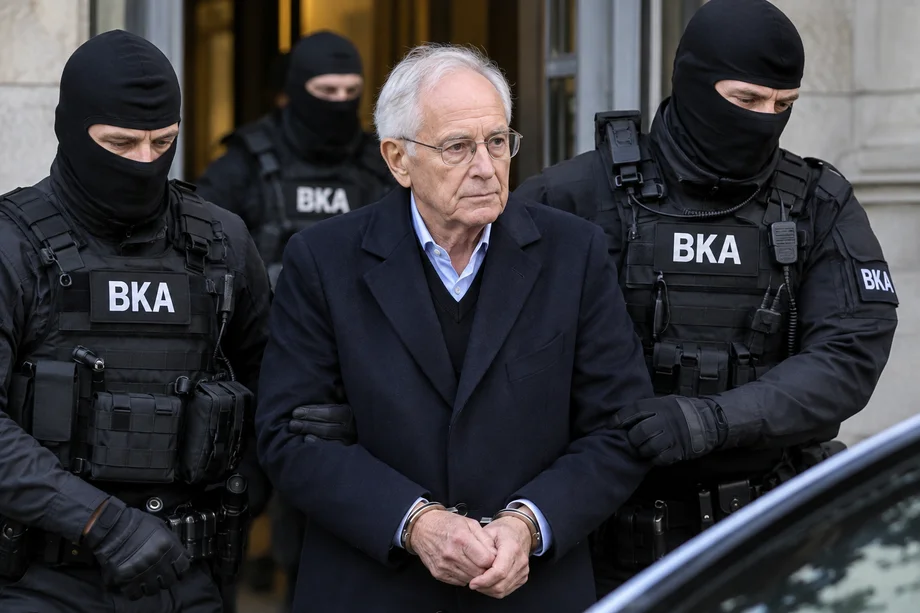
Germany has arrested one of its former intelligence chiefs in an extraordinary espionage investigation involving thousands of secret documents and alleged contacts with foreign intelligence officers.
Federal prosecutors said Tuesday that August Hanning, 80, is strongly suspected of treasonous espionage, obtaining state secrets, attempted treason and acting as an intelligence agent.
Hanning led Germany’s Federal Intelligence Service, known as the BND, from December 1998 until November 2005.
A former senior aide, identified under German privacy rules as Manfred D., was also arrested. Prosecutors accuse him of assisting attempted treason and treasonous espionage.
The allegations are among the most serious to hit Germany’s intelligence establishment in years.
The German Federal Prosecutor’s Office said the two men were arrested Tuesday in Bavaria and North Rhine Westphalia. Authorities also searched properties connected with the suspects, including locations in Berlin.
The case centers on an alleged arrangement dating back to 2010.
According to prosecutors, Manfred D. agreed to repeatedly provide Hanning with valuable intelligence from the BND in return for payment.
The arrangement was particularly sensitive because Manfred D. continued working at the heart of Germany’s foreign intelligence service long after Hanning had left government.
He had previously served as Hanning’s chief of staff.
From March 2012 until March 2026, prosecutors said, he again worked as chief of staff for several successive BND presidents.
That position gave him access to highly sensitive information.
Investigators now believe he supplied Hanning with approximately 2,000 documents over the years.
Many contained classified information intended exclusively for internal BND use, according to the Federal Prosecutor’s Office.
Some material was associated with executive intelligence briefings, the regular meetings involving senior officials from German ministries and security agencies at the Federal Chancellery.
Prosecutors allege Hanning used the information in his private consulting activities after leaving government.
The investigation becomes considerably more serious because of what authorities say happened to at least some of the intelligence.
On one occasion, prosecutors allege, Hanning used classified information supplied by Manfred D. to prepare an analysis for an officer belonging to a foreign intelligence service.
Authorities have not identified that intelligence service or the country it represented.
Prosecutors also stressed that investigators have not yet established whether the material ultimately reached its intended recipient.
That remains an important unresolved element of the case.
The Federal Prosecutor’s Office also alleges that Hanning maintained close contact for several years with a representative of another foreign intelligence service.
During that relationship, Hanning allegedly provided political information that was partly based on material supplied by Manfred D.
Again, German authorities have not publicly identified the foreign service involved.
That means speculation about which country may have benefited from the information remains unconfirmed.
German media including WDR, NDR and Süddeutsche Zeitung reported that Russia was not the foreign power involved in the alleged operation, but prosecutors themselves have not publicly named the service.
Reuters reported that the documents allegedly obtained by Hanning included material concerning Iran’s nuclear program and the Russian military, as well as information classified by Germany’s foreign intelligence partners.
If confirmed, the involvement of intelligence supplied by allied countries could significantly increase the consequences of the case.
Intelligence agencies depend heavily on cooperation and the exchange of classified material with trusted foreign partners.
A serious breach involving information supplied by another country can therefore damage not only domestic security but also the willingness of partner agencies to share sensitive intelligence in the future.
The BND has launched an internal investigation.
The agency’s current president, Martin Jäger, said the service has zero tolerance for violations of internal security, Reuters reported.
Hanning’s arrest is particularly remarkable because of the senior positions he previously held inside the German state.
After running the BND, he became a state secretary in Germany’s Interior Ministry from 2005 until 2009.
He later entered the private sector and worked as a consultant.
The allegations therefore concern a former official who once had access to some of Germany’s most sensitive national security information.
The investigation also has an unusual origin.
Federal prosecutors said the case emerged from evidence uncovered during a separate investigation involving Hamburg businesswoman Christina Block.
Block has been at the center of a widely followed criminal case concerning the abduction of two of her children from Denmark during a long running custody dispute.
German authorities previously investigated whether Hanning and another former law enforcement official, working through a security company, had accepted an assignment connected with an earlier attempt to abduct the children.
Hanning’s premises were searched in September 2025 during that investigation.
Information discovered in the search eventually raised concerns about classified BND material, according to prosecutors.
Germany’s Federal Prosecutor’s Office took over the intelligence investigation in May 2026 and worked with the BND and Federal Criminal Police Office.
The allegations against Hanning and Manfred D. have not been proven in court.
The investigation is ongoing, and both men are entitled to challenge the accusations against them.
The precise duration of the alleged transfer of documents is also still being established.
Prosecutors say the arrangement began in 2010 and continued for years. Manfred D.’s access to sensitive BND information lasted until he left his senior position in March 2026.
It is not yet clear whether documents were continuously passed throughout that entire period.
German lawmakers have already begun demanding answers.
Konstantin von Notz, a member of the parliamentary committee overseeing Germany’s intelligence agencies, described the allegations as deeply troubling and called for a rapid and comprehensive investigation.
Von Notz also renewed concerns about former senior security officials moving into private consulting after leaving government, according to the Associated Press.
The case could now raise broader questions about how Germany controls access to intelligence after senior officials leave office and how closely individuals with the highest security clearances are monitored when they begin private consulting work.
It may also prompt scrutiny of internal BND safeguards.
Manfred D. allegedly occupied positions giving him access to confidential information for years while the document transfers were taking place.
If prosecutors prove that sensitive intelligence was systematically removed from the agency, investigators will need to determine how the activity avoided detection and whether security procedures have since been strengthened.
Germany has experienced several serious espionage cases in recent years, including investigations involving alleged Russian and Chinese intelligence activity.
The arrest of a former BND president, however, places the current investigation in a different category.
Hanning was not simply an employee with access to classified information.
He once ran the organization responsible for collecting Germany’s foreign intelligence.
The case now before German investigators concerns what allegedly happened after he left that position, when prosecutors say his former aide continued supplying information from inside the agency.
Approximately 2,000 documents may ultimately need to be assessed to determine what information was compromised, how sensitive it was and whether it reached foreign intelligence services.
Those questions remain unanswered.
What is confirmed is already extraordinary: Germany has arrested a former head of its foreign intelligence service on suspicion of some of the country’s most serious national security crimes.



