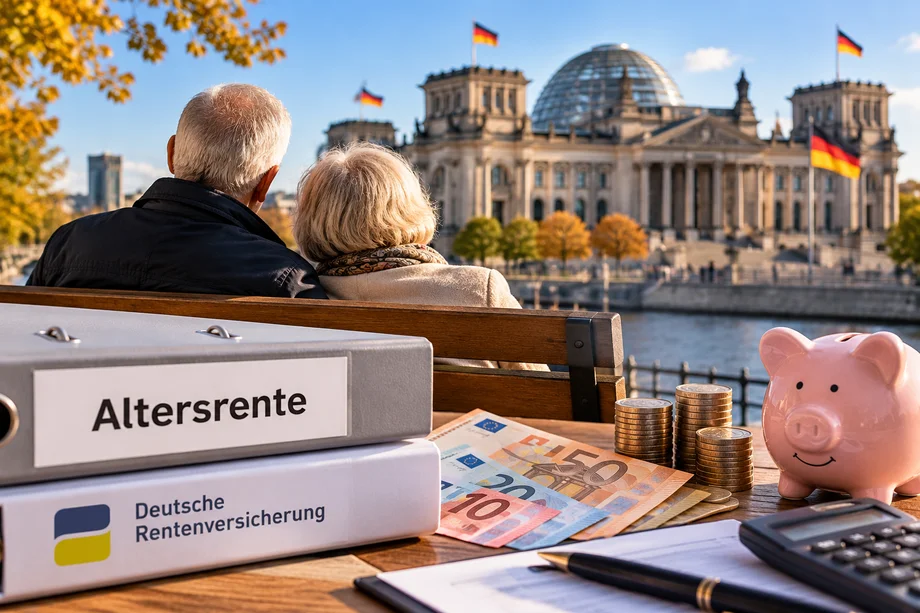
A question affecting many households in Germany has a surprisingly important distinction: what happens financially in retirement if someone has never worked?
The answer is not that Germany automatically pays everyone a pension.
To receive Germany's regular statutory old age pension, a person generally needs to have completed a minimum insurance period of five years, according to the German Pension Insurance authority, Deutsche Rentenversicherung.
However, people who reach retirement age without sufficient pension income may be able to receive a separate social benefit known as Grundsicherung im Alter, or basic income support in old age.
No Contributions Can Mean No Statutory Pension
Germany's statutory pension is based largely on contributions and credited insurance periods.
People accumulate pension entitlements through employment and certain other qualifying periods.
Deutsche Rentenversicherung states that the standard old age pension normally requires at least five years of qualifying insurance periods.
This means someone who has never worked and has no other qualifying pension periods does not simply receive a normal statutory pension because they have reached retirement age.
There is an important qualification.
Periods such as raising children can count toward pension insurance, meaning a person who has never had conventional paid employment may still have pension entitlements.
What Happens If You Have No Pension?
Germany has a separate safety net for people whose income and assets are insufficient to cover essential living expenses.
This is called Grundsicherung im Alter.
According to Deutsche Rentenversicherung, people who have reached the regular retirement age and cannot finance their living costs from their own income may qualify. Applicants must also live in Germany.
The benefit is therefore different from a pension.
It is a means tested social benefit designed to guarantee basic living expenses.
How Much Can Someone Receive?
For a single person, the standard basic needs amount in 2026 is €563 per month, according to a current report examining the rules for people who reach retirement without a sufficient pension.
But €563 is not necessarily the person's total support.
Recognised housing and heating costs can generally be added to the basic amount. Individual circumstances can also affect the calculation.
That means there is no single total monthly payment that applies to every recipient.
A person living in an expensive city such as Munich, for example, may have different recognised housing costs from someone living in a smaller German town.
Income and Assets Matter
Unlike the statutory pension, Grundsicherung is based on financial need.
Authorities therefore examine income and assets when determining whether someone qualifies and how much support they can receive.
Deutsche Rentenversicherung explains that the benefit is intended for people whose income is insufficient to cover their living costs.
Other income can therefore affect the final payment.
The same applies to assets, subject to the applicable exemptions and social assistance rules.
What About Adult Children?
One concern among older people is whether their children could be forced to pay their living expenses.
There is an important protection in the German system.
Deutsche Rentenversicherung states that the income of children or parents is generally considered only when it exceeds €100,000 per year.
This rule can make it easier for people with relatively modest family incomes to apply for support without assuming their children will automatically become responsible for the cost.
German Pensions Rose in July
For people who do receive a statutory pension, payments increased significantly this year.
Germany raised statutory pensions by 4.24 percent from July 1, 2026.
The current pension value increased from €40.79 to €42.52 per pension point, according to Deutsche Rentenversicherung.
Around 21.5 million pensioners were affected by the adjustment.
A theoretical standard pension based on 45 years of average earnings consequently increased by €77.85 per month.
Actual pensions vary considerably because they depend on individual earnings and accumulated pension points.
Pension and Basic Support Are Not the Same
The distinction is crucial.
A statutory pension is an insurance benefit based on accumulated pension rights.
Grundsicherung is financial assistance for people who cannot adequately support themselves in old age.
Someone could therefore receive a small statutory pension and still potentially qualify for additional basic support if their overall financial resources are insufficient.
Similarly, someone without a statutory pension may qualify for Grundsicherung if the eligibility requirements are satisfied.
You Must Apply
Basic income support is not simply converted into a pension and automatically paid when someone reaches retirement age.
People who believe their income will not be enough should check their eligibility and submit an application to the responsible authority.
Deutsche Rentenversicherung advises people whose income in retirement does not cover their living expenses to investigate whether they qualify for Grundsicherung.
The key point is simple: never having worked does not automatically create a German pension entitlement, but reaching retirement age without sufficient income does not necessarily mean being left without financial support.
Germany's basic income system can provide eligible residents with money for essential living costs, along with recognised housing and heating expenses.



