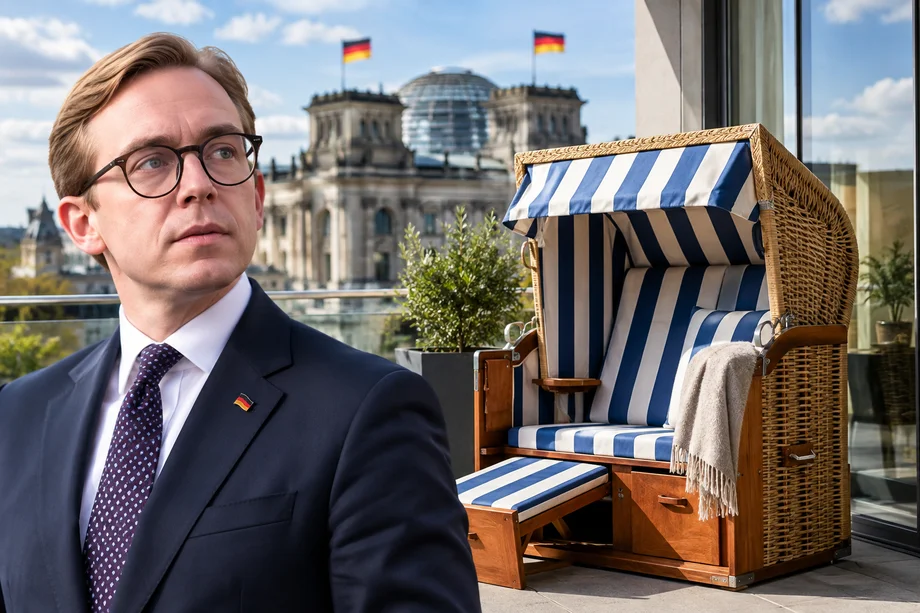
A beach chair would normally be an unlikely source of political controversy. For German politician Philipp Amthor, however, one piece of furniture has generated days of headlines, online criticism and ridicule.
The CDU politician, who serves as Minister of State for Federal and State Relations at the German Chancellery, was shown having a traditional German Strandkorb delivered to the balcony outside his Berlin office.
The scene appeared in the ZDF documentary series “Inside CDU” and quickly attracted attention on social media.
NDR reports that Amthor personally bought the beach chair and also paid for its delivery and installation. According to a government spokesperson, it was intended as a symbol of his connection to his home state of Mecklenburg Western Pomerania.
A beach chair inside Germany’s seat of power
The Strandkorb is a familiar sight along Germany’s Baltic and North Sea coasts, but its appearance at the Chancellery created a very different reaction.
Some social media users criticized the scene as inappropriate or overly luxurious for a government office. Others treated the controversy humorously or defended Amthor.
NDR reports that an Instagram post by ZDF about the scene attracted more than 2,000 comments by Monday afternoon.
The criticism eventually prompted an official response.
Deputy government spokesperson Steffen Meyer said Amthor was taking the reaction seriously and had decided to remove the chair from the Chancellery.
Now the chair has a new home
The story did not end with its removal.
NDR reported on October 1 that the beach chair will now be donated to the new Fliederhof care facility in Ueckermünde, Amthor’s hometown in northeastern Germany.
The facility is operated by AMEOS and provides care for people with mental and physical disabilities.
According to reports, the chair will be treated as a private donation and used by residents at the facility.
A spokesperson for AMEOS said the organization received the news with gratitude.
Was it really a scandal?
The episode has also triggered a debate in German media over whether the reaction was disproportionate.
In a commentary published Friday, NDR columnist Ulrich Kühn questioned whether the privately purchased chair should have been treated as a political scandal at all.
That distinction is important because there is no indication that taxpayers paid for the Strandkorb.
NDR and Tagesschau both report that Amthor paid for the chair, its delivery and installation himself.
The controversy instead focused largely on the symbolism and public image created by placing the furniture on the Chancellery balcony.
Why Philipp Amthor is attracting attention
The timing has added to the interest surrounding the 33 year old CDU politician.
Amthor has served as Minister of State at the Chancellery since late July and has long been one of the more recognizable younger figures in Germany’s Christian Democratic Union.
The ZDF documentary provided viewers with an unusually close look at his daily political life, and the Strandkorb scene became one of its most discussed moments.
The chair itself has now left Berlin.
But what began as a personal reminder of Germany’s Baltic coast has turned into an unexpected national conversation about political image, public perception and whether a beach chair ever deserved this much attention.



