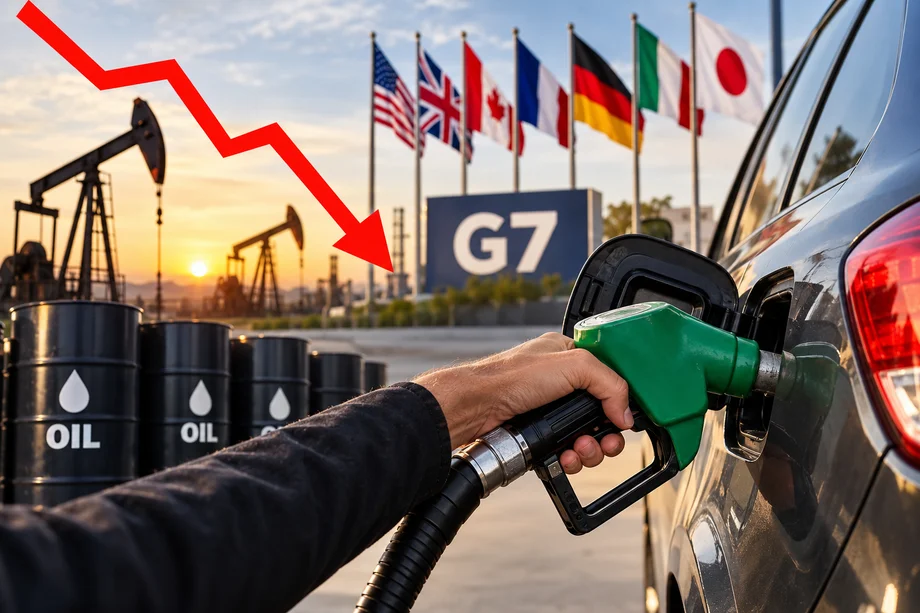
Drivers facing sharply higher fuel bills could finally see some relief after the world's leading industrial economies agreed to release 100 million barrels of diesel and crude oil from emergency stockpiles.
The Group of Seven announced the coordinated action on October 2, with the release beginning immediately and continuing over four months.
A substantial amount of diesel will be released within the first 20 days, according to the joint G7 statement reported by Reuters.
The decision comes as diesel and oil prices have surged amid severe pressure on global energy supplies.
Oil Prices Are Already Falling
The announcement had an immediate impact on markets.
International Energy Agency Executive Director Fatih Birol said oil prices had already fallen by around $5 following the decision, Reuters reports.
Birol said the IEA would work with member countries on distribution and remained prepared to release additional emergency reserves if market conditions required further intervention.
Brent crude settled at about $102.25 per barrel on Friday, while US West Texas Intermediate crude fell to approximately $91.11 per barrel.
Whether those declines quickly translate into lower prices at petrol stations will depend on refining costs, taxes, regional supply and local market conditions.
Why Diesel Has Become the Bigger Problem
The current energy squeeze is not simply about whether the world has enough crude oil.
Diesel supplies have become particularly tight.
Military conflict and disruption to refinery infrastructure in the Middle East and Russia have reduced the global capacity to transform crude oil into diesel and other fuels.
Russia has also extended restrictions on diesel exports until the end of October, according to Reuters. Russia was previously one of the world's largest diesel exporters.
That has created additional pressure in Europe, which has become increasingly dependent on imported diesel.
The European Commission said on October 2 that EU diesel supplies remain stable for now, but acknowledged that prices remain high because of tight conditions in the global market.
Germany and France Are at the Center of the Response
European governments have been discussing how much fuel should be released from strategic reserves.
Reuters reported that France proposed releasing 50 million barrels of European diesel, alongside another 50 million barrels of crude oil from International Energy Agency members.
Germany and France are especially important because both maintain substantial emergency energy reserves and represent two of Europe's largest economies.
The United States had increased pressure on European allies to release diesel stocks as prices continued climbing.
President Donald Trump had previously discussed restricting US diesel exports if Europe did not act, although he later said an export ban would not be imposed.
The G7 agreement also includes a commitment to avoid energy export restrictions among member countries.
What It Could Mean for Drivers
The central question for households is whether the emergency release will make filling a car cheaper.
The early decline in oil prices is encouraging, but changes at petrol stations normally depend on more than crude prices alone.
Diesel prices are particularly influenced by refinery availability and regional inventories.
This is why the G7 plan is designed to put diesel into the market quickly rather than relying exclusively on additional crude oil.
The first 20 days will therefore be closely watched.
If additional diesel reaches European and North American markets as planned, wholesale prices could face further downward pressure.
There is no guarantee, however, that every country will experience the same reduction or that prices will immediately return to levels seen before the latest energy crisis.
Europe Says Supplies Remain Secure
Despite the price surge, European officials are not currently warning of an immediate diesel shortage.
The European Commission's Energy Union Task Force met on October 2 to examine diesel supplies and prices.
Officials said EU supply remains stable but emphasized the need for continued coordination because global markets remain tight.
Europe already has experience using emergency reserves during the current energy disruption.
Earlier this year, EU countries contributed roughly 20 percent to an International Energy Agency coordinated release of more than 400 million barrels of emergency oil stocks.
The latest 100 million barrel action is specifically intended to put additional pressure on prices and address the shortage of refined fuels.
Could More Oil Be Released?
Possibly.
The IEA has indicated that additional action remains available if necessary.
That means governments could again tap strategic reserves if fuel markets remain under severe pressure.
For now, the first test will be whether the latest release can push wholesale diesel and oil prices lower and whether consumers eventually see that change at the pump.
With winter approaching in the Northern Hemisphere, governments are under growing pressure to prevent high energy costs from spreading further through transport, food and household expenses.
The 100 million barrel release is one of the largest coordinated attempts this year to do exactly that.



