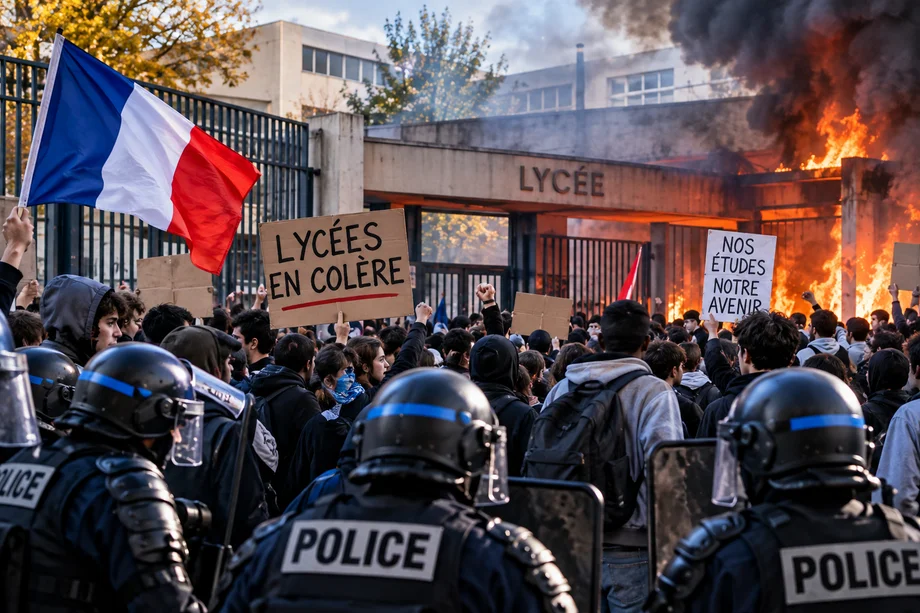
A growing wave of student protests has disrupted schools and universities across France, escalating into clashes, fires and hundreds of arrests as the government attempts to contain one of the most serious education protests in the country in recent years.
The demonstrations intensified on Thursday, October 1, with high school students joined by university students in several major cities.
French Prime Minister Sébastien Lecornu convened an interministerial crisis meeting as disturbances were reported in Paris, Nantes, Lille, Marseille, Strasbourg and other parts of the country.
Why are students protesting in France?
The movement initially grew from complaints about conditions inside French schools.
Students have demanded replacements for absent teachers, additional resources, renovations of deteriorating school buildings and better learning conditions.
Some protesters have also raised concerns about academic pressure and the Parcoursup university admissions system.
By Wednesday, 356 high schools were experiencing full or partial blockades, up from 338 a day earlier, according to figures reported by French Interior Minister Laurent Nuñez.
The movement has since expanded, with students at around 30 universities joining the protests, according to Le Monde.
Violence breaks out in several cities
While many students have participated peacefully, serious incidents have been reported around some demonstrations.
The entrance hall of Nelson Mandela high school in Nantes was destroyed by a fire on Thursday morning. The blaze spread to the building's facade before firefighters brought it under control. School officials described the fire as deliberate, although its precise origin had not been established.
Reuters reported additional incidents involving fires, damage to schools, clashes with riot police and attacks on emergency vehicles.
Public transport was also disrupted in some cities. Bus, tram and metro services were interrupted in Marseille, while tram services in Strasbourg were suspended amid the unrest.
Hundreds arrested as injuries mount
The scale of the unrest has produced a significant police response.
For Wednesday alone, authorities reported 625 arrests, while 83 police officers and gendarmes were injured.
Education authorities said 119 students and education staff had been injured since the protests began, including 34 members of staff.
As the demonstrations expanded on Thursday, reports indicated that hundreds of additional arrests had taken place across the country.
France calls emergency crisis meeting
The growing disruption prompted Lecornu to convene a crisis meeting involving senior government officials, including Education Minister Édouard Geffray and Interior Minister Laurent Nuñez.
The government has condemned the violence surrounding some demonstrations while acknowledging the underlying concerns raised by students.
Political arguments have also intensified over responsibility for the unrest. Government officials have accused figures associated with the left of encouraging the movement, while La France Insoumise has rejected allegations that it is responsible for the violence. Reuters reported that party figures have called for peaceful protest while criticizing the government's response.
Some schools could move classes online
With access to some schools becoming difficult or unsafe, Education Minister Édouard Geffray announced that classes could temporarily move online.
He said remote lessons should be provided when damage or blockades prevent schools from safely receiving students.
Decisions will be made individually by school administrators in coordination with education authorities, according to TF1.
Geffray is also expected to meet education unions and associations as the government looks for ways to reduce tensions and address student demands.
The coming days will be crucial in determining whether the demonstrations begin to ease or continue spreading across France.



