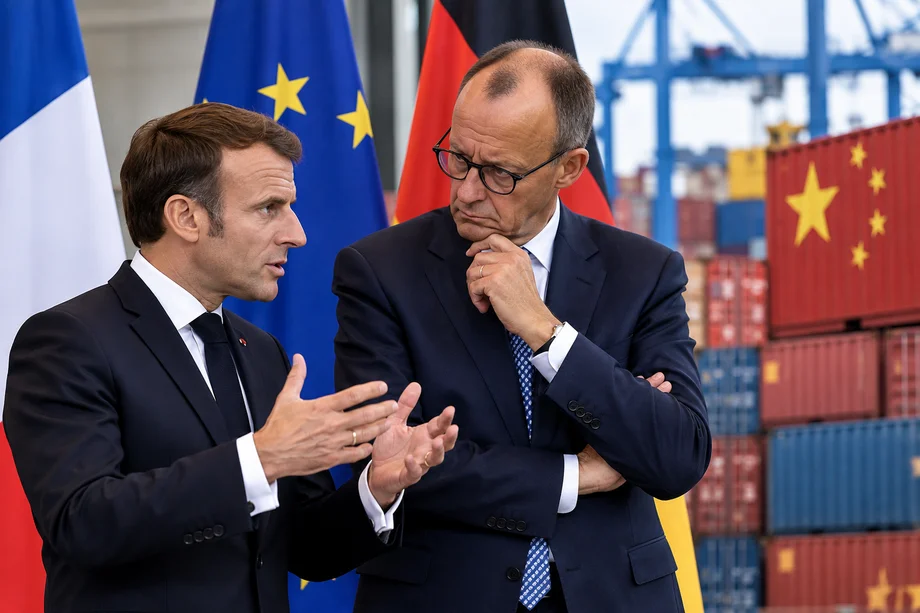
France and Germany are pushing for a powerful new European Union trade mechanism that could allow Brussels to rapidly restrict access to the single market when foreign countries are judged to be seriously harming European industry.
The proposal was presented by French President Emmanuel Macron and German Chancellor Friedrich Merz in a joint letter to European Commission President Ursula von der Leyen.
Reuters reports that Paris and Berlin want the EU to be capable of responding within days when trade is used as an economic weapon or when persistent market distortions threaten European companies.
The proposal does not formally target a specific country. However, China is clearly at the center of the debate.
European governments have become increasingly concerned about dumping, extensive state subsidies, restrictions involving critical materials and a rapidly growing flow of Chinese manufactured goods into Europe.
According to Euronews, the EU's trade deficit with China reached an estimated €1 billion per day in 2025. European officials increasingly fear that the imbalance could weaken major industries including automobiles, chemicals, pharmaceuticals, aerospace and industrial machinery.
Macron and Merz argue that existing EU trade defense mechanisms are too slow for a global economy in which economic pressure can escalate rapidly.
Under their proposal, the European Commission could receive stronger powers to impose restrictions quickly. Decisions could operate under a reversed qualified majority system, making it harder for member states to block Commission action and potentially allowing measures to be introduced within days.
In extreme circumstances, the mechanism could even allow goods or services from a country responsible for severe and systematic distortions to be immediately excluded from parts of the EU internal market.
The initiative represents a notable shift for Germany, which has traditionally favored open trade and maintained deep commercial ties with China.
Pressure has increased, however, as European manufacturers face intense competition from cheaper Chinese products while governments seek to reduce their dependence on individual foreign suppliers for strategically important goods and raw materials.
The timing is significant. EU Trade Commissioner Maroš Šefčovič is expected in Beijing later this week for talks aimed at addressing trade tensions, while European leaders are due to discuss relations with China at their October summit.
The French German initiative does not mean a trade war has begun. Instead, it signals that Europe's two largest economies want the EU to have a much stronger deterrent if negotiations fail or economic pressure intensifies.
For European businesses, the outcome could have major consequences. A tougher EU approach could provide greater protection against heavily subsidized imports, but it could also increase the possibility of retaliation and further strain relations with one of Europe's largest trading partners.



