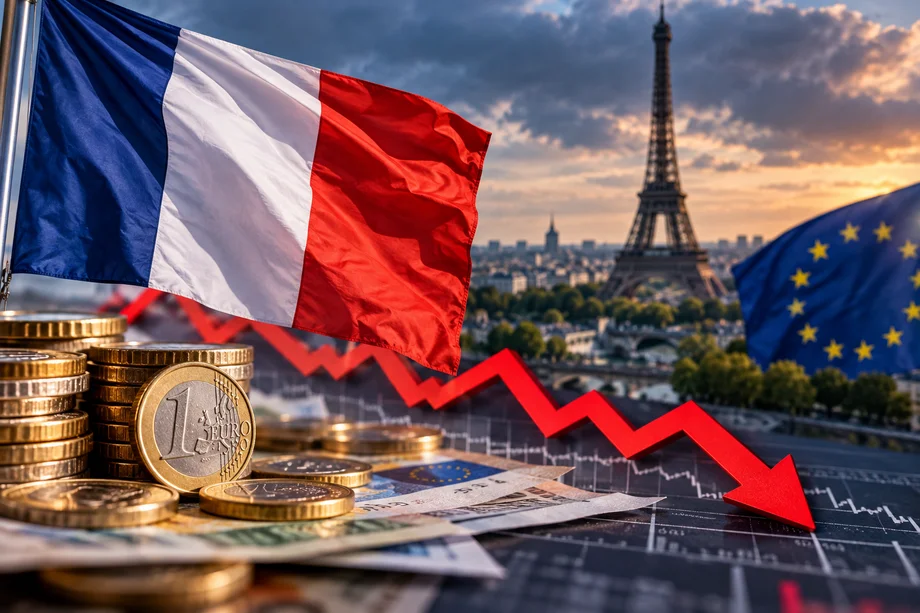
France is facing a deep financial and political crisis, while economists warn that its problems could spread throughout the eurozone.
According to the German newspaper Rheinische Post, economics professor at the University of Dusseldorf, Ulrike Neyer, has named France the biggest current problem in the eurozone.
The warning comes at a time when investors are seeking ever higher interests to lend the French government.
French debt reaches disturbing levels
According to the Financial Times, France's public debt has reached about 3.5 trillion euros, approximately 120% of gross domestic production.
This means that the country has a greater debt than the value of goods and services its economy produces over a year.
Economist Ulrike Neyer, quoted by Rheinische Post and German television n-tv, warns that combining high debt, poor economic growth and political instability is damaging investor confidence.
Only annual interest payments for the French debt are approaching 80 billion euros, according to the n-tv report.
Investors are leaving French bonds
The Reuters agency reports that investors have begun selling French bonds and moving capital towards German bonds, which are considered safer.
The gap between the borrowing costs of France and Germany has expanded to levels that had not been seen since the Eurozone debt crisis in the 20112012.
This is a sign that financial markets are seeking greater compensation for the risk they see in French finances.
Euros Under Pressure
France's problems have also begun to affect the common European currency.
According to Reuters, the euro fell this week to the lowest level of 17 months against the US dollar, falling below $1.12.
Meanwhile, Euronews reports that rising energy prices and uncertainty about the French budget are increasing pressure on the European economy.
A weaker euro could make electricity imports and dollar-market products more expensive.
Is a new European crisis approaching?
Economists warn of risks, but this does not mean that a new euro crisis is inevitable.
The European Central Bank has instruments to intervene in the event of serious financial markets disorders, although using them depends on certain conditions.
According to Rheinische Post analysis, France must take measures on its own to stabilise public finances, while Germany and other European countries must avoid policies that could exacerbate the situation.
The coming months will be crucial to the way Paris manages the 2027 budget and will try to restore investor confidence.
At the moment, the message of markets is clear: France's financial problems are no longer considered a French internal issue.



