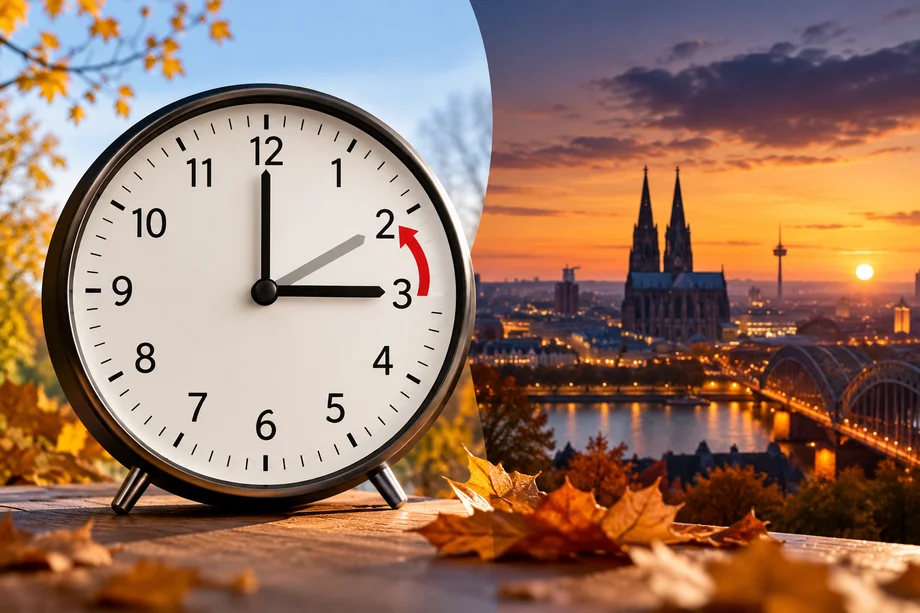
The annual clock change is approaching again across Europe.
On Sunday, October 25, 2026, Germany and most European countries will switch from summer time to standard time, commonly called winter time.
In Germany, clocks will move back one hour from 3:00 a.m. to 2:00 a.m., meaning people effectively gain an extra hour during the night. Germany will then return to Central European Time.
When Do the Clocks Change?
The change takes place during the night from Saturday, October 24, to Sunday, October 25.
For Germany, the rule is simple:
3:00 a.m. becomes 2:00 a.m.
This means October 25 will effectively contain an additional hour.
The same transition takes place across most European countries at 01:00 UTC, although the local clock time differs depending on the country's time zone.
What Changes After October 25?
The most noticeable difference will be daylight.
Sunrise will occur approximately one hour earlier according to the clock, while sunset will also arrive around one hour earlier.
That means brighter mornings but noticeably darker evenings.
In parts of Germany, darkness will arrive around 5 p.m. by the end of October, according to regional reporting from Tagesschau.
For commuters, families and businesses, the change marks the beginning of the darker part of the European winter season.
Do Phones Change Automatically?
Most modern smartphones, computers, smartwatches and connected devices should update automatically if automatic date and time settings are enabled.
Some devices may still require manual adjustment.
Traditional wall clocks, analogue watches, older alarm clocks and clocks inside some cars may need to be moved back manually.
Anyone travelling overnight on October 25 should also check departure and arrival times carefully because transport schedules are designed around the time change.
Is This the Last Clock Change?
No.
Despite years of debate about ending seasonal clock changes in Europe, the system remains in place.
The European Union previously considered ending the twice yearly change, but the proposal has not resulted in a final coordinated system replacing the existing arrangement.
Current schedules therefore continue to include seasonal clock changes.
Germany is expected to return to summer time on Sunday, March 28, 2027.
An Easy Way to Remember the Direction
The October change often creates the same question: do clocks go forward or backward?
The answer is backward.
At 3 a.m., Germany returns to 2 a.m.
That gives people one additional hour overnight, although evenings will begin getting dark earlier according to the clock.
For millions across Germany and much of Europe, October 25 will therefore bring one small consolation as winter approaches: an extra hour in bed.



