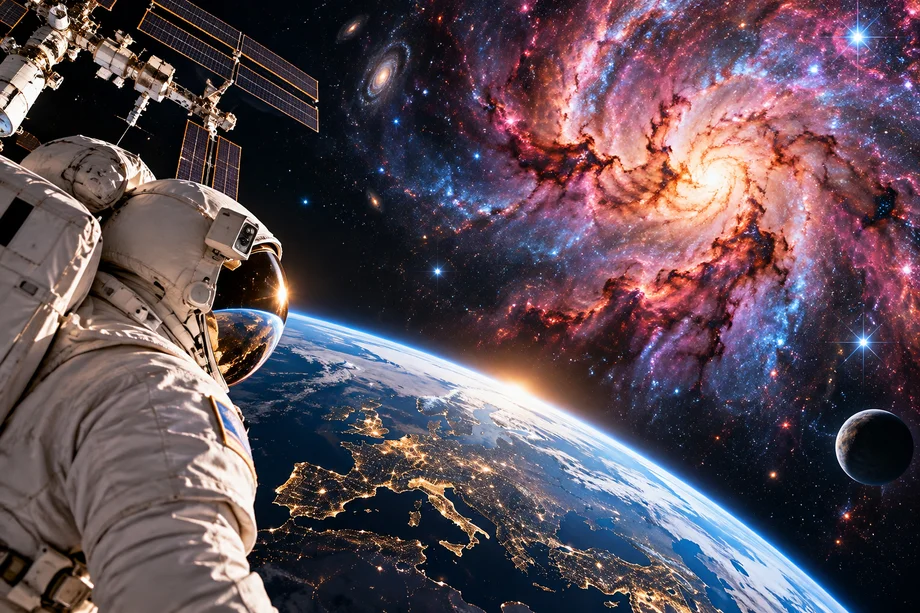
World Space Week 2026 is being marked by scientific activities, spectacular pictures of the universe, and important developments in space technology.
The international event, held from October 4th to October 10th, brings together scientific institutions, universities, space agencies and millions of people interested in the mysteries of the universe.
According to the United Nations Organization, this year's official theme is “Missile Revolution”, focused on technologies that are making exploration of space more accessible.
Images of the Universe That Are Astounding the World
Google has joined celebrations through special illustrations on his research page, drawing attention to astronomical discoveries.
According to scientific media reports Space.com, one of the objects presented during celebrations is the Rosebud Nebula, photographed by space telescope James Webb of NASA.
This mist is about 3,300 years away from the Earth and contains more than 130 new stars, surrounded by thick clouds of gas and dust.
Photos offer a remarkable view of star - bearing regions and help scientists better understand the formation of star systems.
Even the Carina Nebula, one of the most popular star formation regions, is part of the intense interest in the images of the James Webb telescope.
A French astronaut in the spotlight
The festivities also coincide with significant developments in space human missions.
French Astronaut Sophie Adenot, part of the European Space Agency, has been at the centre of reports for her mission at the International Space Station.
According to the European Space Agency, Adenos headed towards the station in February 2026, as part of the Crew-12 mission.
During her orbit, she participated in scientific research that aims to improve the knowledge of life and the work of astronauts in microgravity conditions.
Such missions are considered important in preparing future trips to the moon and Mars.
Why is the year 2026 called a missile revolution?
The space industry has changed significantly in recent years.
One of the most important developments is the use of missiles, which can be recovered and used again.
This technology can lower the costs of certain missions and create new opportunities for satellite emissions, scientific experiments and space exploration.
According to the UN, technological developments are increasingly enabling companies, universities and states to participate in space activities.
That is why this year's theme focuses on rockets and their future role in mankind.
Why is the World Space Week held between October 4 and 10th?
The dates of this event have special historical significance.
On October 4, 1957, the Soviet Union issued the first artificial satellite to orbit the Earth.
This moment marked the beginning of the space age.
Meanwhile, on October 10, 1967, the Foreign Space Treaty went into effect, which established fundamental principles for exploring and peaceful use of space.
The United Nations organization declared World Space Week in 1999.
Even the October sky holds surprises
In addition to scientific activities, the beginning of October is an interesting period for those who want to observe the sky.
According to Space.com, the Drachonid meteoric rain is expected to reach a peak of about October 8th and 9th.
The possibility of seeing meteors depends on weather conditions, artificial lighting, and the intensity of meteoric activity.
As modern telescopes continue to discover remote galaxies and regions of the universe, new space technologies are creating opportunities that until decades ago seemed elusive.
World Space Week 2026 is a reminder that despite remarkable scientific progress, the universe continues to preserve mysteries that mankind has not yet discovered.



