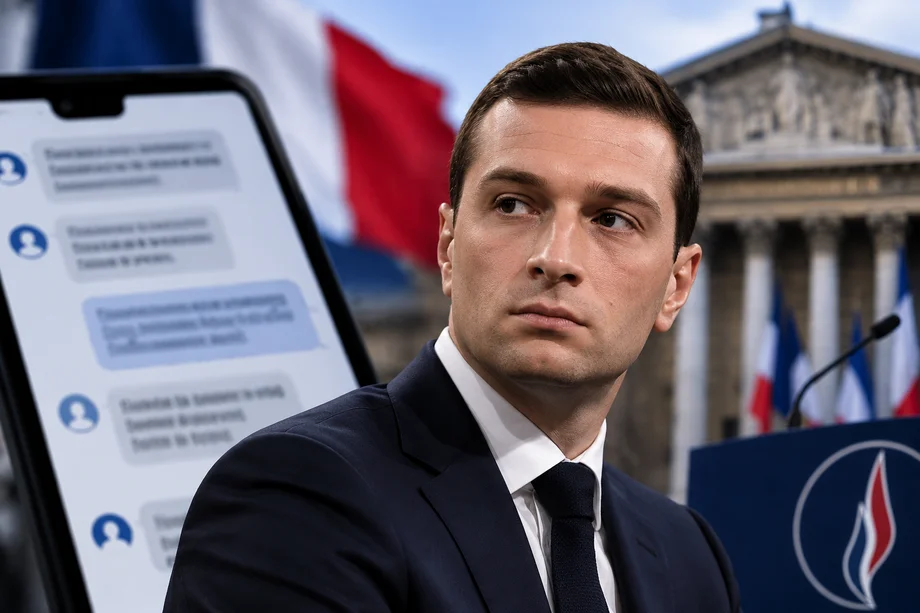
A political controversy surrounding Jordan Bardella intensified in France on Thursday after investigative outlet Mediapart published new material that it says supports the authenticity of private Facebook conversations attributed to the president of the Rassemblement National.
The messages date from 2013, when Bardella was 17, and allegedly contain antisemitic stereotypes and conspiracy theories.
Bardella has categorically denied being the author of the remarks. He has described the allegations as fabricated and politically motivated, while his party has challenged the authenticity of the material.
The latest development is significant because Mediapart is now presenting technical material that it says connects the conversations to Bardella's Facebook identity.
What did Mediapart publish?
Mediapart originally reported on September 28 that it had obtained private conversations allegedly involving Bardella during the early stages of his political life.
Among the messages attributed to him were statements involving antisemitic stereotypes about Jewish people, banking and political influence.
Bardella denied writing the messages and challenged Mediapart to provide evidence.
On October 1, the investigative outlet published screenshots, emails and additional information explaining how it says the conversations were authenticated.
According to Le Monde's account of the new evidence, Mediapart obtained Messenger conversations from two sources who had been part of Bardella's circle.
Mediapart says the conversations were recovered through Meta's platform rather than relying solely on screenshots. It also says the data extraction was authenticated by a judicial officer.
Facebook data becomes central to the dispute
The authentication process is now at the heart of the controversy.
According to Mediapart, the extracted data established the date of the conversation, indicated that it had not subsequently been modified and identified the other participant within Meta's system under the name Jordan Bardella.
The outlet also says biographical information contained in the conversations corresponds with details from Bardella's life.
Le Monde reported that Mediapart additionally examined email addresses associated with Bardella and material relating to his interest at the time in Alain Soral, a French political activist repeatedly convicted over antisemitic statements.
These are Mediapart's findings and authentication claims. Bardella disputes the central allegation that he authored the antisemitic messages.
Bardella maintains his denial
Bardella has not withdrawn his denial following publication of the additional material.
Before Thursday's release, he had said that if documents were published purporting to prove the allegations, he would pursue legal action over alleged forgery.
Reuters reported earlier this week that Bardella had filed a defamation complaint against Mediapart over the original investigation.
He described the allegations as an attempt to destabilize him politically.
Marine Le Pen has also defended Bardella and rejected Mediapart's allegations.
The dispute therefore remains unresolved, with the investigative outlet presenting material it says authenticates the conversations while Bardella continues to reject their attribution to him.
Why the allegations matter for National Rally
The controversy is particularly sensitive for the Rassemblement National because the party has spent years trying to distance itself from antisemitism and some of the most controversial elements of its history.
Bardella, now 31, has played a major role in presenting a younger public face for the party.
The RN was formerly known as the National Front and was founded in 1972. Marine Le Pen has pursued a long running strategy aimed at broadening its electoral appeal and distancing the party from statements associated with its founder and her father, Jean Marie Le Pen.
The allegations against Bardella have therefore generated a wider debate in France about the party's transformation and its relationship with its own history.
Attention turns to Bardella's political youth
The controversy has also prompted renewed scrutiny of Bardella's early political environment.
Le Monde reported this week on Bardella's connections during his teenage years with activists influenced by Alain Soral and his political movement, Égalité et Réconciliation.
Some people familiar with Bardella during that period told the newspaper that he did not personally express antisemitic views.
However, Le Monde reported that several people around him were engaged with Soral's political ideas and material.
Bardella joined the National Front as a teenager and subsequently rose rapidly through the organization before becoming president of the party, now called Rassemblement National.
The legal battle could become important
Bardella's legal response means the dispute could eventually move beyond competing claims in the media.
His defamation complaint gives him a formal avenue to challenge Mediapart's reporting.
At the same time, Mediapart has publicly defended its investigation and is now providing more information about how its journalists say they verified the material.
That makes the provenance and authentication of the digital records particularly important.
A court has not established that Bardella authored the disputed messages, and his denial remains central to any accurate account of the controversy.
For now, France is left with two directly conflicting positions: Mediapart says it has authenticated digital conversations containing antisemitic remarks and linked them to Bardella, while Bardella says the allegations are false and is challenging the reporting through legal action.



