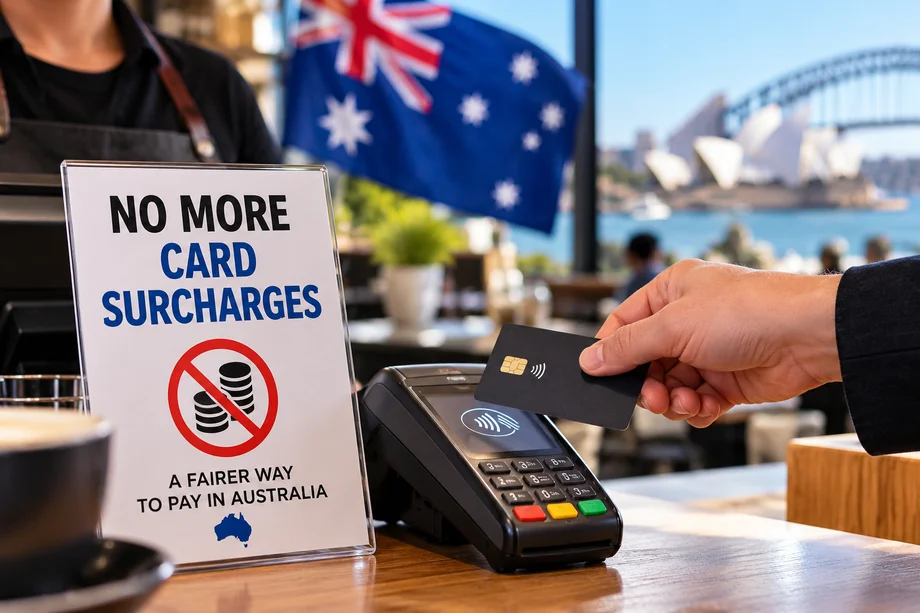
Australians paying by card are waking up to a major change at the checkout.
From October 1, businesses can no longer add payment surcharges to most debit, credit and prepaid card transactions, ending a practice that has been part of everyday Australian shopping for more than two decades.
The change covers eftpos, Visa and Mastercard. American Express, PayPal and UnionPay have also decided to remove card surcharging under their network arrangements.
The reform is expected to eliminate about A$1.6 billion in card surcharges paid by Australian consumers each year, according to the Reserve Bank of Australia.
But the disappearance of the familiar card surcharge does not necessarily mean every purchase will become cheaper.
Some businesses are already increasing prices as they adjust to absorbing card processing costs themselves.
What changed on October 1?
Until September 30, Australian businesses were generally allowed to charge customers an additional fee when they paid by card, provided the surcharge did not exceed the cost of processing that payment.
That changed on October 1.
Card networks can now enforce rules preventing businesses from imposing separate surcharges on customers using their cards.
For shoppers, the most visible difference should appear when paying at cafes, restaurants, shops and online businesses.
A product advertised at A$10 should no longer suddenly become A$10.15 or A$10.20 simply because the customer chooses an affected card payment method.
The rules apply to card payments made in stores, online and through digital wallets when the underlying transaction uses a covered card network.
Which cards are covered?
The changes cover the major payment networks used by Australians.
Visa, Mastercard and eftpos introduced no surcharge rules from October 1.
American Express, PayPal and UnionPay have also decided to remove surcharging, according to the RBA.
Consumers should still pay attention to how individual transactions are processed because some payment methods and special circumstances may operate under different arrangements.
Weekend surcharges are not banned
One important distinction could cause confusion.
The new rules specifically target fees charged because a customer chooses to pay by card.
They do not eliminate weekend surcharges, public holiday surcharges, booking fees or legitimate service fees that are unrelated to the payment method.
That means a restaurant can still apply a weekend or public holiday surcharge when permitted under Australian consumer law.
It simply cannot disguise an additional card payment fee as another charge solely because the customer used a card.
Why Australia removed card surcharges
The Reserve Bank concluded after an extensive review that Australia's surcharge system was no longer working as originally intended.
Card payments have become the dominant way Australians pay for everyday purchases, making surcharges increasingly difficult for consumers to avoid.
The RBA said the system had also become complicated for both consumers and businesses, while card fees were not always clearly disclosed.
Around three quarters of Australian transactions are now cashless, according to figures reported when the reforms were announced.
The RBA therefore decided that card processing costs should operate more like other normal business expenses rather than appearing as an additional fee at checkout.
Could prices now increase?
This is the biggest question for Australian consumers.
Businesses still have to pay costs associated with accepting card transactions.
The new rules remove their ability to pass those costs directly to individual card users through a separate surcharge.
Reuters reported on October 1 that some Australian businesses have responded by increasing their general prices instead.
That could mean customers pay slightly more regardless of whether they use cash or card.
The Reserve Bank has attempted to reduce that pressure by simultaneously lowering interchange fees and introducing other changes designed to reduce payment processing costs.
The broader package was initially estimated to save businesses about A$910 million annually through lower transaction fees.
Small businesses face the biggest adjustment
The impact is particularly important for cafes, restaurants and other small businesses where customers frequently make low value card transactions.
A small surcharge on thousands of purchases previously allowed businesses to recover some of their merchant processing costs directly from card users.
Those costs have not disappeared.
Businesses may still pay merchant service fees, terminal rental charges and other fees to payment providers.
The difference is that these costs can no longer simply be added as a separate surcharge to covered card transactions.
Some businesses could absorb the cost through their margins. Others may negotiate cheaper payment processing arrangements, encourage alternative payment methods or adjust their overall prices.
Cash discounts are still possible
Businesses are also allowed to encourage customers toward cheaper payment options.
The RBA says merchants can continue offering discounts for particular payment methods.
That could create an unusual consequence of the surcharge ban.
Instead of customers paying extra for using cards, some businesses may advertise lower prices for customers who choose cash or another preferred payment method.
What shoppers should check
Australian consumers should now watch their receipts carefully.
If a business adds an extra charge specifically because a customer pays with an affected debit, credit or prepaid card, consumers can first raise the issue directly with the business.
The RBA says concerns about incorrect card surcharges can also be reported to the relevant card network.
The Australian Competition and Consumer Commission remains responsible for Australian Consumer Law issues, including potentially misleading pricing practices.
For millions of Australians, the immediate result should be a simpler checkout experience.
The longer term question is whether eliminating card surcharges actually leaves households paying less, or whether part of the A$1.6 billion previously collected through visible fees gradually returns through higher everyday prices.



