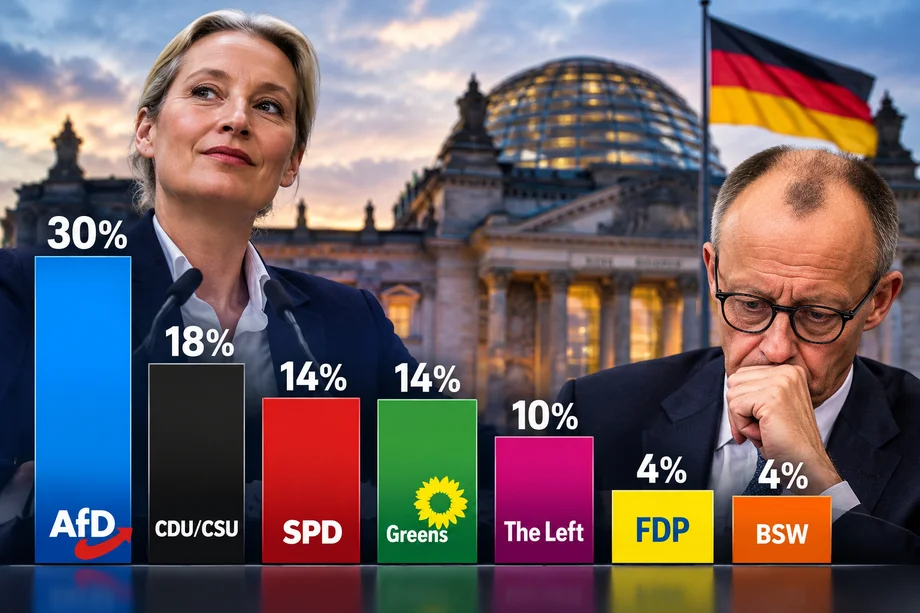
Germany’s political landscape has shifted further after a new national poll showed the AfD reaching 30 percent support for the first time.
The latest INSA Sunday poll, conducted for Bild and published on October 3, puts the AfD 12 percentage points ahead of Chancellor Friedrich Merz’s CDU and CSU alliance.
According to Die Zeit and Welt, the AfD gained one percentage point compared with the previous poll, while the CDU and CSU lost one point and dropped to 18 percent.
It is the largest gap between the two blocs ever recorded in INSA’s national polling series.
AfD 30%, CDU and CSU 18%
The latest figures put Germany’s major parties at:
AfD: 30%
CDU and CSU: 18%
SPD: 14%
Greens: 14%
The Left: 10%
FDP: 4%
BSW: 4%
Die Zeit reports that the AfD’s 30 percent represents a new high in INSA’s nationwide polling, while the Union’s 18 percent is a new low.
The movement continues a pattern visible in recent surveys. Welt reported on September 29 that another INSA poll had the AfD at 29.5 percent and the Union at 19 percent.
Pressure Grows on Merz
The latest poll also contains difficult numbers for Chancellor Friedrich Merz and his government.
According to Bild, 79 percent of respondents said they were dissatisfied with the federal government, while the same percentage expressed dissatisfaction with Merz’s performance as chancellor.
Only 10 percent said they were satisfied with the government, while 16 percent expressed satisfaction with Merz.
The figures come as Germany continues to debate economic conditions, migration, energy costs and the direction of the federal government.
What Would These Numbers Mean?
The poll does not represent an election result.
If a federal election were held now and voters behaved exactly as respondents indicated, the distribution of seats would also depend on which smaller parties crossed Germany’s five percent threshold.
With the FDP and BSW both measured at 4 percent, neither would currently clear that threshold in this particular poll.
The numbers would also make forming a parliamentary majority complicated.
However, polling results can change significantly before an election and should not be treated as a prediction.
Poll Has a Margin of Error
INSA surveyed 1,202 people for the latest poll.
Welt reports that the maximum statistical margin of error is approximately 2.9 percentage points.
That means small differences between parties should be interpreted cautiously.
The 12 point gap between the AfD and CDU and CSU, however, is considerably larger than the reported margin of error.
For Germany’s governing parties, the October 3 poll adds another data point showing substantial dissatisfaction among respondents.
For the AfD, reaching 30 percent marks a new milestone in INSA’s polling series.



